

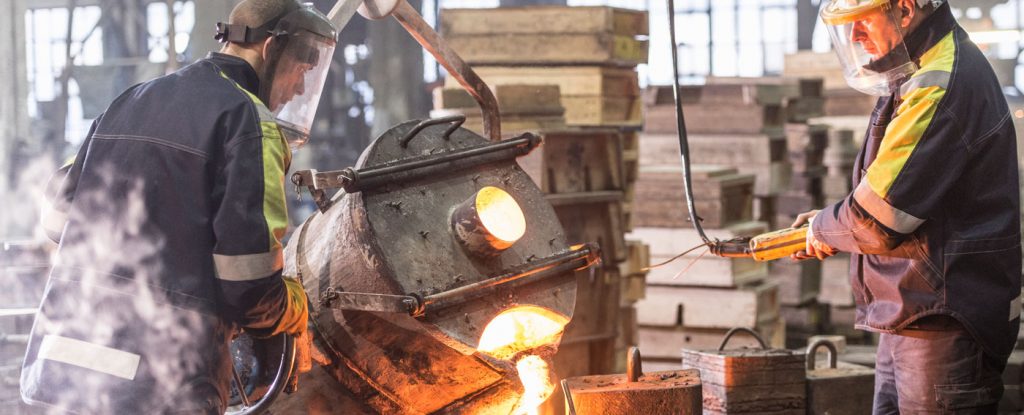
Industrial manufacturing rarely collapses in public. Failure stays hidden—inside a valve body, inside a pump casing, inside a casting that looked acceptable until pressure, heat, vibration, and chemistry exposed the truth. High-integrity components exist because industries cannot afford silent weaknesses. A steel castings foundry company sits at the fault line between operational stability and expensive failure, responsible for components that must survive without excuses.
Metallurgy Is Where Accountability Begins
Stainless steel casting does not begin with pouring metal. It begins with restraint. Chromium creates corrosion resistance, but chromium alone never guarantees performance. Nickel stabilizes structure. Molybdenum resists localized corrosion. Nitrogen improves strength without destroying toughness. Every element changes how metal solidifies and how it behaves after years of service.
In a serious stainless steel casting foundry company, melt chemistry remains tightly controlled. Furnace temperature deviation creates inclusions. Poor slag management contaminates metal. Inconsistent holding time causes segregation. These defects rarely appear during visual inspection. They appear months later, under load, inside operating equipment.
High-integrity castings are born from metallurgical discipline, not production targets.
Casting Method Is a Structural Decision
Casting is not a decorative process. Casting defines internal reality. Choosing the wrong process guarantees hidden defects, no matter how clean the surface looks.
Investment Casting for Precision-Critical Parts
Investment casting allows thin sections, controlled geometry, and consistent surface finish. Ceramic shell systems, when executed correctly, manage solidification and reduce internal stress. This process supports valve internals, impellers, actuator components, and precision mechanical assemblies.
Shell thickness, burnout temperature, firing cycle, and pouring stability must remain predictable. Deviations introduce micro-cracks and shrinkage defects that escape detection. Precision casting does not tolerate improvisation.
Sand and Shell Casting for Structural Mass
Large components demand mass and rigidity. Engineered sand casting handles housings, casings, and structural frames when gating, risering, and cooling profiles are designed deliberately. Shell molding improves dimensional control where moderate precision is required without the cost of investment casting.
A steel foundry company focused on integrity selects process based on service conditions, not purchasing pressure.
Defect Prevention Happens Before Production
Inspection does not create quality. Inspection only reveals damage already done. Porosity, hot tears, inclusions, and shrinkage cavities form during mold filling and solidification. Once trapped, these defects remain until failure.
High-integrity foundries rely on process control, not hope. Mold flow analysis controls turbulence. Thermal simulation predicts hot spots. Riser placement compensates shrinkage. Cooling control refines grain structure. Every variable reduces risk before metal moves.
Quality is engineered upstream or not at all.
Verification Systems That Do Not Negotiate
Industrial buyers no longer accept declarations. Evidence rules procurement. Chemical analysis verifies alloy composition. Mechanical testing confirms tensile strength, yield behavior, and impact resistance. Non-destructive testing exposes internal defects invisible to surface checks. Dimensional inspection validates assembly compatibility.
Traceability protects supply chains. Heat numbers, batch records, inspection data, and process logs establish accountability. Without traceability, compliance collapses during audits and disputes.
A credible stainless steel foundry company documents everything and assumes nothing.
Where Weakness Becomes Visible Immediately
Some industries punish shortcuts instantly. Stainless steel castings serving these sectors expose every mistake.
Oil, Gas, and Chemical Processing
Corrosive media, pressure cycling, and thermal shock attack material relentlessly. Inferior metallurgy accelerates fatigue and leakage.
Power Generation and Energy Systems
Steam paths, turbine casings, and auxiliary components demand dimensional stability and creep resistance. Failure carries safety and financial consequences.
Heavy Engineering and Process Machinery
Material handling systems and industrial frames rely on castings that absorb load without distortion or cracking.
Automotive and Mobility Infrastructure
Exhaust systems, transmission housings, and structural brackets require corrosion resistance and consistent mechanical properties.
Each environment reveals the difference between surface quality and structural integrity.
Engineering Integration Is the Quiet Advantage
Modern foundries no longer operate as isolated suppliers. Design collaboration reduces risk before tooling begins. Digital simulation optimizes gating and feeding. Rapid pattern development shortens validation cycles. Near-net-shape geometry reduces machining waste and lead time.
A mature stainless steel foundry company integrates design, metallurgy, and production into a single controlled workflow. Fragmentation introduces variability. Variability creates failure.
Within this industrial framework, MangalSteelCastings operates with emphasis on stainless steel casting discipline, metallurgical control, and application-specific manufacturing for demanding industrial sectors. Process stability and verification remain central to operations.
Lifecycle Economics Expose Cheap Decisions
Initial price rarely reflects true cost. Components with poor internal integrity demand maintenance, cause downtime, and fail early. Stainless steel castings produced with metallurgical discipline deliver longer service life and predictable performance.
Corrosion resistance preserves structural integrity. Dimensional stability protects assembly alignment. Material recyclability strengthens sustainability metrics without sacrificing reliability.
Cheap castings always collect payment later.
The Foundry as Risk Management Infrastructure
Industrial systems depend on components that behave predictably over time. Reliability is not accidental. Reliability is engineered. A steel casting foundry company functions as industrial risk management, removing uncertainty at the material level before equipment enters service.
High-integrity castings do not announce themselves. They remain unnoticed precisely because they perform.
Where Procurement Decisions Actually Go Wrong (And How Foundries Fix Them)
Procurement failures in industrial manufacturing rarely come from lack of options. They come from wrong assumptions. Too many component failures trace back to purchasing decisions driven by drawings, unit cost, or surface appearance—while ignoring how castings behave after installation. This gap between buying logic and operating reality is where high-integrity foundries quietly add the most value.
A competent steel foundry company does not simply supply metal. It actively corrects flawed assumptions before they turn into operational damage. Foundry engineers see problems procurement teams never see: over-specified grades that crack due to improper heat treatment, under-specified alloys that pit in months, geometries that look machinable but solidify poorly, and tolerance demands that contradict casting physics.
This is where experience replaces paperwork.
Common Industrial Assumptions vs Foundry Reality
| Procurement Assumption | What Actually Happens in Service | Foundry-Level Correction |
| “Higher alloy automatically means better performance” | Over-alloying increases segregation, hot cracking, and cost | Alloy selection matched to environment, not excess |
| “Surface finish indicates internal quality” | Polished surfaces hide porosity and inclusions | Process control and internal defect prevention |
| “All stainless steel behaves similarly” | Austenitic, duplex, and martensitic grades fail differently | Grade selection based on load, corrosion, temperature |
| “Machining will fix casting defects” | Machining exposes internal voids and weak zones | Near-net-shape casting with controlled solidification |
| “Inspection at the end is enough” | Defects are already locked into the metal | Upstream simulation and melt discipline |
This gap explains why identical components perform differently across suppliers. Integrity is decided upstream, long before inspection reports are printed.
A mature foundry challenges drawings, flags risk zones, and pushes back when specifications contradict metallurgy. Silence from a supplier is not cooperation. Silence is risk.
Within this decision space, MangalSteelCastings operates with emphasis on correcting specification blind spots through metallurgical control, casting discipline, and application-driven manufacturing rather than transactional supply.
Conclusion
Industrial failure rarely begins with ambition. Failure begins with compromised material integrity. A steel casting foundry company committed to metallurgy, process control, and verification eliminates that compromise before production begins. Through disciplined alloy management, engineered casting processes, and uncompromising quality systems, stainless steel components endure pressure, corrosion, heat, and time.
Integrity proves itself quietly—inside systems that keep running when everything else stops.


