

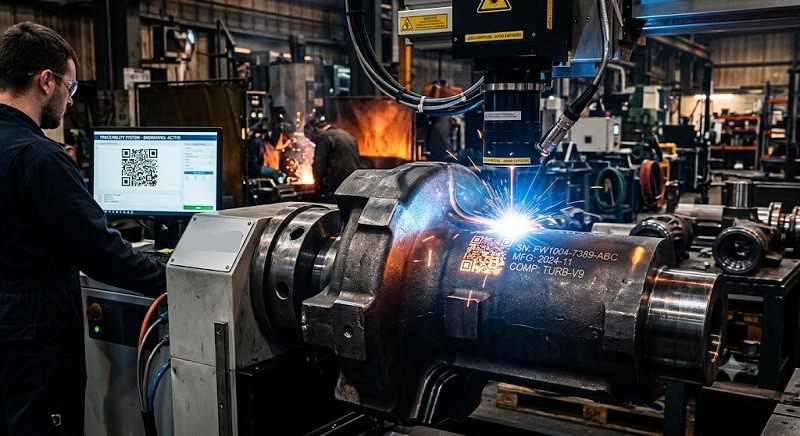
Imagine you have a valve body that has been sitting in a refinery for 10 years. During a routine inspection, you want to know what material it is made from. You have the mill certificate but the heat number on the component is badly worn, painted over and corroded. You cannot match the certificate to the component and this causes a costly downtime, uncomfortable audit and order for a new component.
Most problems like this are not due to bad quality steel but due to lack of identification. This has led to the need to look at laser engraving forged parts manufacturers.
-
Why Traceability is Important
When using a forging in the oil and gas, power generation, aerospace or heavy engineering industries, they will usually be part of a documented process. This includes; raw material, melting, forging, heat treatment, machining, inspection and delivery. At every stage of the process there will be documentation. Material test certificates will be issued with data relating to the chemical and mechanical properties of the material. These are issued commonly to EN 10204 3.1/3.2 and will relate to the chemical and mechanical properties of a certain heat. Non-destructive testing, heat treatment and dimensional reports will all use the same identification.
The mark on the component is the only link between the document and the component. If this cannot be seen or is unclear then the documents become useless.
Regulators, end users and inspection bodies increasingly want the marking to last the whole service life of the component. This is so they can recall, warranty and investigate failures. With concerns around counterfeit components having a reliable permanent marking will help identify if the component is genuine.
-
The Limits of Conventional Marking
Hard die stamping has been the go-to method for marking components. It is quick, cheap and a traditional method but it does have some downsides.
Impact marking can cause localised deformation. If the component is a high strength or fatigue sensitive component the indent can cause a stress raiser. Many specifications will therefore limit where stamping can be used or require low stress dot or rounded characters. Paint and ink marking can easily be worn away. Electrochemical etching is a clean method but requires stencils, consumables and careful handling. Manual methods will cause variation in the height, spacing and depth of the characters.
Generally, they fail due to poor readability. The marking needs to be readable after blasting, coating, handling, weathering and years of use.
-
How Laser Engraving Changes the Equation
Laser engraving uses a highly focused energy source to remove a controlled amount of material. There is no contact so there will be no tool wear and no shock to the component. The marking can be digitally controlled to give consistent characters, depths and positioning.
Some key benefits of laser engraving for forged components:
- Permanent – The marking will be more resistant to abrasion, handling and most coatings.
- High Resolution – Tiny characters can be engraved to fit into tight spaces. 2D codes such as Data Matrix can be used to store much more data.
- Repeatable – The marking can be controlled using software to reduce variation.
- Integration – The marking can be directly integrated with production or ERP data to reduce any errors.
Good laser engraving forged parts manufacturerswill have a controlled process with defined parameters, verification and documentation.
-
Comparison of Marking Methods for High Value Forgings
The table below shows how common marking methods compare with the most important criteria for traceability. The ratings are general and will depend on the material, surface and control of the process.
| Method | Permanence | Stress Impact on Part | Data Capacity | Repeatability |
| Hard-die stamping | High, if deep enough | Notable; stress riser risk | Low | Moderate, operator dependent |
| Dot peen marking | High | Lower than stamping, still mechanical | Moderate | Good |
| Paint or ink marking | Low | None | Moderate | Variable |
| Electrochemical etching | Moderate | Very low | Low to moderate | Moderate |
| Laser engraving | High | Very low, non-contact | High, including 2D codes | High |
Whilst laser engraving is not the best in every area, it does offer a high level of permanent marking with low stress impact and high data storage.
-
About Shailesh Forging Works
Shailesh Forging Works produce forged components such as rolled and forged rings for demanding industries such as oil and gas. Components for these applications will have documented material, heat treatment and inspection requirements.
-
Considerations for Laser Engraving
It is easy to think that laser engraving is a simple upgrade but there are a few things to consider.
Surface preparation will affect the marking. If the surface of the forging is scaly, rough or has a lot of coating then this can cause poor contrast. Curved components will require compensation. If the depth is too shallow the marking will be lost during blasting or coating. If it is too deep then the engraving becomes a problem.
Timing is also important. If you engrave before heat treatment or shot blasting then the marking may be changed or lost. It is important to know when you are engraving, transferring the marking and engraving. Some customer specifications and industry standards still require certain marking methods or locations. This will override the supplier preference.
Data is the most important thing to consider. If the code is perfect but relates to the wrong data then this is worse than a faded code. Even the best laser engraving forged parts manufacturers will need a verification process. This could include grading of the code, readability and matching to certificates.
-
Things to Consider When Purchasing
When looking at suppliers you can reduce risk by looking at:
- Marking Sequence – When during the process is the marking done? When is the marking transferred after heat treatment and machining?
- Documentation – Are there documented parameters for engraving? Depth, character size and position? Is this verified?
- Verification – How is the marking verified? Code readability and matching.
- Customer Specifications – Are they compatible with customer specifications? Are they limited to certain areas?
- Data Control – How is the data controlled to ensure each marking links to the certificate and inspection?
When qualifying laser engraving forged parts manufacturers it is better for the procurement and quality teams to look at the controls in place. A sample will not really tell you much if it is well engraved. However, if you can ensure consistency between lots then this tells you a lot.
Conclusion
Traceability of high value forgings is simple – you need to be able to identify each component with readable and permanent marking. Traditional marking methods can sometimes provide this but can also fail. This is especially the case for stress sensitive components, harsh environments and high data requirements.
Laser engraving can overcome many of these issues with non-contact, repeatable and high data marking. However, to get the most out of it you need to ensure the surface is prepared correctly, the marking is done at the right time, there are defined parameters and strict data control. The marking is only as reliable as the process.
In conclusion, choosing laser engraving forged parts manufacturers based on the documented process will ensure the marking is reliable. This will give you confidence that the inspector, auditor or maintenance engineer will have when they look at the component years after it has left the factory.