
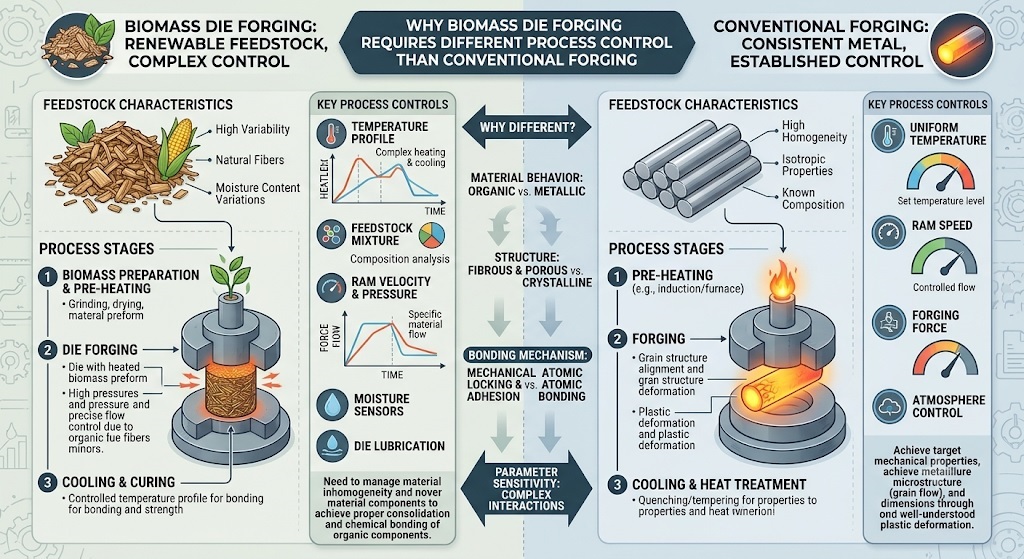
Although they are similar in terms of the family of steel, press and general manufacturing process (as seen on a drawing) to any other die forged part, any fake hammers, pellet mill rolls or boiler grate parts will have different uses within a biomass plant. These parts are sanded down by the silica rich feedstock, hammered with uneven forces and exposed to the harsh chemistry of the ash.
This means that biomass die forging manufacturers cannot apply the same standards to these parts as general purpose forgings.
Why Biomass Changes Forging Requirements
Typically, general purpose die forging will have requirements around strength, toughness, fatigue and dimensional accuracy. This is due to the component needing to be strong and reliable under load and fit into an assembly. These requirements are tough but well known and standardised.
Biomass components, however, require additional requirements. The feedstock used in biomass components, such as wood chips, straw, husks and agricultural products will all have soil, sand and minerals in them. This will cause continuous abrasion. Additionally, many feedstocks will also contain potassium and chlorine which cause aggressive deposits at high temperatures found in combustion systems. This, along with irregular shock loading will cause the component to fail due to wear, corrosion and fatigue.
The forging must therefore have specific surface conditions, microstructure and hardness profile to ensure the component survives in such a harsh environment. This is where the process controls play a crucial role.
Where Controls Differ
Material and Billet Selection
Alloy steels will be chosen based on their ability to harden. This will ensure a deep and even wear resistant component. Case hardening steels, quenched and tempered alloy steels and martensitic stainless steels will all be seen in biomass components depending on the application.
Cleanliness becomes a key consideration. Non-metallic inclusions in the material close to the wear surface will cause initiation of cracks and pitting. Therefore, tighter controls on the chemistry of the billet, cleanliness and traceability back to the heat should be in place.
Heating and Scale Control
All die forgings will have temperature ranges. However, as the surface of the component is the working face, the controls are more important. Too much scale or decarburisation will cause the component to have a soft skin. Therefore, controlled furnace atmospheres, tight soak times and billet temperatures will ensure the surface isn’t damaged. Machining allowances should also be considered so the final surface is in good fully hardened material.
Die Design and Metal Flow
Grain flow will play a key role in the service life of the component. Fibres should flow along the main loading directions to prevent the grain ends showing on critical surfaces. This is affected by the die design, preform and forging ratio.
Additionally, die temperature control is important. If the die isn’t heated evenly, it will cause uneven metal flow. This can cause inconsistent structure within the component. Components that will suffer from predictable wear will require consistent structure.
Heat Treatment and Hardness Profile
This is where the biggest differences will happen. Typically, general purpose forgings will require a certain level of hardness and strength to be verified in a few places. However, biomass wear components will often require a controlled hardness profile. This will ensure the component has a hard surface for wear resistance and tough core to deal with impact.
This can be achieved by controlling the severity of the quench, tempering schedule, case depth or induction hardening depth. Ensuring there isn’t too much retained austenite or brittle carbide networks. Small differences can have a big impact on service life. Therefore, records of furnace loads, quenching and verified hardness profiles become key.
Comparing the Two Disciplines
Below is a comparison of where the focus changes. This is not a rule, just typical practices. Requirements will vary depending on the component, feedstock and customer.
| Control Area | Conventional Die Forging | Biomass Die Forging |
| Primary performance goal | Strength, toughness, dimensional accuracy | Wear resistance combined with impact and corrosion tolerance |
| Material focus | Mechanical properties and machinability | Hardenability, cleanliness, corrosion behaviour |
| Surface condition | Adequate for machining | Critical, since the surface is the working face |
| Heat treatment | Property verification at defined points | Controlled hardness gradient and case or surface depth |
| Failure mode of concern | Fatigue and overload | Abrasion, chloride corrosion and fatigue together |
| Documentation emphasis | Certification to standard | Process records tied to wear and service-life performance |
It can be seen that no new controls are introduced. However, controls that are usually considered standard are now more important. There are a few additional controls.
A Counterpoint Worth Taking Seriously
It may seem that the harder the component the better. However, this is not the case and can cause damage.
Too much hardness will reduce toughness. If the hammer or roller doesn’t suffer from wear but breaks under impact it has failed. We want to get the right balance for the application. This will differ for a pellet mill die, hammer and boiler grate element.
Also, general purpose forging is not a lax industry. Components such as aerospace, energy and automotive have very strict controls. Many of these will be applied. The focus will change and the components will be used in a different service. Biomass die forging works best when the high integrity forging principles are applied and focused on wear, corrosion and cyclic loads.
About Shailesh Forging Works
Shailesh Forging Worksis a forging manufacturer supplying components to high integrity industries such as oil andgas. We have experience of forged components, rolled rings and bearing rings. This means we have the same level of control in our processes as required for wear critical components. This will include controlled heating, documented heat treatment and verified material properties on all lots.
Inspection and Traceability in Practice
Verification will ensure your component is performing as it should. Typically, a verification plan for biomass components will include:
- Chemical analysis andTraceability back to the heat of the billet to the final forging.
- Ultrasonic andMagnetic Particle Testing.
- Hardness testing on the surface and through the component.
- Microstructure examination if case depth, carbide distribution or retained austenite is critical.
- Checking dimensions against the approved drawing and machining allowance for decarburisation.
These are all standard practices but when applied together with documented processes it will give you confidence in the service life of the component.
What Buyers Should Verify Before Awarding an Order
When comparing biomass die forging manufacturers, asking technical questions will help. Questions to ask could be:
- How do you control the furnace atmosphere and scale?
- How do you verify hardness profiles?
- What considerations were made to grain flow in the die design?
- How do you store and share your heat treatment records?
It’s also important to know how they deal with feedback from the field. If the manufacturer is tracking wear patterns and failures against their process records, they can adjust their parameters. However, if they don’t treat each order as individual they can’t. This is a key consideration in this segment as components will be consumed.
Conclusion
Biomass die forging will have the same press, die and steels as general purpose forging. However, the components will be used in different service conditions. The abrasive feedstock, corrosive ash and irregular shock loads will mean surface condition, hardness profile, grain flow and material cleanliness will be key quality factors.
This means tighter controls will be in place for biomass die forging manufacturers in this sector. This will include tighter controls on billet selection, heating atmosphere, die temperature, heat treatment and verification. If you understand this you will ask better questions and receive longer lasting components that will fail predictably.
If comparing biomass die forging manufacturers, the process documentation, documented hardness profiles and experience of wear critical components will tell you more about how the components will perform in the future. This is the most important factor to consider as it relates to downtime and replacement costs.