

A machinist in a bearing plant places a new ring on a vertical lathe. As the lathe speeds up to operating speed and the tool approaches the steel surface, the noise changes. Instead of cutting the material, the machine is now chattering. With each revolution of the lathe, the insert is digging into one side of the ring and cutting nothing from the other. The machinist turns off the machine and takes some measurements. The wall thickness is too thick at 3 o’clock and too thin at 9 o’clock. The amount of variance is greater than can be accounted for by machining.
Although this is a composite example, most machine shops will have encountered something similar. The ring was passed in by the incoming inspection team. The outside diameter, inside diameter and height were all within tolerance. However, no checks were carried out to ensure that the steel was evenly distributed.
This is often where many issues with rolled ring manufacturers begin. Although most don’t result in formal complaints, the ring will either cause problems during machining, be scrapped quietly or re-ordered from somewhere else.
The Easy Part – Diameter
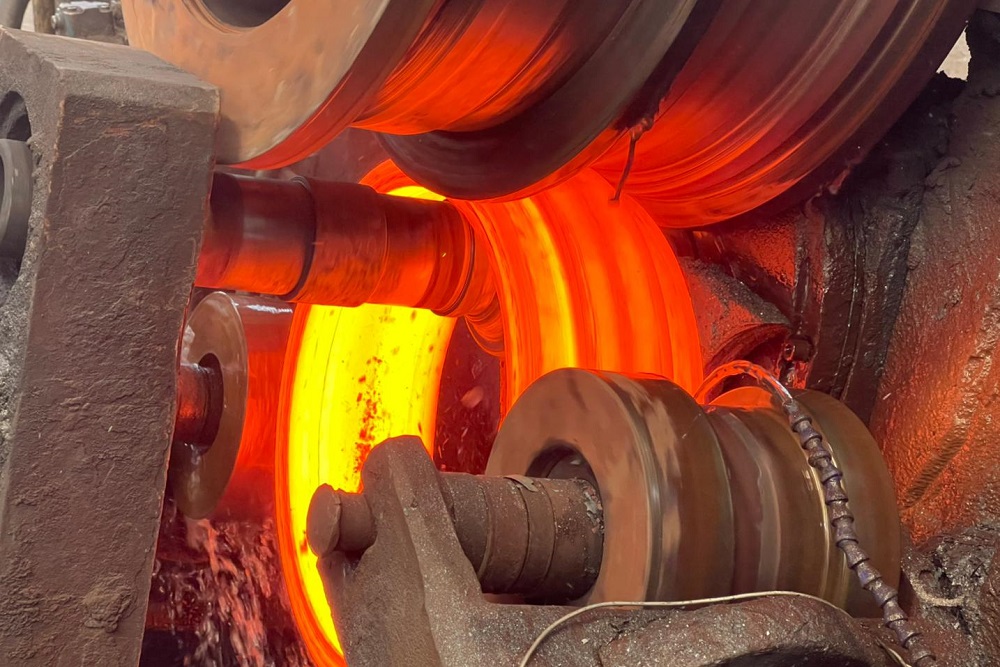
A rolled ring begins with a heated billet. The billet is upset and pierced to produce a thick-walled ring. This is then placed over a mandrel and is squeezed between the main driven roll. The wall thickness reduces and the diameter increases. On Radial Axial mills, a pair of axial rolls will control the height. Guide rolls also help to ensure the ring doesn’t wander.
The diameter of the ring will always be a focus. The operator will know to produce the ring to a certain diameter. The controller will monitor the growth and stop once the correct diameter is reached. This will result in a ring that is dimensionally correct.
The concentricity and wall thickness of the ring are not so clear. Concentricity refers to how well the inside and outside circles are centred. Wall thickness refers to how evenly the steel is distributed between the inside and outside. A ring may have the correct diameter, but may have an eccentric bore. It may also be slightly oval and the average will be correct. The tape measure will show the correct diameter based on the circumference.
Where Does the Eccentricity Come From?
Although variance can occur from many sources, there are obvious signs of what is causing it. An experienced rolling team will often be able to tell what is causing the issue with the ring, much like a crime scene investigation. The table below shows the usual suspects.
| Source of Variation | Effect on the Ring | Typical Control |
| Uneven billet temperature | Hot side flows faster, cold side resists, wall thins unevenly | Soak time, furnace uniformity, calibrated burners |
| Off-center piercing or uneven preform | Bore sits off axis before rolling even begins | Preform checks, upsetting and piercing practice |
| Mandrel or guide roll misalignment | Ring wobbles during growth and turns oval | Scheduled alignment checks, roll condition monitoring |
| Aggressive growth rate | Ring chases the rolls and loses roundness | Feed rate tuned to ring size and steel grade |
| Distortion in cooling or heat treatment | A round ring leaves the furnace oval | Fixturing, quench control, final-state measurement |
How many of these are external to the mill? This is no coincidence.
Cost To Machine Shop
Machine shops will machine based on the minimum wall thickness. If the wall thickness is inconsistent, either the lathe will barely cut the thin area and aggressively cut the thick area or a larger machining allowance will be applied to everything. This means extra steel will be purchased.
Cutting is interrupted causing tool wear. If the ring is oval and held in a chuck, the ring will be machined to be round whilst in the chuck. Once released it will spring back into an oval shape. This causes longer set up times as the operator will have to manually indicate the part.
During heat treatment, if the ring isn’t evenly weighted, it will heat and quench unevenly. This will cause distortion on top of what is caused during rolling. If the reduction is not even around the circumference of the ring, this can cause uneven working of the material. This is not as obvious as chatter, but can cause issues with bearings, gears, wind tower flanges and pressure parts.
This won’t show in the price per kg, but will cause issues with scrapping, late deliveries and long arguments over who is to blame.
The Turn: The Mill Gets the Blame, the Furnace Deserves a Look
Usually, the mill will be blamed. Operators will blame worn mandrels; purchasers will blame the rolling team. Everyone will assume that the modern controllers will have fixed the issues. Although now we can monitor the diameter increase in real time, some mills use lasers to monitor the position of the ring. All of this is helpful, however there is nothing we can do to remedy the issue with the hot billet.
A lot of the geometry issues are already set before the ring reaches the rollers. The furnace is even, the soak time is correct, the billet was upset and pierced correctly. If the preform is eccentric then no matter how advanced the mill is, the ring will be eccentric. The errors will be spread out over a larger ring.
This can be an uncomfortable topic for the trade. Many rolled ring manufacturers will invest in mill controllers as they are obvious, easy to take pictures of and add to brochures. However, furnace surveys, preform checks and measurement discipline aren’t so obvious. No-one will tour your plant to see how good your thermocouple records are! However, these can often determine whether the ring will be round.
Where This Plays Out in Practice
Based in Rajkot, Gujarat, Shailesh Forging Works have been forging since 1980. They are ISO 9001:2015 certified and produce seamless rolled rings up to 7000mm diameter. They have in-house processes from CNC billet cutting machines, heating (oil fired furnaces with API & ASTM standards), forging (open die & closed die on high tonnage presses), ring rolling, heat treatment, machining (CNC & VTL) and inspection (ultrasonic, hardness & dimensional). They produce bespoke seamless rolled rings, standard flanges, wind mill tower flanges, forged valve components, casing connectors & pellet ring dies for industries such as oil & gas, renewable energy, aerospace, infrastructure & heavy engineering.
Having everything in house from heating to machining means that we can trace the issue back to the source. The furnace, preform and final machining are all controlled by the same plant.
Questions To Ask Your Supplier
Although general questions about quality won’t give you much information, asking specific questions will. A good supplier won’t mind:
- What measurements are taken on every ring? How many points around the circumference?
- Is the wall thickness measured?
- How do you ensure the billet temperature is even? How often is the furnace surveyed?
- Is the ring measured after heat treatment?
- What machining allowance would you recommend for this ring? Why?
- Can you provide measurement records from a similar order?
If they can provide you with data, you know they are trying. If they are vague, you know they aren’t. If they are usually asked these questions, they will usually have a standard process. This will help you to identify reliable rolled ring manufacturers.
One easy thing to do is to ensure your drawings specify concentricity and wall thickness tolerances. This will mean the ring will be measured for these requirements. If they aren’t specified, they tend to be assumed.
Conclusion
A ring that is dimensionally correct isn’t the same as a ring that is built correctly. The diameter and height are easy to measure and almost every supplier will pass. The concentricity and wall thickness are harder to see, but cause machining waste, chatter, distortion and uneven properties.
Many of the causes are external to the mill. The billet temperature, preform quality, roll alignment, growth rate and distortion after heat treatment will all affect the final geometry. No one sensor will catch everything. If the whole process is controlled and honestly measured, the ring will be correct.
Asking your supplier for the numbers they don’t usually give will help. If they can provide wall thickness records, furnace survey data and measurements after heat treatment then they are working to a standard the rest of the trade can only claim. The lathe operator will be the final inspector and is hard to deceive.