

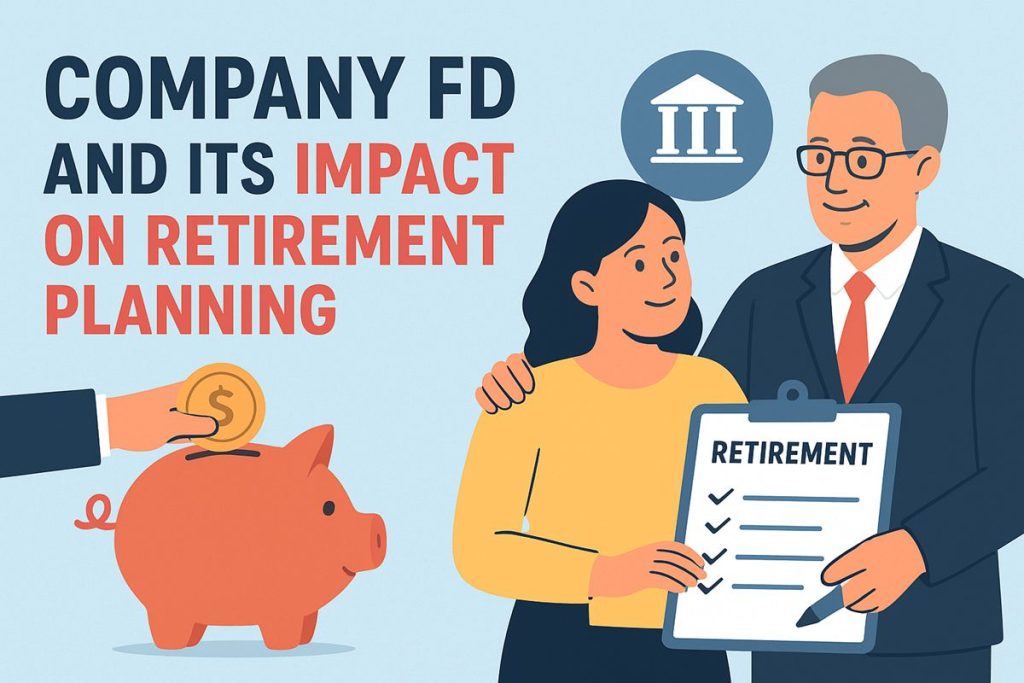
Retirement planning is perhaps the most important component of financial security. Although old-age saving schemes such as Employee Provident Fund (EPF), Public Provident Fund (PPF), and National Pension System (NPS) continue to be in demand, fixed deposits (FDs) are still the first choice among risk-free investment seekers.
Out of all the categories of FDs, company fixed deposits have emerged as an alternative to investment with possible returns in the form of higher interest rates compared to bank FDs. This article talks about company FDs, their usage in retirement planning, and provides tips on how to invest in fixed deposits.
What is a Company FD?
A company FD is a fund-raising scheme provided by corporates or Non-Banking Financial Companies (NBFCs) as a mode of financing. Contrary to bank FDs, which are backed by the regulator in the form of schemes such as Reserve Bank of India (RBI), company FDs are regulated by guidelines provided by the Ministry of Corporate Affairs or SEBI (Securities and Exchange Board of India). Interest rates for company FDs are higher than bank FD interest rates and are therefore attractive to investors seeking high returns.
Company FDs are the same as bank FDs. Investors invest with a tenure locked and receive interest from time to time or on maturity. The only difference is that company FDs involve higher credit risk based on the financial health and credit profile of the issuing firm.
Features of Company Fixed Deposits
1. Higher Interest Rates
The best feature of company FDs is the high rate of interest of 8-12% per year, based on the company and tenure. This is much more than the common interest rates of bank FDs, which are usually 5-7%.
2. Flexible Tenure
FDs of firms provide flexibility in tenure period from 12 months to 10 years, depending upon which one of these an investor can opt for a tenure most suited to his/her investment requirements.
3. Regular Payout Options
Interest can be received at regular intervals—monthly, quarterly, or annually—or the interest can be reinvested and a sum at maturity.
4. Credit Rating
Company FDs are assigned ratings by credit rating agencies such as CRISIL, ICRA, and CARE. The ratings assist investors in identifying the credit quality of the company and the company’s capacity for repayment. For instance, instruments rated AAA have lower default risk than instruments rated BBB.
 How Company FDs Fit into Retirement Planning
Retirement planning means designing a diversified investment portfolio of financial instruments to create a constant income stream after retirement. That is how company FDs help doing so:
1. High Returns Provide Enhanced Corpus Growth
The higher interest rates provided by company FDs can get your corpus growing faster, and that is something that is essential for retirement planning. Let’s say you put ₹5,00,000 in a company FD with a 10% interest rate for 10 years. At maturity, you will get about ₹13,05,000, with the compound interest calculated every year.
2. Regular Income Stream
Retirees seeking regular income can be helped by regular interest payment. Going in for monthly or quarterly interest payment can be towards meeting periodic outgoings without touching other sources.
3. Longer Tenure Options
As retirement planning is a long-term affair, investing in company FDs of higher tenures is in the direction of creating wealth over the long term.
4. Risk Considerations
Riskiness of FDs of companies is greater than of banks, considering defaults. Careful tenure planning, diversification, and choosing highly rated companies can reduce some such risks in retirement portfolios.
How to Invest in Fixed Deposits – A Step-by-Step Guide
Investment in a company FD involves cautious analysis of the issuer, interest rates, credit ratings, and terms. Follow a step-by-step guide below:
Step 1: Research the Company
Research the company and the financial history of the company. Make sure that the company has a strong history and is supported by strong fundamentals. Look at recent credit ratings provided by well-established agencies, as such credit ratings reflect the creditworthiness of the company.
Step 2: Compare Interest Rates
Numerous companies provide varying interest rates for equivalent tenures. Compare interest rates online and select the FD schemes that provide the highest returns within risk tolerance.
Step 3: Choose Tenure and Payment Terms
Choose a tenure as per your requirements—short-term requirements (1–3 years) or long-run accumulation (5–10 years). Choose interest payment per annum based on your liquidity needs.
Step 4: Fill the Form
Nearly every company provides online submission of fixed deposit applications. Or simply visit the company branch or registered intermediaries and fill out the forms. Provide KYC documents, i.e., Aadhaar, PAN, and address proof.
Step 5: Keep Track of Your Investment
After investing, keep a check on credit ratings and how they change in the firm’s context. Companies can become financially stressed, and a rating downgrade can indicate higher default risk.
Risks Involved in Company FDs
Even with improved growth, there are certain risks associated with it:
- Credit Risk: Businesses may not pay back since they may have working or financial problems.
- Liquidity Risk: Withdrawal of company FDs before time incurs charges, and hence they are less liquid in nature than the other funds such as mutual funds.
- Regulatory Risk: Company FDs do not come under the cover of Deposit Insurance and Credit Guarantee Corporation (DICGC) compared to bank FDs.
 Summary:
Company fixed deposits are an attractive investment avenue for retirees because of their premium interest rates compared to the standard bank FDs. They also come with flexible tenures, systematic payments, and the option of accelerated corpus growth, which is an excellent option for creating diversified retirement portfolios. But corporate FDs are also riskier, with higher credit risks and liquidity risks, and hence it is important that investors scrutinize in depth the financial condition and credit rating of the company issuing them.
For instance, investing ₹10,00,000 for 5 years in a company FD with 10% interest can earn ₹16,10,510, as against a bank FD of ₹13,38,228 with 6% interest. The returns are certainly sweet, but one has to balance reward and risk and exercise careful due diligence before investment.