

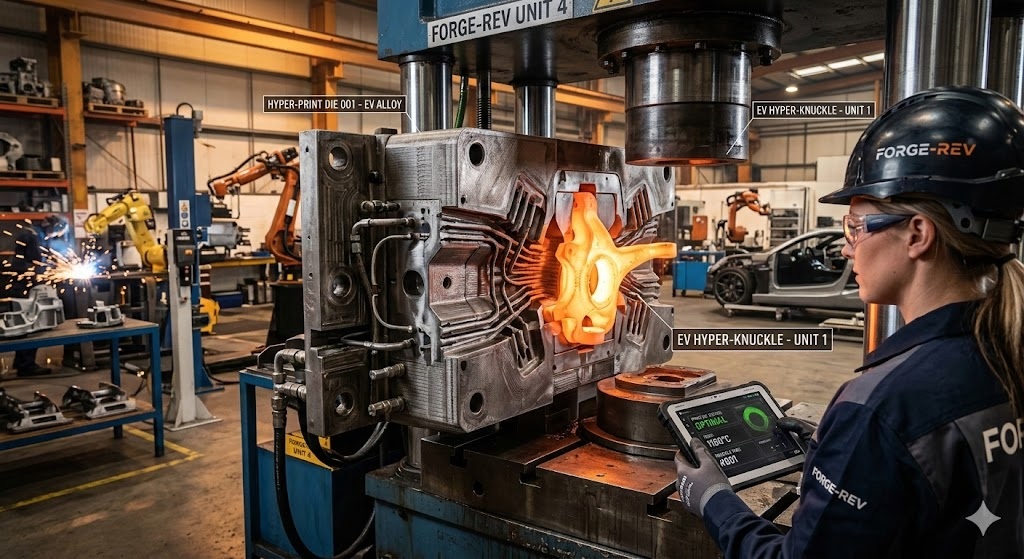
The automotive industry is no longer a monolith of mass production. The shift toward Electric Vehicles (EVs) has fractured the market into two distinct speeds: the high-volume commodity sector and the hyper-custom, low-volume “specialist” segment. For the latter, the biggest obstacle has never been the electric drivetrain or the software; it has been the astronomical cost and lead time of hard tooling. Traditional forging dies, carved out of massive blocks of tool steel via CNC milling and Electrical Discharge Machining (EDM), can take months to produce and cost tens of thousands of dollars. This “innovation tax” is being dismantled by the integration of 3D-printed dies, a move that is fundamentally altering the lifecycle of Forged Automotive Components in the 2026 landscape.
The Hard Tooling Crisis in the EV Age
In the internal combustion engine (ICE) era, a single die set might be used to strike a million connecting rods over five years. The upfront capital expenditure (CAPEX) was easily amortized. EVs change the math. An EV has roughly 90% fewer moving parts in its drivetrain, but the parts it does have—steering knuckles, suspension arms, and motor shafts—are subjected to much higher instantaneous torque and fatigue cycles. Furthermore, the rapid iteration of EV platforms means a chassis design might be obsolete in 18 months. Using traditional die-making processes for a run of only 5,000 hyper-custom delivery vans or high-performance electric coupes is a financial suicide mission.
The industry is pivoting toward Additive Manufacturing (AM) not just for prototypes, but for the actual production of forging inserts. Metal 3D printing technologies, specifically Laser Powder Bed Fusion (L-PBF) and Directed Energy Deposition (DED), allow for the creation of die inserts with geometries that were previously physically impossible to machine. This shift is not about replacing the hammer; it is about making the hammer smarter and faster to deploy for a new generation of Forged Automotive Components.
Technical Superiority: Conformal Cooling Channels
The most significant technical advantage of a 3D-printed forging die isn’t the speed of production—it is the thermal management. Traditional drilled cooling channels are straight lines; they cannot follow the complex, undulating curves of a die cavity. This leads to “hot spots” where the die remains significantly warmer than the rest of the surface, causing uneven thermal expansion and premature die failure due to thermal fatigue. 3D printing allows for “conformal cooling,” where internal water channels twist and turn just millimeters beneath the die surface, perfectly mirroring the part geometry.
By maintaining a uniform temperature across the die face, manufacturers can reduce cycle times by up to 20%. More importantly, it drastically extends the life of the tool. In a hyper-custom EV production run, where a single die set must last the entire project duration without a mid-run replacement, this thermal stability is the difference between profit and loss. The ability to pull heat away from critical radii prevents the “checking” or cracking that typically ends the life of a forging tool, ensuring that the last of the Forged Automotive Components in a batch is as dimensionally accurate as the first.
Precision Engineering at Sendura Forge
The transition to these advanced manufacturing routes is a natural evolution for firms that already prioritize high-precision metallurgical outcomes. Sendura Forge exemplifies this shift by maintaining a rigorous focus on closed-die forging for the automotive and power transmission sectors. By operating within the strict confines of IATF 16949:2016 certifications, companies like Sendura Forge ensure that the internal grain structure of every forged part is optimized for the extreme load cases seen in modern EV drivetrains.
The integration of 3D printing into the tool-room workflow allows for “hybrid” die construction. Instead of printing the entire massive die block—which would be cost-prohibitive—the focus is on printing high-wear inserts. Sendura Forge’s expertise in handling diverse materials like alloy steel and stainless steel becomes even more critical when these hybrid dies are used. The precision of the strike must be matched by the precision of the thermal cycle, ensuring that the rapid-response tooling can deliver the same mechanical performance as legacy hard-tooled systems.
Metallurgy: Why Forging Still Beats Casting in EVs
There is a misconception that the reduction in parts in an EV makes forging less relevant. The reality is the opposite. Because an electric motor delivers 100% of its torque at zero RPM, the shock loading on the drivetrain is immense. Castings, which can suffer from internal porosity and irregular grain structures, are increasingly being phased out of critical EV load paths in favor of Forged Automotive Components. Forging “heals” the metal by closing internal voids and aligning the grain flow with the direction of the stress.
When a 3D-printed die is used, the metallurgist can experiment with “near-net-shape” designs that were too risky with expensive CNC tooling. We are seeing a move toward lighter, thinner-walled forgings that maintain the same strength-to-weight ratio as their heavier predecessors. This is vital for EV range extension. Every gram saved in a steering knuckle or a wheel hub is a gram that doesn’t have to be moved by the battery, and 3D-printed tooling allows for the rapid “tuning” of these parts through multiple iterations without the six-figure price tag of traditional die revisions.
Hybrid Manufacturing: The “Forging Plus” Model
The 2026 trend is moving toward a hybrid manufacturing route where the base of a component is forged for structural integrity, and complex secondary features are added via 3D printing. This “Forging Plus” model uses a pre-formed forged blank—produced quickly using a simplified 3D-printed die—and then utilizes Wire Arc Additive Manufacturing (WAAM) to build up complex ribs, brackets, or cooling fins directly onto the forged substrate.
This approach combines the best of both worlds: the unmatched fatigue resistance of a forged core and the geometric freedom of additive manufacturing. For hyper-custom EVs, this means a manufacturer can use a standardized forged axle beam for five different vehicle models but customize the mounting points and sensor brackets for each specific application using 3D printing. This modularity reduces the total number of unique Forged Automotive Components that need to be inventoried, dramatically lowering the “carrying cost” of the supply chain.
Economic Realities of the 2026 Tooling Market
The global market for automotive 3D printing is projected to hit $5.31 billion in 2026, and a significant portion of that growth is in functional tooling. The ROI (Return on Investment) for a 3D-printed forging die becomes positive at volumes as low as 500 units. For a niche EV startup, this is a game-changer. They can go from a CAD design to a physical, forged, safety-critical part in under three weeks. In contrast, the traditional route would take 12 to 16 weeks—a delay that can be fatal in the fast-moving EV sector.
Furthermore, the “digital inventory” concept is now a reality. Instead of storing massive steel dies in expensive warehouse space for “just-in-case” spare parts, companies now store the digital print files. If an out-of-production EV model needs a replacement steering arm five years from now, the die insert can be printed on demand, the part forged, and the customer served without the manufacturer ever having to maintain physical tooling. This shift from physical to digital assets is fundamentally restructuring the balance sheets of a modern forging foundry India.
Sustainability and the Zero-Waste Forge
Traditional die manufacturing is a subtractive process; you start with a 500kg block of tool steel and grind away 150kg of it to create the cavity. That 150kg of “swarf” or metal chips is down-cycled and loses significant value. 3D printing is an additive process; you use exactly the amount of powder required to build the part, with a 98% material utilization rate. When you multiply this across a fleet of hyper-custom EVs, the environmental impact is substantial.
The energy savings extend to the forging floor as well. Because 3D-printed dies with conformal cooling reach an equilibrium temperature faster and stay there more consistently, the induction furnaces used to heat the billets can be tuned for maximum efficiency. There is less “warm-up” scrap—the first few parts of a run that are usually discarded because the die hasn’t reached the correct temperature. In the 2026 economy, where carbon taxes are being integrated into the industrial supply chain, the “green” credentials of 3D-printed tooling are becoming a primary driver for the adoption of modern Forged Automotive Components.
Future Outlook: Generative Design Meets the Hammer
The next frontier, already appearing in high-end EV projects, is the use of generative design for forging dies. AI-driven software is being used to design the internal structure of the die itself—not just the cooling channels, but the lattice structures inside the die block. This allows for dies that are 40% lighter yet stiffer than solid steel blocks, further reducing the energy required for the forging press to move the hammer.
We are entering an era where the forge is no longer a place of brute force, but a place of high-data-rate engineering. The 3D-printed die is the catalyst for this change, allowing the “old” world of metallurgy to speak the “new” language of rapid-iteration digital manufacturing. For the EV industry, this means the end of the compromise between speed and strength. The revolution in Forged Automotive Components is here, and it is being printed one layer of tool steel at a time.


