
That moment sticks. Back in early 2026, I was alongside a small workshop in Punjab – they’d just scored their first deal out of Europe. Big order. High-precision forged pieces, hundreds of units. Energy ran high; people moved fast, talking loud, smiling more. Then, silence. Three weeks in, word came: goods stuck in Hamburg. Customs wouldn’t clear them. Funny thing – nobody saw it coming. What caused trouble wasn’t size, nor the mix of metals. Instead, it came down to missing paper trails along with a slight shift in how the metal grains ran – just enough to fall outside their strict EN rules.
We definitely had the parts and the intention, but we did not have the system. We had to send a team to the location, make new arrangements, and, quite honestly, that was almost the end of the company’s reputation before we even started. That realization was a big shock, and it hurt a lot: in the global marketplace, a forging is not just a piece of shaped metal; it is a full package of certifications, metallurgical soundness, and logistical accuracy.
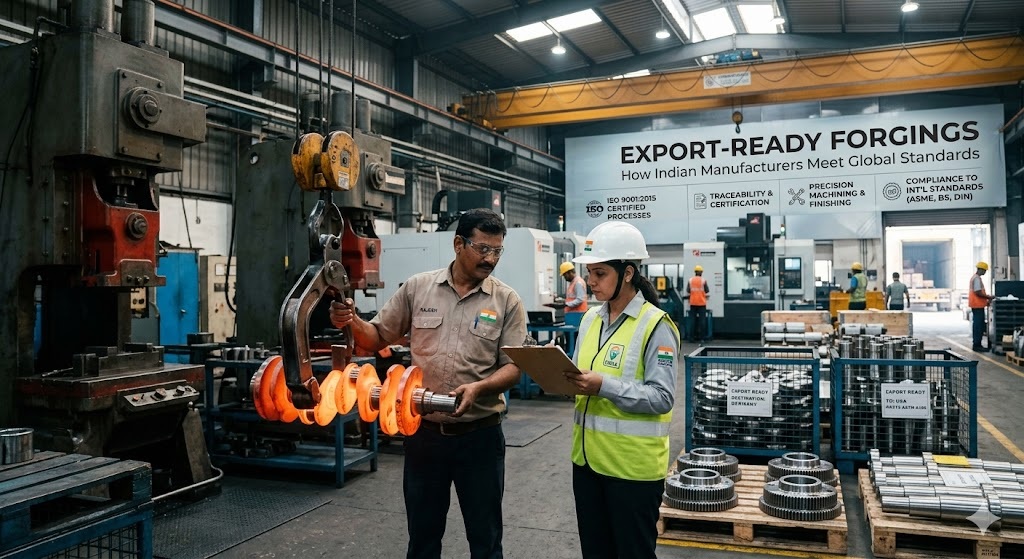
Now, the “Forging Exporters India” you are searching for are not just a hammer-wielding factory. You want a partner who understands that the “India Scale” should now be equivalent to the “Global Standard”. This book is a distillation of painful lessons learned, a clear, practical, and straightforward guide to help you identify manufacturers capable of performing at the global level.
The Compliance Filter: Beyond the Basic Stamp
At the start of your search, you will probably see many practitioners flash ISO 9001 at you. And, of course, it’s okay. It’s merely a baseline. But, for a Senior Strategist, ISO 9001 is like mentioning that a vehicle has four wheels, it is taken for granted. To compete in the USA, Europe, and Japan, you will face much more complex requirements.
The Alphabet Soup of Global Trust
Hunting down certifications tied to the sector? That means checking if the maker can actually handle high temperatures – no metaphor, just real heat resistance proven on paper.
- Out here, IATF 16949 sets the rules. Missing it means showing up uninvited – local games feel familiar, sure, but worldwide networks move differently. One step off track and everything shifts.
- Zero mistakes allowed – that’s how strict AS9100 gets in aviation work. Built only for flight-focused industries, it demands near-perfect results every time.
- Got equipment like boilers or gas systems headed for Europe? The PED rule must be followed. When placing such gear on the market there, compliance isn’t optional. Pressure matters – so does following local law. Equipment under pressure needs proper checks. This directive covers safety across member states. Skipping it means delays. Meeting it keeps things moving.
Here’s something else to consider: ESG standards matter more now. Top global purchasers keep asking about emissions data. When a factory swaps out gas-powered furnaces for electric induction systems, it isn’t just reducing pollution – such moves also help shield your operations if carbon pricing rolls out.
Metallurgical Integrity: It’s What’s Inside That Counts
This is where many purchasing decisions go horribly wrong. You can’t inspect grain flow with the naked eye, but it is the very reason why a forging is superior to a casting. A first-class manufacturer, the type of Forging Exporters India that survive long term, makes considerable investments in what I term the “Internal Architecture”.
The Grain Flow Obsession
Request the manufacturer to provide a macro-etch test report. Frankly, if they are reluctant, leave them. It is important to check that the grain flow of the metal corresponds to the shape of the part. This is what imparts to the component its resistance to fatigue. In highly loaded applications, e.g., crankshafts or steering knuckles, discontinuities in grain flow are a time bomb.
In-House Testing Capabilities
Is the exporter equipped with a NABL-accredited lab? They should be capable of these:
- Spectrometry: To verify the chemical composition of every heat code.
- MPI (Magnetic Particle Inspection): To detect surface cracks that visual inspection might miss.
- UT (Ultrasonic Testing): To detect internal defects or “piping” in the raw material.
From my perspective, if a company is outsourcing its fundamental testing, you are adding both a risk factor and a week to the lead time.
The Technology Leap: From Hammers to Precision
Honestly, we could say that the picture of a forge polluted with smoke is very much a thing of the past. The top Forging Exporters India are transforming into highly automated factories. Why? A human operator starts feeling tired at 3:00 PM on Tuesday, but the robotic arm never gets tired.
Why Speed and Precision Matter
Industry insights have revealed that speed to market is an enormous competitiveness factor. If a supplier employs Simulation Software (e.g., DEFORM or QForm) even before the dies are manufactured, they can save weeks of mistakes and adjustments.
- Closed-Die Forging: Suitable for high-volume production with precision.
- Warm Forging: Many Indian exporters consider this as their “sweet spot”. It provides better dimensional accuracies than hot forging and requires less force than cold forging. It is also excellent for making complex shapes.
Concrete Tip: Visit their Die Shop. A manufacturer who makes their own dies using CNC high-speed milling is a manufacturer that controls their own destiny (and your delivery timeline).
Bridging the “Trust Gap”: Documentation and Traceability
In the B2B world, the “paperwork” is as important as the “ironwork.” I mean, look, if a part fails in a wind turbine in the North Sea, the first thing the lawyers ask for is the 3.1 Mill Certificate.
Total Traceability (The “Birth Certificate”)
Every single part should be traceable back to the specific “heat” or batch of raw material it came from.
- Heat Number Stamping: Ensure the exporter uses permanent marking (laser or dot-peen).
- Digital Documentation: Are they still sending PDFs via WhatsApp? Or do they have a proper ERP system where you can log in and see the test reports for your specific PO?
Honestly, the “digital twin” of the document is what helps you clear customs without a headache.
Navigating the “India Advantage” vs. The “Price Trap”
India provides a considerable price advantage due to labor and integrated steel production. However, and here comes a big “but”, if the quote you get from Forging Exporters India is 40% lower than the global average, then you have to start posing very uncomfortable questions.
Logistics The Last Step In Exporting
Out at sea, metal bits can rot clean away – even if built just right. One builder skipped VCI wraps, lost every piece to rust. Thirty days on water? That cargo needs a ghost-like cover, sealed tight. Machines won’t care how fine they were made once salt air gets in
Practical Shipping Checklist:
- Start by wrapping parts in VCI bags to block moisture. These materials slow corrosion before it begins. A layer of quality rust-inhibiting oil adds extra defense. Protection improves when both methods work together. Moisture stays out, metal stays clean.
- Pallets need ISPM-15 heat treatment – skip it, then officials could torch your cargo at the border to stop bugs spreading.
Most quick delivery relies on stored goods nearby. Think twice before assuming fast shipping means production speed. A supplier might rely on a local warehouse instead. That buffer usually covers two weeks of demand. Locations like New Jersey or Rotterdam commonly host these reserves. Check if your seller works with regional storage partners. Stock already on hand makes turnaround times look impressive.
The Self Correction Questioning If Forging Is Always The Way?
Back then, truth be told, someone might request a forged component even if a strong cast piece could handle the job just fine. When forces strike hard or pressures climb, though, nothing beats what forging delivers. It sneaks up on people – how often specs go beyond what’s actually needed. That tiny 0.1mm precision on a surface that doesn’t connect to anything else – is it truly necessary? Pushing limits too far only lifts price tags while giving zero benefit.
Conclusion
Selecting the right Forging Exporters India means going beyond the glossy brochure and getting into the “boring” stuff:the lab reports, the die shop, and the IATF certificates.
Balance matters most. Get the lower costs India offers, yet hold firm on metal quality global buyers expect. Begin with something tiny. Place a test order first. Check it yourself through outside testing that finds flaws without damage.
After all, you are not merely buying steel. You are investing in the reassurance that the “invisible foundation” of your product will not fail under pressure.
The takeaway? Don’t just source; partner. Choose a manufacturer who has the mindset of a Senior Strategist, one who understands that a single 10-cent bolt can bring down a million-dollar machine. That’s the person you want dealing with you.
Now, go out there and build something that lasts.