

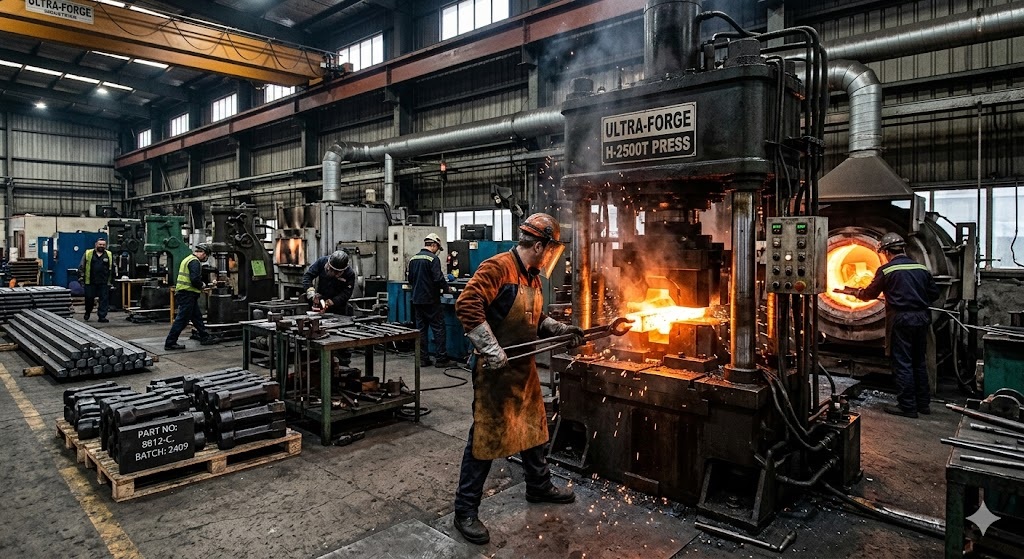
Steel does not become a machine component by accident. Steel becomes useful only after force, heat, and controlled deformation push the metal into a stable structure. Forging stands among the oldest industrial methods used for shaping metal, yet the process remains deeply relevant in modern engineering. A workshop operated by a professional forging parts manufacturer runs on strict discipline, high temperature operations, heavy presses, and experienced technicians who understand the behavior of hot metal.
Forged components sit inside trucks, tractors, gearboxes, hydraulic machines, rail equipment, and industrial plants. These components carry load, absorb vibration, and tolerate mechanical abuse for years. A cracked or weak component inside such machinery causes costly downtime or safety risks. Because of this reality, industries prefer forged metal structures produced by a dependable forging parts manufacturer.
Steel Stock Arrives Before the Real Work Begins
Production starts long before the first hammer blow. Steel bars or round billets arrive from steel mills in bulk quantities. Every batch must match the grade required for the final component. Alloy composition matters. Even a small deviation in carbon or alloy content changes the mechanical behavior of the metal.
At the receiving yard of a forging parts manufacturer, incoming material rarely moves directly to production. Inspection takes place first.
Steel bars pass through:
- Visual inspection for surface cracks
• Ultrasonic checks for internal defects
• Diameter measurement and weight verification
• Material grade confirmation using spectrometers
Material that fails inspection goes back to the supplier. Defective steel inside a forging line creates far bigger problems later.
Stacks of approved billets then move toward the heating section.
Heat: The First Real Step of Forging
Cold steel resists deformation. Heated steel moves like clay under pressure. Forging therefore begins with controlled heating.
Inside a forging facility, furnaces glow bright orange for most of the working shift. Billets slide into furnace chambers where temperatures climb above 1100 degrees Celsius. At this level the metal softens and becomes workable.
Gas furnaces dominate many traditional workshops, though induction heating systems appear more frequently in modern units. Induction heating raises billet temperature quickly and evenly.
Operators at a forging parts manufacturer watch temperature carefully. Overheated steel grows coarse grain structure. Underheated steel cracks during forging. Both situations produce scrap.
When the billet reaches the correct temperature, time becomes critical. The metal must move quickly to the forging machine before heat escapes.
The Moment Metal Meets Force
This stage defines the forging process.
A red-hot billet travels from furnace to machine using tongs, manipulators, or automated arms. Seconds later the billet lands between hardened dies inside a forging hammer or hydraulic press.
The machine comes down with massive force.
Metal spreads, compresses, and fills the die cavity. The internal grain of the metal bends and flows along the shape of the component. That internal grain flow gives forged parts their famous strength.
Repeated strokes shape the metal further. The workshop floor echoes with the rhythmic impact of forging hammers. Noise, heat, vibration — all normal inside the production line of a forging parts manufacturer.
Closed die forging handles many industrial components. Dies carry the negative shape of the final part. When pressure forces the hot metal into that cavity, the near-final geometry appears.
Open die forging follows a different path. Instead of enclosed dies, flat tools compress the metal repeatedly. Large shafts, rollers, and thick bars usually come from open die work performed by a forging parts manufacturer.
Flash Appears Around the Edges
During closed die forging, extra metal escapes through narrow gaps between die surfaces. That thin strip of excess metal forms flash.
Flash actually helps the forging process. Resistance from the flash forces metal deeper into the die cavity, ensuring proper filling.
After forging finishes, flash must disappear.
Trimming presses handle that job. The still-hot part enters a trimming die where excess metal shears off instantly. The component now resembles its final form, though surface scale and rough edges remain.
At this point the shop floor of a forging parts manufacturer fills with stacks of rough forged parts waiting for the next stage.
Scale, Oxide, and Surface Cleaning
Hot steel exposed to oxygen forms scale on its surface. The dark oxide layer does not belong on finished components.
Cleaning happens through shot blasting. Steel shots blast against the part surface inside a rotating drum or enclosed cabinet. Scale breaks away under the impact.
After blasting, the true surface of the forged metal appears. Inspection teams at a forging parts manufacturer examine parts again. Surface cracks, laps, or folds must not pass further down the line.
Any flawed component leaves the production batch.
Heat Treatment Changes the Metal Again
Forging shapes the metal but heat treatment controls its final strength.
Parts move into another furnace after forging. This time the purpose differs. The metal must develop the correct internal structure.
Common treatments inside a forging parts manufacturer include:
- Normalizing
- Quenching
- Tempering
- Stress relieving
Each treatment alters hardness, strength, and ductility. Some automotive parts require extreme strength. Others require moderate hardness but high toughness.
Precise temperature cycles control the outcome. Furnace charts record every batch.
Without proper heat treatment, forged metal never reaches full performance potential.
Machining Brings Accuracy
Forged shapes remain close to the final geometry but not perfect. Critical surfaces still require machining.
CNC lathes, milling machines, and drilling centers finish the component.
Typical machining work includes:
- Boring holes
• Cutting threads
• Finishing flat surfaces
• Achieving tight dimensional tolerances
Modern facilities run integrated machining departments. A full-service forging parts manufacturer therefore supplies parts ready for assembly rather than unfinished blanks.
Dimensional accuracy becomes extremely important when forged components enter gear systems, engines, or hydraulic equipment.
Inspection Never Stops
Quality inspection runs parallel with production.
Forged components often handle shock loads and constant vibration. Hidden defects cannot remain inside the metal.
Testing teams inside a forging parts manufacturer apply several inspection methods:
Ultrasonic testing reveals internal cracks.
Magnetic particle testing exposes surface flaws.
Hardness testing confirms heat treatment success.
Dimensional checks verify compliance with engineering drawings.
Documentation accompanies every production batch. Industrial buyers require traceability from raw material to finished component.
Where Forged Parts Actually Work
Forged components rarely appear in visible locations. Most operate deep inside machines.
Automotive systems rely on forged crankshafts, steering knuckles, and suspension components.
Construction equipment contains forged pins, couplings, and structural connectors.
Oil and gas pipelines use forged flanges capable of handling pressure and temperature.
Agricultural machines use forged linkages and drive components built to tolerate mud, shock, and torque.
Such demanding environments explain why industries prefer sourcing from a capable forging parts manufacturer rather than relying on weaker production methods.
Workshop Reality: Heat, Noise, Discipline
Forging workshops do not resemble quiet assembly plants.
The environment remains intense. Heat radiates from furnaces. Forging presses generate deep mechanical vibrations. Workers move carefully between machines carrying glowing metal parts.
Strict safety rules govern the shop floor. Protective clothing, face shields, heat-resistant gloves, and steel footwear become mandatory equipment.
Process discipline also matters. A forging parts manufacturer cannot allow inconsistent temperatures, poorly maintained dies, or careless handling. Small mistakes quickly produce scrap metal.
Good forging plants run like tightly controlled mechanical ecosystems.
Forging Still Dominates Heavy Engineering
However, despite all the advanced machinery that has been added to manufacturing processes, the art of forging still refuses to go away. The reason is as simple as this: metal is better able to withstand stress when it is forged rather than when it is manufactured by any other means.
Parts that must carry loads within a machine need to be strong, tough, and able to withstand fatigue. These are all traits that are provided by compression in a forging.
As industries continue to create bigger and better vehicles, buildings, and machinery, so does the need for more forged parts.
Behind all of this is the technical ability of a reliable forging parts manufacturer.
Final Industrial Perspective
Forging represents controlled violence applied to metal. Heat softens the steel. Massive force reshapes it. Careful heat treatment refines its internal structure. Machining finishes the geometry. Inspection confirms reliability.
Each stage carries equal importance. Skip one step or perform it poorly and the entire component fails its purpose.
A serious forging parts manufacturer understands this chain completely. Raw steel enters one side of the workshop. Durable industrial components leave the other side, ready to carry load inside machines that keep modern industry running.