

There was this one rainy Tuesday morning that I’ll always remember, standing on the shop floor of a huge automotive components factory near Chennai. We were just weeks away from a big production deadline for a shipment to Germany! The whole team was so tense. Procurement had just bought a big batch of custom parts, balancing cost and quality. Strict tolerances were met. Everything was perfect on paper: the certificates, sized dimensions, and the price were unbeatable.
Then we did the stress tests…
Parts started showing tiny cracks when heated or underweight. It wasn’t a fault in the design. It was a metallurgical defect (microscopic porosity) that no normal visual inspection can detect. We ended up stopping the production line, scrapping the whole batch, and going through a depressing three-week delay. It was a tough, eye-opening experience. Industrial procurement is a risky game; what on a spreadsheet appears to be a deal, in the real world can turn out to be a nightmare if in manufacturing the quality control is not perfect.
This one crisis made us change completely our way of looking at sourcing globally. We were led, through it, to seek and adopt high technology, precision solutions, where precision is not only a measure but a lifesaver. And the skill of investment casting exporters is exactly what the argument supports.
Global Changes, Indian Drive
Let’s be frank here. For a long time, the story of world manufacturing was a tale of just one thing: getting the lowest cost per unit. The managers of the purchasing departments seldom minded minor quality differences if the piece price was low enough. But the earth has changed so drastically. Disrupted supply chains, volatile raw material markets, and a very demanding customer wanting a product fast have totally changed the circumstances.
Now, industrial buyers expect more from the manufacturing facility aside from just the capability to produce the parts only. They want to see a resilient, agile operation which also offers a guarantee of technical reliability.This is just the reason that, more and more, global customers are looking at the Indian market. The phenomenon of the “Made in India” brand is being massively changed on the international level. Labor is no more a cheap resource along with raw materials being available in plenty. Rather it is, sophisticated engineering, cutting-edge automation, and an unparalleled adherence to global quality standards. Indian investment castings exporters are not only joining global supply chains but are also winning them by their capability of addressing technical complexity and quick operational execution.
Investment casting is the king of all casting processes
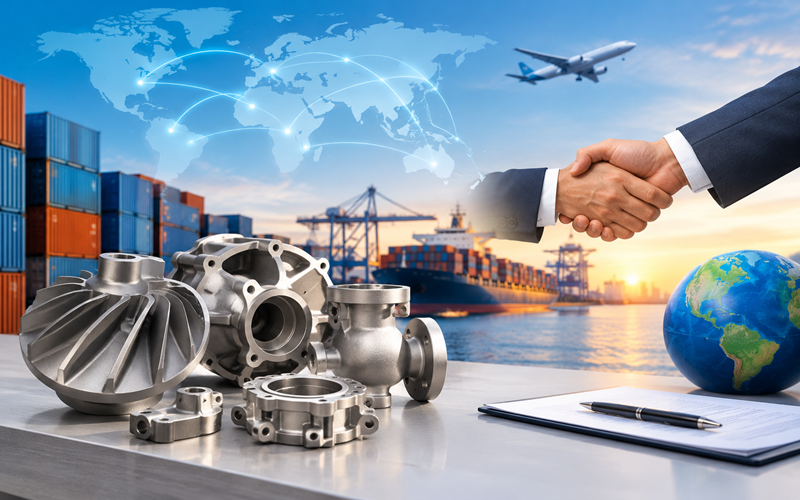
Generally, investment casting or the lost wax process is the ability to deliver components with very complex shapes. This technique is the go-to method where manufacturing of complex parts is concerned, such as thin walls, delicate internal passageways, or an exceptional surface finish straight out of the mold.
Very often, the parts are made by investment casting near-net-shape, which means that they are given to the machinist for very minor work or even without the machinist. For the high-end industries such as aerospace, defense, oil and gas, medical devices, automotive, the use of this process is not a matter of choice but a necessity.
Investment castings exporters: Identifying the best fit
Finding the right business partner among the numerous investment castings exporters may leave you with the feeling of being lost. Marketing plans, as a rule, start to look identical with passing time, right? Quality is their top priority, delivery is fastest, and price is most competitive. Everyone makes these claims. Still, as a procurement expert, your role is to look beyond the surface and get to the engineering reality.
Here is the practical system that you need to implement.
Step 1: Assess metallurgy capabilities and experience with different materials
Capability in working with metals is the first and the most important criterion to assess with an exporter. A top-notch casting facility will have no problem working with drawings made of complex superalloys, duplex stainless steel, or specialized cobalt/nickel-based material.
- Diversification in alloys: Check if the exporter regularly handles a variety of metal types for casting. You do not want to entrust a highly sensitive duplex stainless steel casting to a foundry that mainly works with carbon steel.
- Limits on geometry and size: It is essential to know their operating limits. Are they capable of casting a small component of only a few grams with the same level of accuracy as a large valve body weighing 100 kg? The equipment and pouring techniques for these two extremes are completely different.
- Tool design and simulation: This could be a significant differentiator. Most leading investment castings exporters rely on casting simulation software. Without actually melting any metal, the software is used to assess the molten metal flow, solidification patterns, and possible cooling stresses. This technological advantage greatly reduces trial-and-error sessions, thus giving a significant speed-to-market boost.
Step 2: Ask for complete certification and quality evidence
Internationally, certifications back you up. They serve as evidence by a third party that the factory follows repeatable, documented processes. If the exporter cannot give clear, up-to-date publication of certifying documents, you should consider this a major red flag. Frankly, just walk away.
And in terms of NDT, examine what they can do for you. Have they equipped their folks with Liquid Penetrant Testing (LPI), Magnetic Particle Inspection (MPI), Radiography (X-ray), and Ultrasonic Testing?
The story about the Chennai plant reminded me, if only that foundry had performed these comprehensive NDT or X-ray examinations on the very first lot, they would have found the internal micro-porosity right away, thus saving weeks of wasted efforts and great frustration.
Step 3: Inspect infrastructure and level of automation
Present-day investment casting is not a laborious, sweaty production process; it is an extremely automated, high-tech one. So, when you are doing the virtual evaluation of the facility or physically auditing it, be very attentive to their automation level.
- Robotic Slurry Coating: Making of the ceramic shell around the wax pattern needs a very delicate touch. Automated robotic arms make sure that every single layer of slurry and stucco is applied with absolute uniformity. Human error in manual dipping results in thickness variations that might lead to shell cracking or dimensional distortion on pouring.
- Atmosphere-Controlled Melting: Sensitive alloys should be made in vacuum induction melting (VIM) or protective atmosphere furnaces. Atmospheric gases such as oxygen and nitrogen, when released into the molten metal, cause weakening and internal defects.
- Traceability Systems: Is it possible for the exporter to link a finished, machined casting to the specific heat number of the raw material ingot it came from? A few global leaders use barcodes or RFID tracking throughout the shop floor, thus providing the customer with full transparency and a sense of security.
One of the major factors: balancing cost with speed
Business is all about speed to market the entire time it takes from when you have the finalized 3D model to the arrival of the production part at your doorstep. This factor alone could decide the success or failure of a new product launch.
Organizations are so obsessed with grinding down the unit cost that they completely ignore the huge financial consequences related to long lead times, delayed communications, and production schedules refused to be changed.
Present global operations research reveals that organizations which are able to make quick procurement and supply chain decisions based on accurate real-time data experience much greater profit growth potential than slow-moving competitors.
Speed does not imply that you hasten your manufacturing and skip quality checks; it means that you identify the unnecessary frictions, streamline communications, and, most importantly, leverage technologies to act with absolute determination.
When meeting with the investment castings exporters, query their rapid prototyping capabilities. Is it possible for them to employ 3D-printed wax or PMMA patterns to omit the traditional, time-consuming metal tooling step for initial sample approval?
A progressive exporter who can give you functional production-ready prototype parts within a month instead of several is granting you a wonderful competitive edge. You can test the market, confirm your designs, and react to your customers’ changing needs way ahead of your competitors finishing the steel mold machining.
Price versus value, buying the right one appreciation of costs and price
We need to discuss pricing, because this is where most sourcing strategies simply fall apart. The Indian market is vast and very competitive. If you issue a Request for Quotation (RFQ) for an investment cast component, you will probably be presented with a very wide range of offers. Some bids might come in 20% to 30% lower than the market average. It is extremely tempting to take these numbers immediately, especially when your finance director is pressing you to cut spendings.
But let’s reason this out. Globally prices for raw material ingots, be it scrap nickel, ferrochrome, or pure copper, are very closely aligned since these are heavily commoditized and also highly volatile. Energy costs and advanced ceramic materials also have fairly stable base costs. So, if an exporter is competing on price to the extent that it is dramatically different from reliable competitors, what exactly are their escape routes?
The ample pockets of savings typically come courtesy of:
- Mode De-oxidation and Refining Level: Omitting critical refining operations will leave impurities in the metal which lead to compromised mechanical properties and possible failure under stress.
Your Next Sourcing Cycle Actionable Checklist
Making a critical sourcing decision that you won’t regret requires preparation in advance. You can keep this handy reference checklist to have firm control over the entire process when you finalize the manufacturing agreement:
- [ ] Verify Metallurgical Match: Does the foundry regularly produce your exact specified alloy?
- [ ] Audit Simulation Software: Are they modeling solidification to eliminate internal porosity?
- [ ] Check Robotic Consistency: Is the automated system used for shell building, ensuring uniform thickness?
- [ ] Review NDT Credentials: Are their internal testing labs license-approved and their technicians completely certified?
- [ ] Assess Prototyping Flexibility: Do they have 3D-printing capabilities to make rapid prototypes to market faster?
- [ ] Validate Total Cost Transparency: The quote should explicitly show the cost breakdown of materials, machining, and the different tests performed.
By holding your manufacturing partners to these stringent, measurable standards, you are shielding your company from the extra costs and productivity downtime that can result from a delay in the chain. Also, you lay the foundation for quality products that can survive in a competing global market. Rely on your strategy, check the technical aspects of the floor, and work with an exporter who sees your quality standards as their top mission of the absolute non-negotiable.