
Years ago, I was visiting a heavy engineering shop in Pune, the kind of factory where the air smells faintly of ozone and burnt metal and I saw four guys working hard on a manual 3-roll bender. They were trying to round a 20mm thick carbon steel plate perfectly. It was a time-consuming process of measuring, adjusting, re-rolling, and using quite a bit of “colorful language”. Quite frankly, it was a wonder they even managed to meet their deadline.
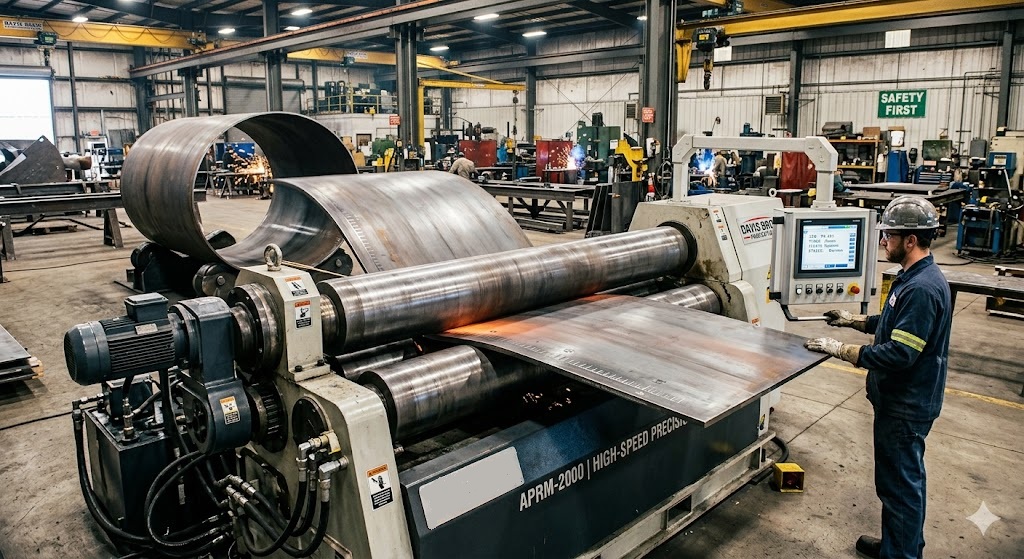
Changes can be seen in just few lines…. Last month, I saw a similar plant, which had just joined forces with one of the leading Automatic Plate Rolling Machine Manufacturers. The change was drastic. Not only were they quicker, their whole mindset towards the production process was different now. One worker, a touch screen, and the plate came out perfectly on the very first pass. It’s at times like this that you understand that “efficiency” is not a mere corporate slogan; it’s what sets apart those who grow their business from those who only manage to survive.
If you think your current fabrication line might be putting a brake on your growth, you are still part of a very large group of companies. The Indian B2B market is changing really fast. With the government actively promoting huge infrastructure projects and renewables, there is an almost unbelievable rise in the demand for precision-rolled cylinders and cones. And here is the point: there is no way to produce 2026 volumes with 1990s equipment.
Why “Wait and See” is a Dangerous Strategy
Just because your manual rollers are still functional, doesn’t mean you should delay upgrading your equipment. Today’s market conditions demand rapid development and any delay may kill your business without making a sound.
Firms that move ahead quickly are those who make the most of new developments. Anyway, while it takes your manual worker three days to master that difficult curve, your rival computer controlled unit has already been put on the job, done and dusted the delivery, and got the next order.
The Real Cost of a Slow Line
- The Loyalty Gap: Customers simply don’t wait anymore. If you cannot deliver fast, they move on.
- Wasted Material: Manual rolling, with its “trial and error” phase, often results in scrapped plates. And with the current price of high-grade steel? That’s money thrown away.
- Missed Signals: When you are down and out in manual work, you fail to see big changes in the market like the sudden demand for wind tower components or for high-pressure vessels.
The Anatomy of an Automatic Plate Rolling Machine
Before you ring up Automatic Plate Rolling Machine Manufacturers, you really should understand what “automatic” actually means for these machines. It is not just getting a motor; it is a combination of hydraulics and software working in perfect harmony.
1. The CNC Control System
This head of the machine. Instead of Classic CNC, nowadays, Graphic CNC systems are being used where you just give the plate thickness, width, type of material and target diameter. Software determines roll positions, force needed and even “spring-back” which is metal’s pesky tendency to slightly un-bend after the pressure is released.
2. Hydraulic 4-Roll Systems
Though 3-roll machines are available, the 4-roll setup is the one which is most suitable to automation.
- The Bottom Roll: Grips the plate so that the leading edge is properly “pre-bent”.
- Side Rolls: They go up and down in order to generate the curve.
- The Outcome: A cylinder can be produced in one single pass without the necessity to turn the plate over. It is safer, faster and much more accurate.
3. Integrated Handling Systems
I’ve come across cases where a company purchased a premium machine but then continued to use five people with a crane for the feeding. That is a huge bottleneck. Top Automatic Plate Rolling Machine Manufacturers offer overhead and side supports that move in perfect sync with the rolling process, thereby turning a dangerous manual operation into a streamlined, automated movement.
Measuring the ROI: Is It Worth the Price Tag?
To be frank, a compulsive purchaser of heavy machinery spending at one go almost brings the CFO to a headache. But viewing ROI (Return on Investment) from a wider perspective is important.
There can come various benefits through AI-enabled automation if you plan well. For example, your “Speed to Market” can be a whole lot faster if in case you achieve 40% higher output via an automatic machine. You are not simply saving on labor costs by 40%; you are also expanding your business capability by that margin because you can handle more orders.
The ROI Calculation Factors:
- Labor Reduction: You are going from a four-men crew to one single operator only.
- Energy Efficiency: Latest hydraulic systems are equipped with variable frequency drives (VFDs) that will only consume power when the rolls themselves are actually in motion.
- Precision and Quality: Practically no rework required. Just think about the last time a customer rejected your tank because the seaming line was not exactly matching. How did that impact your reputation and transportation cost?
How to Choose the Right Manufacturer in India
India is a buyer’s market with a lot of choices here, from fancy European imports to reliable local brands of Rajkot and Coimbatore. What a perfect partner is to be picked, well it’s something which can be a little difficult, more so if you don’t have a checklist.
Step 1: The “Non-Negotiables”
Don’t even consider a quotation if the manufacturer cannot demonstrate:
- BIS/ISI Certification: Safety must not be compromised.
- Testing by NABL: Are the critical components (e.g. rollers) tested for hardness, fatigue which is a sign of durability, etc.
- Software Stability: Is the CNC software their own or is it a standard one? You don’t want a machine that becomes a “brick” after the manufacturer goes out of business and no one else can roll the code.
Step 2 : In House Research And Development
Could the maker actually be innovating, or just copying past blueprints again? Try discussing their approach to strong metals instead. When confusion shows up during that talk, maybe leave. Knowing the difference between shaping soft 10mm steel and bending tough 8mm Hardox matters a lot. That awareness should already be there.
Step 3 : Hidden Support Revealed
Midnight Sundays taught me something. A machine’s real value shows up when someone skilled steps in, tools in hand, ready to make it right. It is not about gears or wires. What matters is the person behind the repair, calm under dim light, solving what others walk away from.
- Service spots nearby – do they exist?
- Training comes up – does it count as part of the package? Shifting from manual to CNC isn’t only about drafting guides; culture needs to move too.
- Should something like a hydraulic seal fail, is a new one ready within a day? Or does it mean weeks lost waiting on a container crossing the ocean?
The Human Element: Managing the Transition
It just occurs to me that people very often forget the most expensive “part” of any machine: the individual operating it. When a high-speed automatic line is introduced, your staff are likely to become scared. Their association of “automatic” is with “unemployed”.
However, it should be looked at from a different viewpoint, automation should not be equated with layoffs; rather it should be considered as a means to upskill employees. The person who was formerly breaking his back carrying plates can now be the one who is running the digital workflow. “Change management” is absolutely necessary in this scenario. If your people do not have confidence in the machine, they are bound to find ways to bypass the automation, and you will never get to see that 16% profit increase.
Common Sourcing Traps (And How to Avoid Them)
I have considerable conversation with procurement heads who are convinced they got “a steal” on a machine from an unorganized manufacturer. Half a year or so later, they are contacting me to check if I know any good repairmen.
The “Under-Powered” Trap
Some Automatic Plate Rolling Machine Manufacturers will offer a machine which on paper meets your thickness specification but actually operates constantly at its limits.
- Pro Tip: It is always advisable to purchase a machine which has 20% “buffer” in capacity. Suppose you want to roll 20mm, then actually buy a machine which is rated for 25mm. This not only prolongs the life of hydraulics but also ensures that the frame will not flex under the pressure.
The “Software Lock”
Be cautious of manufacturers who employ a complicated, closed-loop software that need continuous “license fee” renewal every year for the machine to remain operational. You want an open or standard CNC system that hands over ownership of your production to you.
Final Thoughts: The Future is High-Speed
Really, at the end of all, the fabrication industry in India isn’t about who has the largest hammer. Rather it is about who has the most data and the quickest response time.
Getting the right Automatic Plate Rolling Machine Manufacturers onboard is more than just another purchase; it is a strategic step to keep your workshop ready for the future. It will enable you to take the challenging jobs, meet the shortest deadlines, and also do the high-precision contracts that none of your competitors can.
Do not wait for your manual rolls to break down before you start thinking about the future. The cost of hesitation is much more than the price of the machine. If you have to, start small, maybe a pilot program for a single line, but start.
Changes in the market are happening. Are you moving forward with them or are you getting left behind?