
A press brake machine plays an essential role in the production of high-quality parts using sheet metal in the metal fabrication industry; it how we also qualify as an essential machine within that production process. Like many other machines, press brakes today are subject to tremendous weight and/or load being applied to them as a result of their continual use and daily operation. Therefore, regular maintenance of your press brake will be necessary to ensure continued consistency, safety, and effective operation from your machine.
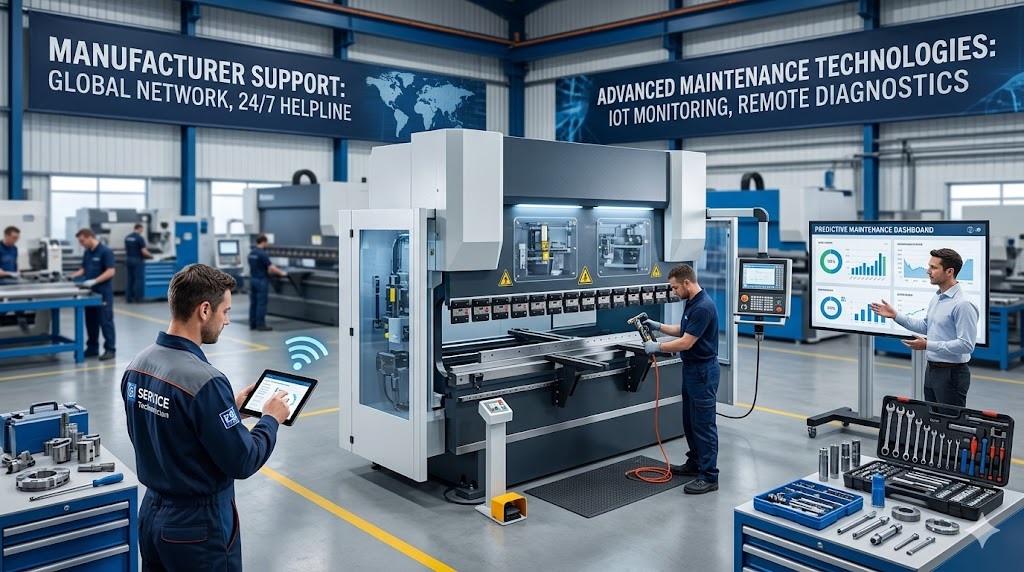
To improve on prior methods for maintaining press brakes, new technology has allowed for improved methods of monitoring, diagnosing, and predicting when service is needed on your compressor. New technologies include smart diagnostic tools providing accurate, real-time data on machine operation; the use of sensors to monitor and collect information from various components on the machine; and the use of automated alerts to notify operators when to service the machine. As a result, downtime may be reduced, unexpected failures of the machine may be reduced, and overall lifespan of the machine may be extended.
In addition to improvements in maintenance technology associated with the press brake, a solid support infrastructure from the manufacturer to provide timely servicing of the equipment, availability of spare parts, technical assistance to operators of the equipment, and operator training will also play an important role in maintaining the press brake in the best possible condition. These technological improvements and solid manufacturer support will lead to increased productivity, reduced operational costs, and an increase in reliability within longer-term manufacturing processes across all industrial sectors.
Integrated CNC technologies with Press Brake Machine
CNC technology has revolutionized how press brakes operate, improving the accuracy, speed, and efficiency of metal bending operations. Today’s CNC systems enable press brake operators to program precise bending angles; material thickness; back gauge positions; and bending sequence with a high degree of precision, resulting in reduced chances of manual error and material loss.
CNC Press Brake Machines today have Touchscreen Interfaces, Automated Tool Makings, and the ability to Monitor Fabrication in Real Time, also allowing for the creation of a CNC Program without having to be on a CNC Machine. All these advanced technologies allow for the Repeat Production of Fabricated Parts with High Quality Consistency; therefore, they are good to use in a variety of industries such as Automotive, Aerospace, Construction, and Heavy Engineering.
Additionally, modern press brake machines equipped with CNC technology result in greater efficiency and reduced setup time, reduced dependency on workers, and reduced secondary maintenance issues for manufacturers, effectively making today’s CNC press brake machines much more cost effective and reliable for manufacturing companies.
Replacing old and obsolate machines with modern Press Brake Machines
For many Press brake manufacturers India, upgrading obsolete and outdated equipment to modern press brake machinery can have a major impact on production speed, precision, and efficiency.
Older press brake equipment tends to break down more frequently than newer presses, is less accurate than current models, uses more energy than necessary, and has much higher maintenance costs. All of these factors result in delays in production schedules and loss of profit.
Modern press brake machines — particularly those with CNC technology, enhanced safety features, and automated controls — allow for quicker machine set-up time, consistent bending quality from one part to another, and less material waste than past machines.
In addition, there is greater flexibility and less need for manual intervention in the fabrication of complex parts when using modern press brake machines.
The transition to modern press brake machinery enables manufacturers to stay current with manufacturing standards, increase the safety of their work environments, reduce machine downtime, and continue to succeed in the ever-changing and competitive landscape of industrial markets and manufacturing.
Check warranty of the press brake machines
When considering the purchase of a press brake machine, evaluating its warranty will provide peace of mind against future costs associated with repairs or manufacturing defects. The strength of the warranty is indicative of the willingness of the manufacturer’s confidence in the machine. Thus, understanding how long the warranty will be in effect, what is covered under warranty (i.e. hydraulic systems, CNC controls, motors and tooling) and the limitations on service support through technical support and parts will ensure that operational problems can be identified earlier rather than later, preventing an operational lapse for production or undue financial strain in terms of lost revenue for manufacturing businesses. A strong warranty policy will ultimately provide buyers with peace of mind while providing a foundation for producing uninterrupted or greater efficiency through better security for their investment as manufacturers.
Opt in for Support and maintainace services with regular check ups
In a controlled environment, it is imperative that you opt to have on-going maintenance with regular professional servicing. The ‘scheduled maintenance’ of your press brake will allow you to detect any minor faults prior to them developing into a serious breakdown, allowing for less unplanned down time and less costly repairs. Support services from both manufacturers and accredited technicians will include inspecting the machine, hydraulic system inspection, lubrication of the machine, checking alignment, CNC calibration, and replacement of worn components. Furthermore, performing routine maintenance will improve safety at the industrial level and improve the accuracy of bending by keeping equipment properly adjusted for proper function as well as extend equipment lifespan by having regular preventative maintenance done; providing a high return on investment when using an on-going maintenance program, will allow companies to establish stable production operations with increased efficiency; also long-term savings associated with the company through reliability of machinery.