
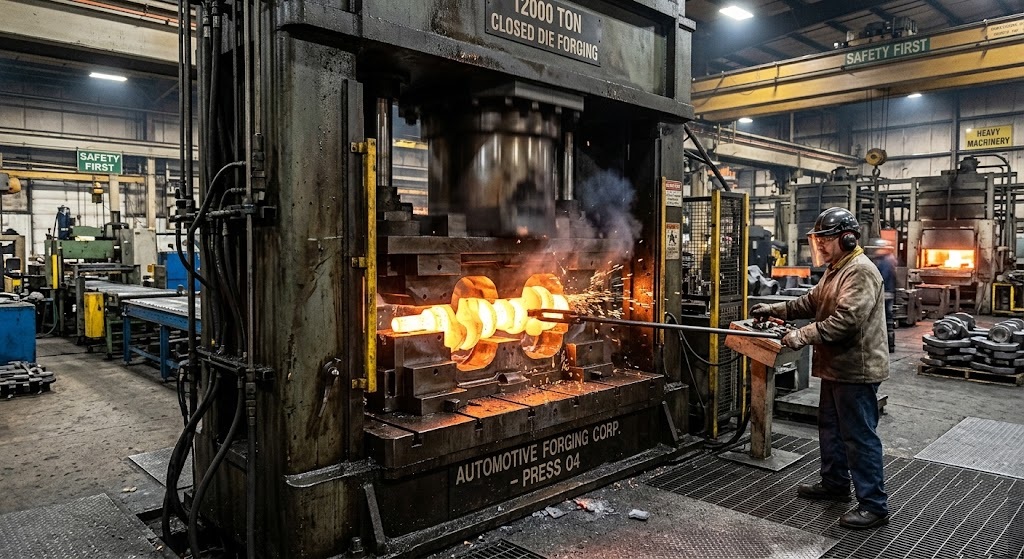
The automotive manufacturing industry depends heavily on closed die (also referred to as impression die) forging. The exact nature of closed die forging is that it is an advanced metal forming technique which produces components by heating metals in the presence of precisely designed forging dies. A close die forged part exhibits high strength and structural integrity with accurate dimensions. The desire by the automotive industry for durable, lightweight and high performance components has made closed die forging a mainline method for producing components that are critical to the operation of an automobile.
What is Closed Die Forging?
Closed die forging is completed when metal billets are set between two matching dies containing a pre-shaped hydraulic cavity. The billet flows into the cavity and then fully conforms to the shape of the die as the compressive force is applied.
Closed die forge helps minimize the amount of material damaged when forge, resulting in superior grain structure alignment and mechanical properties of the final product.
Additionally, closed die forge has tighter tolerances, better surface finish characteristics and higher repeatability than open die, making it more suitable for high volume production in the automotive industry.
Importance in Automotive Manufacturing
There are many cases in which automotive parts suffer from harsh working circumstances due to constantly heavy loads and vibration along with large changes in temperature. Because of these factors a high strength and reliable product is critical for automotive parts. Closed die forging creates a refined grain structure with few, if any, internal defects; therefore, the mechanical properties produced via closed die forged components will always exceed expectations. Closed die forging is a popular process to produce automotive parts; however, there are many different applications that use closed die forging to produce critical parts. Some major examples are crankshafts, connecting rods, gear blanks, axles, steering knuckles, and transmission components. All of these applications are produced using closed die forging to provide high strength, exceptional fatigue resistance, and long-term durability, therefore producing an exceptional closed die forged product.
Advantages of Closed Die Forging in Automotive Applications
Closed-die forging offers numerous benefits for the manufacture of automotive components. Each piece of closed die forgings is manufactured by aligning the internal flow of the grain structure of the metal with that of the shape of the finished product. This improves the fatigue resistance (the ability to resist being fatigued) of parts that will be used in applications where they are subjected to a continuous amount of forcing. Furthermore, precision dies are used in this process to ensure that all pieces manufactured to a desired size and dimension have a high level of quality. Additionally, this high level of quality greatly reduces the amount of secondary machining required and produces very little wasted material (in the form of recycleable flash), making closed die forging a cost-effective and sustained method to manufacture automotive parts. In addition to this, the closed die forging process produces a higher-quality surface finish that enhances the performance characteristics of the finished component and reduces the amount of additional processing that will be necessary. Due to the high level of repeatability found in closed die forging, this manufacturing process is well-suited for large volume production in order to satisfy the volume demands of the automotive manufacturing industry.
Materials Used in Automotive Forging
Closed die forging can provide a wide variety of materials that are commonly used in the automotive industry and that allow for flexibility to meet individual requirements for performance. A few of the examples of commonly forged materials are carbon steel, as a low-cost material with strength; alloy steel (due to improved mechanical properties); stainless steel, as a material with resistance to corrosion; alunimum alloys in order to make lightweight parts; and titanium for high-strength, high-temperature, and high-performance components. Based on the functional need of each part, the supplier of the material will analyze the necessary characteristics of the material such as strength, lightweight, durability, corrosion resistance, and thermal stability in order to obtain the best possible performance in the automotive environments in which they will be used.
Role in Lightweight Vehicle Design
As the world moves forward to become more eco-friendly by using less fuel and putting out fewer pollutants, auto makers are making lightweight parts from new materials and technologies. One way manufacturers build these new light weight parts is through the use of closed die forgings, which allow for the creation of high strength components that also utilize advanced metal alloys such as aluminum. Lightweight forged parts help increase fuel economy (less fuel burned equals lower emissions) and improve vehicle performance; and provide an added benefit of not sacrificing safety in vehicles.
Technological Advancements
Modern technology has made the closed die forging process a lot more sophisticated in terms of both accuracy and efficiency. Today, closed die forging company can use advanced computer-aided design (CAD) and simulation software to create efficient die designs before they actually produce them and also analyse how well the material flows through the die before they start to manufacture it. This helps reduce errors and helps them get die designs developed faster than ever before.
Automation and robotics have increased consistency, speed and safety in the workplace of forging and CNC machining has allowed for accurate finishing of forged components to meet tight tolerances. Additionally, real-time monitoring helps create a continuous quality control system by tracking process parameters and notifying operators when there is a deviation.
By working together, these technological developments provide the means to lower defect rates, remove bottlenecks in a production process, and develop a product at a consistent high quality in the manufacturing of components for automotive.
Challenges in Closed Die Forging
There are a number of benefits to closed die forging, however, there are also a number of challenges associated with the process that need to be addressed in order for manufacturers to produce efficiently and produce high-quality parts. One of the primary challenges is the high initial investment necessary for tooling and tooling development (die and tooling design requires complex designs to create precise component geometries), which will require highly skilled technicians and engineers to run operations, develop process parameters and manage the quality control process. Dies too may have wear from high pressures / temperatures which means that there is a requirement for continual maintenance and replacement for dies. However, manufacturers tend to experience that the longer-term benefits (e.g., increased component durability, consistent production quality, capacity to conduct high quantity productions, and increased operational efficiency) far outweigh any short term inconveniences or problems related to closed die forging process.
Quality Control and Standards
The rigorous manufacturing processes used to produce closed die forged automotive parts must adhere to extremely high levels of quality and safety in order for these automotive components to be used in high-performance applications. To establish the ability of closed-die-forged automotive parts to provide dependable performance in extreme performance applications, the producer has put an extensive series of inspection and testing methods into effect as part of their quality assurance program; among them are non-destructive testing (NDT) methods intended to identify internal defects, dimensional inspections to determine that the components conform to the tolerances and requirements of both dimensional specifications and accuracy, mechanical properties testing to determine the mechanical properties of strength and durability, and metallurgical analysis to ascertain the material structure and chemical/physical composition of the material used. These quality control procedures enable manufacturers to ensure that their closed die forged automotive parts will be able to function in conditions of high demand (e.g., high stress, substantial temperature changes, and repetitive loads over a period of time) and will provide continuing performance characteristics for a longer duration than any other type of closed die forged manufactured components used within automotive systems.
Future Trends
Closed die forging will dictate the direction of automotive manufacturing with a continued emphasis on innovation and sustainability. Industry 4.0 technologies and the adoption of automation, real-time data monitoring and smart manufacturing are being utilized by manufacturers throughout the supply chain to improve operations and increase productivity. In particular, the growth of electric vehicles is driving a significant increase in the demand for precision forged components such as motor shafts, battery housings and advanced drivetrains which is leading to improvements in closed die forming technology. The use of lightweight, high-performance materials continues to increase in order to produce fuel-efficient and high-strength parts for vehicles and an emphasis on energy-efficient forging methods and developing environmentally friendly recyclable materials is also seen as an important part of the industry’s reduction of environmental impacts on production.
Conclusion
Closed die forging is an important manufacturing technology and method for producing high-quality automotive parts. Its benefits of producing reliable, durable and precision automotive components make it an excellent choice for all aspects of automotive manufacturing. As the technology continues to mature and be adopted by the automotive industry, closed die forging will also continue to experience technological advancements in order to provide greater durability, efficiency and scalability while addressing automotive design challenges such as use of lightweight materials, high-performance vehicles and developing sustainable solutions for future vehicles.