
A few years back, I was on the factory floor in Pune. Such heat that it feels like a punch when you get it stepping out of the office. We had a big export order of high precision automotive parts. The customer was a Tier-1 supplier from Germany and they sent an inspector for a surprise inspection. Up to the testing bay everything seemed fine. One of the steering knuckles that we sourced from a mid-level local shop that we tried in order to save on lead times, failed a grain flow analysis. The contract for $2 million started to falter.
See, the part wasn’t “bad” in the usual sense; it was just not up to the mark. And in the global forging market, where Indian manufacturers are competing with the best of Europe and Japan, “average” is basically a death sentence for your reputation. This is when I got that just knowing a Top 10 Forging Company in India is not about looking at a balance sheet or a glossy brochure but understanding who really is making the difference in metallurgical excellence and process innovation.
Frankly, choosing a sourcing partner in India’s industrial expanse is a bit like a Spiti Valley winter expedition, full of thrills and prospects but one mishap in quality and you are left in the cold. You need a guide. This guide is the map.
The Strategic Landscape: Why India, Why Now?
India has been a global forging sector powerhouse for quite some time, even if it has been quietly rumoured (well, maybe not so quietly anymore). We are not just talking about hammering hot metal anymore. It is about Rajkot Investment Castings and large forging hubs in Tamil Nadu and Maharashtra that supply the world’s aerospace, defense, and EV industries.
The government’s encouragement for local manufacturing, you have probably heard the “Make in India” tag lines, has really turned into increased power. We are witnessing the replacement of simple low-value components by complex, “net-shape” forgings that necessitate zero-defect manufacturing. If you are a head of procurement or a business owner, you are likely to reach out to a Top 10 Forging Company in India for that unique combination of cost-effectiveness and world-class engineering.
The Innovation Pivot
The top-dogs have the parts co-engineered with the customers rather than being mere order followers. I think this is where most international buyers get the “aha!” moment. They realize that the first-class Indian companies are:
- Using simulation software to forecast metal flow even before the first die is cut.
- Reducing weight which is very important for the EV market where every saved gram contributes to more battery range.
- Doing material science to be able to work with alloys that can withstand the extremely high pressures in the engines of aircraft.
The 5 Pillars of a Top-Tier Forging Partner
While considering a Top 10 Forging Company in India don’t just ask “how much?” Also ask “how?” Here’s the way I slice and dice the process when I’m helping with a B2B sourcing strategy.
1. Technical Capability & Press Capacity
Many people overlook the physical capabilities of a plant you might be surprised (or maybe not) that this happens quite often. Is this enterprise capable of handling your maximum-size parts with the hammers or the screw press present in the plant?
- Closed-Die Forging: Is the perfect method for making high volume, very precise parts.
- Open-Die Forging: Is more suitable for huge, structural components.
- Ring Rolling: If you are doing your business in the wind energy or bearing sector, this is a must-have for you.
2. Metallurgical Excellence: The Invisible Guard
I spoke about that grain flow failure in Pune. This happened because the “cheaper” supplier did not have a highly sophisticated heat treatment process. The leader of the industry will definitely have a NABL-accredited laboratory inside the plant. They must be able to demonstrate the exact ways they control the cooling rates to get specific levels of hardness and tensile strengths. If they outsource their heat treatment… Well, let’s just say that’s a red flag in my eyes. It is about ensuring the quality chain of custody.
3. Export Experience and Global Compliance
Being present and running a business in India is one thing; transporting goods to Detroit, Stuttgart, or Tokyo is quite something else. Most companies ranked as Top 10 Forging Company in India will have around 30-50% of their revenues coming from exports. So why is this important to you? Because it shows that they understand the language of global standards:
- IATF 16949: Automotive quality gold standard.
- AS9100: If aerospace is your thing, then it’s a must have.
- ESG Compliance: More and more globally, OEMs refuse to deal with a supplier who doesn’t have a clear plan for carbon reduction and ethical labor practices.
- Speed to Market The X Factor
Later comes trouble when timing slips away unnoticed. Seen it happen – projects frozen mid-air thanks to waiting on tools. Some shops shape metal fast, pulling designs straight from computers using precision cutters, done in days instead of long waits. Quick work isn’t just nice – it tilts the game in your favor. When someone drags feet on a test model, picture how slow they’ll crawl during real builds.
5. Financial Stability & Scalability
Forging is a capital-intensive business. You want a partner who is reinvesting their profits into new technology, automated robotic arms, energy-efficient induction heaters, and AI-driven inspection systems. A company that is financially struggling is a company that will sooner or later be cutting corners on your material or your inspection.
How to Do a Virtual Audit
True, hopping on a plane to Rajkot or Chennai every time isn’t practical. Yet watching how things unfold online paints a clear picture. For your upcoming chat, consider these points one by one – slowly
- Start by requesting actual rejection data. Most companies claim perfect quality. Seek out their PPM numbers – both inside and outside – for recent years. Zero means dishonesty. Below fifty? That signals top-tier performance.
- See it live instead of slides. Have the sales engineer grab a phone and walk the shop floor. Watch how tidy things are. Check if scrap gets sorted right away. Notice whether staff wear full safety gear. Clutter down there often points to bigger issues behind the scenes.
- Start by looking at their past work with big names. Who among top manufacturers have they stuck with for over half a decade. Loyalty to firms such as Tata Motors tells its own story. Long runs alongside giants like Mahindra signal quiet strength. Staying power next to heavyweights including Caterpillar speaks louder than claims ever could.
The Pricing Paradox Why Cheap Isn’t What It Seems
Here’s what nobody wants to mention: price. Sure, India offers low rates. Yet when one of the leading ten forging firms there bids thirty percent under rivals, it looks tempting – actually, it spells trouble. That gap? Not savings. A warning sign showing up late at night.
Costs in forging split about like this:
- Steel makes up most of the cost – around half to three-fifths. Its price swings worldwide. When it feels too cheap, think: did they go for top-grade billets or melted-down leftovers reshaped later?
- Burning through vast amounts of electricity is what happens when steel hits 1200°C. Power needs to climb fast at that temperature point.
- What sets a leading company apart shows up in how they handle labor and costs.
A top-tier company saves you money not by being “cheap” on the part price, but by reducing your TCO (Total Cost of Ownership). Think about it: fewer assembly line stoppages, no emergency air-freight costs to replace defective parts, and components that actually last as long as they are supposed to.
Key Takeaway: When sourcing from a Top 10 Forging Company in India, you are paying for the peace of mind that your supply chain won’t snap when the pressure is on.
What Comes Next for Indian Forging?
Staying ahead means watching where those businesses head next. Right now, the field finds itself caught in a sweeping shift toward digital.
- Out of nowhere, sensors pop up inside a massive 5,000-ton forging press – watching every move. When something starts slipping, warnings go out ahead of breakdowns. Indian manufacturers now treat these early alerts like routine practice. Machines talk. People listen.
- Green Forging: From oil-fired furnaces to electric induction heating is a huge step in sustainability. It’s cleaner, more precise, and better for the planet.
- Some firms look at 3D printing to handle tricky molds. Instead of traditional methods, they test building layers on top of forged pieces using special materials. This mix brings new shapes into reach while keeping strength where it matters most.
Final Thoughts on People
People make business go around. What stands out? Leaders who live for what they do – that’s what sets top Indian forging firms apart. Not just moving steel, but solving problems one piece at a time.
Whether you require high-precision Investment Castings or heavy structural forgings, the goal is the same: partner with a company that cares about your brand reputation as much as theirs. Do your homework. Dig deep into metallurgy and compliance.
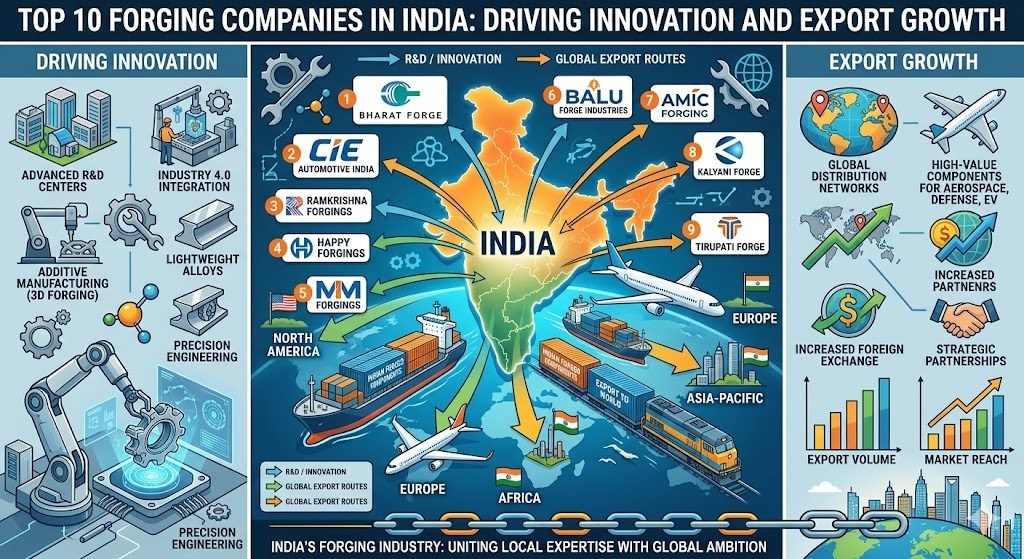
India’s forging industry is rapidly fostering global innovation and export expansion. Investing in a Top 10 Forging Company in India means you are not just purchasing a component but gaining access to an incredibly vibrant manufacturing ecosystem.
Build something enduring now.
FAQ: Sourcing from India
Q: How do I verify a company’s claims about being “Top 10”?
A: The ranking information is usually available from trade organizations such as the Association of Indian Forging Industry (AIFI) or export award winners from EEPC India.
Q: Is it difficult to manage logistics from India?
A: Not really. With major ports like Mundra and JNPT being world-class, supported by a robust network of 3PL providers, shipping a container of forgings to Europe or the US is as commonplace for these companies as domestic shipping.
Q: Can I get small-batch customization from a large forging house?
A: That really depends. Although the giants of the industry usually prefer high volume productions, many also have “Quick Response” cells or smaller subsidiaries that are specially equipped for low volume, high complexity work. Do ask!