
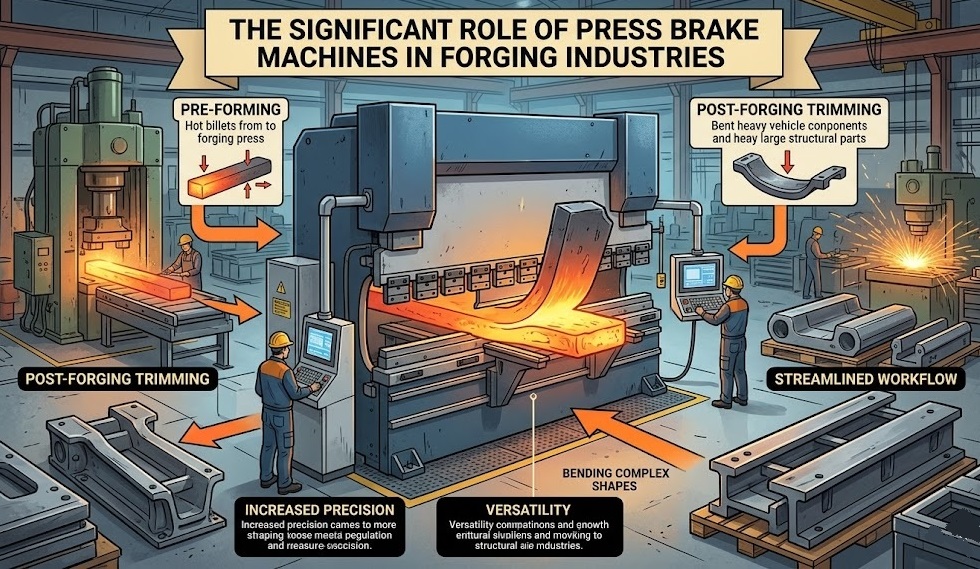
CNC press brake machines have revolutionized the forging industry by providing manufacturers with the means to accurately bend and shape metal products with a high degree of precision, repeatability and consistency to produce products with uniform dimensions and angles. Press brakes are a common machine used in the automotive, construction, railway, aerospace and heavy engineering industries, and are capable of bending very large and thick material, material with high levels of strength, producing very little waste while maximizing product output. With modern advanced CNC controls, top Press brake manufacturers now have the ability to fully automate, repeat and rapidly manufacture complex forged parts with improved accuracy, less labour, better finishes and at more economical prices for both large quantities and for custom fabrication.
What is a press brake machine?
As an industrial metal-working device, press brake machines are used to bend and shape sheet metal at high precision with the use of a punch and die. The punch pushes the metal plate into the die where it will be formed into the specified angles needed for the production of the parts. The press is highly versatile and is used in industries such as forging, fabrication, automotive, construction and heavy engineering because it can produce consistent results, increase productivity, and perform efficiently over a range of simple to complicated metal bending activities.
Essential components of press brake machine
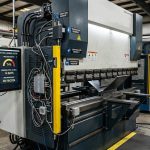
A press brake consists of several important parts; these are the frame, ram, bed, punch, die, back gauge, hydraulic or mechanical system and the CNC control. The function of the frame is to provide support to the machine, while the ram moves in an up and down fashion (i.e. perpendicular) to the frame providing bending force to bend the material.
The punch and die work in conjunction with each other to form the sheet metal into a specific angle or shape. The back gauge provides an accurate location for material placement in order to create accurate bends in the material. The hydraulic or mechanical system of the press brake generates the pressure necessary to bend the metal. With the advent of CNC programming, most new press brakes have CNC control systems. The use of CNC controls increases automation of the press brake, improves accuracy, improves repeatability, and increases the overall efficiency of the machine in metal fabrication and forging.
Working principle of press brake machine
Press brake machines work by providing a controlled amount of force to bend a sheet or plate of metal into a required shape or angle. While in operation, the metal workpiece to be bent is located in between the punch and die and upon the downward travel of the ram cylinder this movement is produced by either hydraulic, mechanical or servo-electric energy to push the workpiece into the die. The amount of charge applied and the depth of penetration causes the workpiece to bend at a specific angle or shape. CNC Press Brake machines execute the bending process using computerized controls that provide precise positioning, repeatability and accuracy, which allows them to be extremely effective in performing metal fabrication and forging processes.
Different types of press brake machine
The forging and metal fabrication industries utilize different kinds of press brakes depending on their needs and the amount they produce. Major categories include mechanical, hydraulic, pneumatic, servo electric, and CNC (Computer Numerically Controlled) press brake machines.
Mechanical press brake machines operate at very high speeds. Hydraulic press brake machines are more powerful, flexible, and precise in heavy-duty applications than mechanical. Pneumatic press brake machines are best for light bending applications. Servo electric machines offer energy-efficient and highly accurate performance.
CNC press brake machines are the most advanced press brake machine because they are fully computer-controlled and provide enhanced automation, repeatability for multiple operations, and ability to perform complex bends with maximum efficiency during production.
Application and uses of press brake machine
The press brake machine is often utilized within many different sectors as a method of bending and shaping metal sheets & plates (particularly used by forge and metal fabrication companies) while maintaining tight tolerances. Some applications include the production of automotive parts, electrical panels, railway components, construction structures, aerospace products, industrial machinery, and metal furniture. The press brake machine can also be utilized to produce custom-made products such as brackets, enclosures, frames, piping, etc. Due to their ability to create consistently accurate bends, complex shapes, and uniform dimensions; they are commonly considered necessary pieces of equipment across industries where strong, durable, and accurately fabricated metal parts are required.
Conclusion
Overall, press brake machines are necessary to the success of both forging industry today as well as the metal fabrication sector because of the ability to produce accurate bends, high precision, and efficient metal forming operations. The advanced technology of press brakes with CNC automatic production makes for increased productivity, decreased waste, improved quality of manufactured products. The wide variety of industries that use press brakes, such as automotive, construction, aerospace, railway, and heavy engineering, means that they are able to meet production needs for both large-scale and small-batch production of metal products that are durable, reliable, and cost-effective.