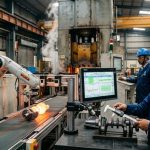


Modern industrial machinery operates under loading conditions that place enormous stress on structural metal parts throughout daily operation. Heavy commercial vehicles experience constant torsional loading across drivetrain systems, construction equipment absorbs repeated impact forces during excavation cycles, mining machinery operates under continuous vibration and abrasive environments, while energy-sector equipment functions under fluctuating pressure and temperature conditions for extended operating durations. In these demanding environments, the long-term reliability of mechanical systems depends heavily on the structural stability of the components carrying operational load.
This is one reason forging components continue dominating industries where fatigue resistance, impact strength, and mechanical reliability are more important than basic dimensional compatibility alone. Unlike cast or fabricated structures, forged parts develop directional grain continuity during compression, allowing the internal grain structure of the material to follow the geometry of the component itself. This directional orientation significantly improves fatigue performance, crack resistance, impact absorption capability, and load distribution under repetitive operational stress.
The importance of grain flow orientation has increased further as modern industrial systems become more compact while simultaneously generating higher torque, greater operating pressure, and stronger mechanical output. Components are now expected to operate longer under more severe conditions without increasing overall equipment weight.
A crankshaft inside a heavy-duty diesel engine may complete several hundred million rotational cycles during its operational life. Transmission shafts continuously absorb fluctuating torque. Steering assemblies experience repeated impact loading during rough-terrain operation. Under these conditions, even relatively small metallurgical inconsistency may gradually evolve into fatigue-sensitive regions capable of reducing component life.
Because of this, manufacturers producing advanced forging components now place enormous emphasis on controlled deformation, material-flow direction, thermal-process stability, grain refinement, and inspection accuracy throughout every stage of production.
Directional Grain Flow Changes the Structural Behavior of Metal
The primary structural advantage of forged metal comes from the way controlled compression alters internal grain orientation.
During forging deformation, the material flows under pressure while the grain structure aligns itself according to the geometry of the component. Instead of remaining randomly distributed, the grains elongate and follow the direction of operational load paths within the part itself.
This creates directional continuity that improves resistance against crack initiation and fatigue propagation during cyclic loading conditions.
Cast components behave differently because molten metal solidifies inside molds with relatively random grain orientation. Depending on cooling behavior and mold conditions, cast structures may contain porosity, segregation zones, or internal discontinuities capable of becoming stress-sensitive areas during operation.
The structural difference becomes especially important in high-load applications involving continuous stress exposure.
| Forged Component Application | Primary Operational Stress |
| Crankshafts | Rotational fatigue |
| Connecting rods | Cyclic tensile loading |
| Axle shafts | Torque transfer |
| Steering knuckles | Impact loading |
| Gear blanks | Surface contact stress |
| Turbine discs | Thermal fatigue |
In forged structures, grain orientation follows corners, fillets, load-bearing sections, and stress-transition regions more naturally. This improves stress distribution and reduces the probability of crack formation during long operational exposure.
The result is not simply higher strength values, but more stable mechanical behavior over extended service life.
Controlled Deformation Improves Internal Density
Grain flow orientation develops only when deformation remains properly controlled throughout the forging cycle.
During compression, hydraulic pressure consolidates the internal structure of the material while reducing discontinuities and improving density. If deformation remains insufficient, coarse grain regions or segregation zones may remain inside the structure. Excessive localized pressure may create unstable material flow and directional stress concentration.
Advanced manufacturing systems producing critical forging components therefore monitor multiple production variables continuously during deformation.
Key process variables commonly include:
- Reduction ratio
- Material-flow direction
- Press-load distribution
- Forging-cycle timing
- Die filling consistency
- Flash formation behavior
Heavy industrial forging systems commonly operate between approximately 3,000 tons and 12,000 tons depending on component dimensions and material grade.
Large drivetrain systems, industrial shafts, and heavy engineering parts often require stronger compressive loading because higher deformation pressure improves grain consolidation and structural continuity throughout the component.
This becomes particularly important in applications where components remain under repeated torsional or dynamic loading conditions throughout operation.
Material Chemistry Influences Grain Stability
The effectiveness of grain flow orientation depends heavily on raw-material consistency before forging even begins.
Small fluctuations in carbon percentage, sulfur concentration, alloy balance, or phosphorus content may later affect grain refinement, hardness response, thermal stability, and fatigue performance.
Advanced manufacturers producing forging components therefore maintain strict incoming raw-material verification systems before billets enter production.
Modern material validation commonly includes:
| Verification Method | Operational Purpose |
| Spectrochemical analysis | Alloy verification |
| Mechanical testing | Strength validation |
| Inclusion analysis | Structural cleanliness |
| Heat-number tracking | Traceability control |
| Mill certificate review | Material accountability |
Common materials used in heavy-duty forged applications include chromium-molybdenum steels, carbon-manganese alloy systems, SAE 4140, SAE 4340, microalloyed steels, stainless steel grades, and heat-resistant alloy materials selected according to operational load conditions.
Material cleanliness becomes particularly important because non-metallic inclusions may later become fatigue-initiation points under cyclic stress exposure.
Manufacturing stability therefore starts with material control rather than final-stage inspection alone.
Billet Heating Stability Directly Affects Grain Refinement
Thermal control during billet reheating strongly influences how the material behaves during compression.
Uneven heating changes deformation stability and affects the way grain refinement develops during forging. Overheated regions may produce coarse grain growth while colder areas resist material flow and create localized internal stress concentration.
Manufacturers producing high-performance forging components increasingly use digitally monitored reheating systems capable of maintaining stable thermal distribution across the billet section.
Depending on alloy composition and component geometry, billets are commonly heated between approximately 1,100°C and 1,250°C before entering forging presses.
Large billets often require extended soaking periods because internal temperature stabilization becomes essential for maintaining uniform deformation throughout compression.
The heating stage influences multiple structural variables simultaneously:
| Thermal Variable | Structural Effect |
| Uniform heating | Stable deformation |
| Controlled heating rate | Better grain refinement |