

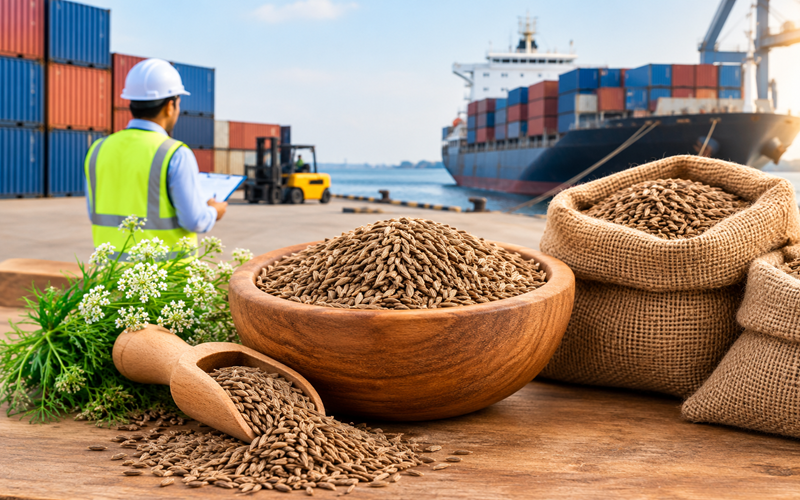
A few years back, I was attending a very important procurement meeting with a multinational food processing company. We were in big trouble. A very important consignment of spices from an overseas supplier was rejected at the rotterdam port in Europe due to non-compliance with pesticide residue standards. Production lines were about to be shut down. The financial penalties were being calculated every hour, frankly, it was a nightmare situation.
We were looking for a partner not only with the product but someone who could act at lightning speed without loosening the tightly controlled food safety regulations. In fact, under the immense pressure, we went ahead and met with top cumin seeds exporters in India. It was within a few days that they not just gave us the complete traceability charts and lab certificates; they also gathered a huge, compliant batch and prioritized the shipment. That was the moment when I understood it. I thought that the Indian market was no longer just a traditional market. It had silently made itself a highly sophisticated, well-technologically-driven industrial powerhouse.
Currently, India commands more than 70% of the global cumin market. But how? Is it just a matter of historical legacy or extremely low pricing? No, it’s something much more fundamental. Let us see the strategic, structural, and operational advantages that have established the Indian exporters as the undisputed leaders of the global spice trade.
1. The Agro-Climatic Monopoly: Why Geography is Destiny
You may copy the technology, and you may imitate business models. But you simply cannot replicate geography. Cumin, whose scientific name is Cuminum cyminum, is a very sensitive plant. It requires a very specific and precise climatic condition: a fresh winter first and then a dry, very hot summer with no frost or rains at the flowering stage.
The Unique Terroir of Gujarat and Rajasthan
Locations like Gujarat (especially around Unjha which is the largest cumin market in the world) and Rajasthan that have semi-arid climate and soil conditions, are absolutely perfect for cumin cultivation. Due to the combination of soil and weather, cumin seeds produced in these areas have very high levels of volatile oils usually ranging from 2.5% to 4.5%. This oil is responsible for the unique, strong aroma of cumin and its rich earthy taste that is highly sought after by global food brands.
Look at places like Syria, Turkey, or Iran. Their cumin production is good but factors like ongoing political turmoil, supply chain disruptions, and smaller farming areas limit their capability to provide large volumes consistently which India can do every year. When global buyers put forward requests for multi-ton, multi-year supply contracts, India is almost always the only choice.
2. Speed to Market: Turning Agility into a Competitive Weapon
For contemporary B2B commodity procurement, speed is not a thing merely to be measured, rather it is an enormous differentiator. Those who act early usually spot opportunities before others and are able to react to changes in the market before even minor logistical troubles get so large that the entire supply chain collapses.
Indian exporters have beautifully harnessed technology to bring down lead times drastically. Right from the moment the winter harvest reaches the local mandis (agricultural markets) in March, the process of turning raw agricultural produce into export-ready, containerised cargo happens at a breakneck speed.
To me, it appears that many global procurement managers still grossly undervalue the high efficiency of the Indian supply ecosystem. Major Cumin Seeds Exporters have developed backward integration models by working directly with Farmer Producer Organizations (FPOs). That means you pass through several middlemen and purchasing stages to get to the product. By automating routine documentation, using digitized customs clearance ports, and keeping buffer stocks in state-of-the-art warehouses, they are giving a speed-to-market advantage that other global competitors cannot match. Quick decision-making and fast delivery are not about rushing madly; they are about getting rid of systemic hesitation so that the effort results directly in seamless supply security.
3. The Quality Revolution: Navigating Global Food Safety Regulations
Let’s be truthful for a moment. The Indian spice business of old was not only known for pesticide residues but also for salmonella and heavy metal contamination. For example, European and North American regulatory authorities like the EFSA and USFDA have some of the strictest sanitary and phytosanitary (SPS) measures in the world.
However, this is the point where the Indian market turned out to be quite tenacious. Rather than resisting, first-rate Indian exporters invested greatly in an up-to-date food safety infrastructure.
Integrated Pest Management (IPM) and Traceability
The present-day Indian cumin trade relies heavily on continuous testing and responsible farming. Top exporters spend a lot of money on training farmers in Integrated Pest Management (IPM) which is a way to control pests with very minimal use of chemical pesticides.
Besides that, the use of a blockchain system and QR-code-based traceability makes it possible for a buyer anywhere in the world from Chicago to Frankfurt to track a bag of cumin seeds to the exact regional farm cluster in Rajasthan where it was harvested.
World-Class Processing and Sterilization
If you visit a high-end Indian processing plant today, you wouldn’t find manual sorting. Instead, you will see multi-million-dollar installations such as:
- Buhler Color Sorters: These are very advanced optical sorting machines that can detect and remove very tiny foreign particles, off-color seeds, and even stones at very high speeds.
- Steam Sterilization Plants: Unlike chemical fumigation or irradiation which are facing very heavy regulatory restrictions worldwide, Indian manufacturers use very advanced steam sterilization technology. This treatment efficiently decreases microbial loads and ensures a pathogen-free product without destroying the natural volatile oils.
- NABL-Accredited Labs: Multi-residue pesticides, aflatoxins, and sudan dyes are tested through in-house labs which guarantee that every batch complies with the relevant regulatory standards of the country of export before the container even leaves the Indian port.
4. The Scale Paradigm and Value-Added Customization
This is when the huge industrial scale of Indian processors becomes a factor. They are not just sending the raw commodity out of the country; they are also providing highly customized solutions.
- Machine-Cleaned vs. Sortex-Cleaned: Indian exporters are able to offer different purity levels of cumin, that start from 99% purity machine-cleaned cumin and go up to 99.5% or even 99.9% Sortex-cleaned grades, depending on the budget and the final product application of the buyer.
- Cryogenic Grinding: Normal milling generates heat and as a result, the precious aromatic oils get evaporated. In order to stop this, premium Cumin Seeds Exporters use cryogenic grinding machines. Liquid nitrogen is used to cool the grinding chamber to very low temperatures, freezing the flavor compounds of the spice and ensuring maximum freshness.
- Oleoresins and Essential Oils: For pharmaceutical, nutraceutical and high-end food products, Indian processors make pure cumin oleoresin and essential oils, which are highly concentrated liquid flavor forms offering enormous formulation flexibility.
5. Navigating the Price vs. Value Paradox: Sourcing Wisely
Pricing is a must discussion if you aim at the Indian B2B landscape, because here you will find a wide diversity of suppliers. If you ask for 50 metric tons of cumin seeds, you will most likely get a very large range of prices. Some unorganized local traders would offer you prices that look very cheap, probably 15% to 20% less than the prices of the established players.
You are naturally inclined to seize those cost savings. But believe me, in the spice trade, choosing the cheapest option is often the quickest way to destroy your brand’s reputation.
The Hidden Risks of Cheap Sourcing
A quote that is way below market means the exporter has to compromise in some areas. So, you can bet on that. Here are the three most frequent areas in which these compromises are made:
- Adulteration with Spent Seeds: Used or “spent” seeds are the seeds which have already been through the oil extraction process. They are indistinguishable visually from fresh seeds but they have no flavor, smell, or nutrients. Mixing these seeds with fresh ones is often how dishonest operators lower the cost per weight.
- Moisture Content Manipulation: The moisture content of cumin seeds must be under 9% for safe storage. Some dishonest suppliers leave the seeds at 11% or 12% so that they can add weight to the shipment. The consequences are a huge risk of mold, aflatoxin formation, and cake formation during the journey in a hot container.
- Inferior Packaging: Standard exporters pack their products in multi-wall paper bags, food-grade non-printed PP bags, or jute bags with high-micron inner liners. On the other hand, cheap suppliers use inferior packaging which breaks easily leading to product loss and contamination.
Choosing a partner is more than looking at just the price tags. Also, make it a point to ask your Cumin Seeds Exporters to show you the verifiable certificates of analysis (COA) indicating parameters like total ash, acid-insoluble ash, moisture content, and volatile oil content as per ESA (European Spice Association) or ASTA (American Spice Trade Association) standards.
6. Building Long-Term Strategic Partnerships
Sourcing should not be a scattered series of fragmented transactional wins. You need to find a company that continuously upgrades its operational capabilities so that you can confidently invest in your own upside.
The spice supply chain is getting changed in the way it is structured. Today, buyers are more inclined towards supply resilience, ethical sourcing, and carbon footprint reduction. Indian exporters, who are future-oriented, are responding to this challenge by growing sustainable farms, implementing fair-trade practices, and getting benchmarked globally in safety with BRCGS, FSSC 22000, and organic certifications (like USDA Organic, OneCert, etc.).
When you get a supplier who combines India’s unique agro-climatic gift with world-class automation, pristine quality assurance, and transparent communication, it means that you have not only found a supplier but also a strategic moat that will safeguard your product quality, delight your end consumers, and keep your business ahead of the competition.
Summary Checklist for B2B Cumin Procurement
Before signing your next letter of credit or purchase order, running through this quick operational checklist will ensure that you are partnering with the right caliber of global Cumin Seeds Exporters:
- Certifications: Does the exporter have active, verifiable certifications such as FSSC 22000, BRCGS, or ISO 22000?
- Quality Compliance: Are the batch pesticide residue levels compliant with those of the destination-market (e.g., in accordance with EU or USFDA mandates)?
- Technical Parameters: Are the volatile oil contents clearly indicated and moisture levels strictly maintained under the 9% threshold?
- Sterilization Method: Is the product treated with steam sterilization and is there a validated microbial reduction report available?
- Traceability: Can the exporter trace the shipment back to the regional farm or cooperative level?
India’s spice market is huge and highly vibrant. By demanding high quality and focusing on proper quality metrics as opposed to superficial price discounts, you can ride on India’s dominance in agriculture to build your global brand with complete confidence.