

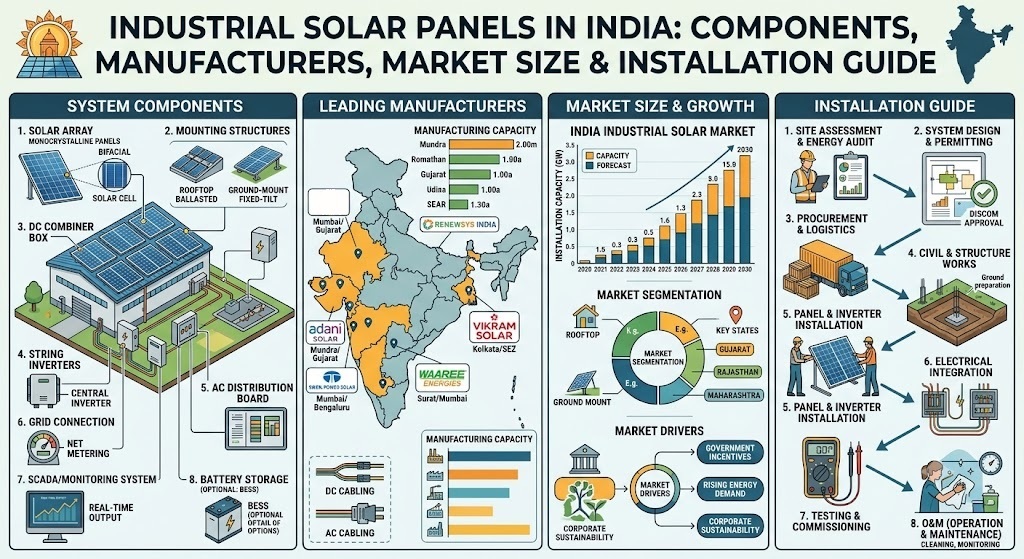
To produce clean electricity and reduce energy costs in industries, high power photovoltaic (PV) panels are set up at factories, warehouses, and manufacturing units, which are termed as industrial plants. There are many elements which together form a solar power unit including the modules, inverter, mounting units, DC/AC cables, transformer, combiner, protection devices, electrical supply, etc. The components for solar units are manufactured and put together by various companies including solar manufacturers, EPCs, PV cell suppliers, and solar inverter manufacturers.
Why do we need Industrial solar panel consulting?
Industrial solar energy consulting services bring expertise with solar technology to business owners and decision makers who want to go solar but have hesitations about making an investment in solar energy technology. Different industrial environments may have differing energy consumption needs and goals. Professional consultants assess electricity use, site conditions, system size and capacity, feasibility of financing solar equipment, government incentives, and legal considerations for determining the appropriate solar installation. In addition, expert consultants help businesses to choose the best quality equipment when it comes to solar technology and measure return on investment (ROI), installation problems, and how to maximize energy generated from solar.
Tips before availing Industrial solar panel installation services
A business should ensure that it checks the experience level, qualifications, and success rate of their solar panel installer in earlier similar projects before hiring their solar panel installation services. The organization should examine their engineering abilities, quality of the solar panels, inverter systems, mounting devices, and terms of warranties before starting the contract. Prior to signing the contract, one must request for a site assessment report, estimated power output from the solar power system, expected duration of the work, and breakdown of the cost of the project. Furthermore, businesses should make sure that the regulations by the local authorities, grid-related factors, and other benefits offered by the local government are reviewed. One also has to compare different proposals and understand various factors, such as expected ROI, maintenance support, and after-sales services.
Benefits of taking Industrial solar panel warranty
An industrial solar panel warranty ensures long-term coverage of one of the key investments in renewable energy technologies for a business. The warranty includes manufacturing faults, guarantees of performance as well as possible errors on the installing and workmanship fronts and reducing the chances of unplanned costs for repair or replacement. It ensures that solar panels consistently produce electricity with the required efficiency over many years of their use, usually 25 years or more. Due to warranty protection, companies receive the increased level of confidence in the reliability of their systems, reduced downtime, and greater protection of their return on investment. Using solar equipment supplied with strong warranties from the manufacturers and installers guarantees reliable power generation and stable performance of the installations during their life cycle.
How much Industrial solar panel installation cost in India?
The process and Industrial solar panel installation cost don’t just depend upon the capacity of the system, type of solar panel to be used, roof or ground installation, location, structural requirements, etc. Initially, commercial solar systems may cost anywhere between Rs 35 lakhs to Rs 5 crores or even more. Though the initial cost of investment may seem quite hefty, industries can earn back the cost by saving significantly on electricity bills and other utility bills. A precise energy appraisal is essential to gauge the right size and complete cost of a suitable solar energy plant for an industry.
Conclusion
Because reductions in electricity expenditures, increased energy security and long-term sustainability are significant goals for businesses, industrial solar modules are considered a wise investment to gain those objectives. In order to make knowledgeable decisions, businesses must understand key components of an industrial solar power solution, the role of manufacturers and solar EPC companies, market potential in India, and significance of professional consultation. By carefully assessing the providers of solar installations, choosing high-quality components with good manufacturer guarantees, and planning the finances wisely, the efficiency of the system and the potential return on investment could be maximized.