

Introduction
A pastry chef uses a vegetable peeler to scrape a dark slab and create loose, slightly uneven shavings which are added to a cake’s icing. Unplanned, these shavings are often more aesthetically pleasing than those produced by moulds.
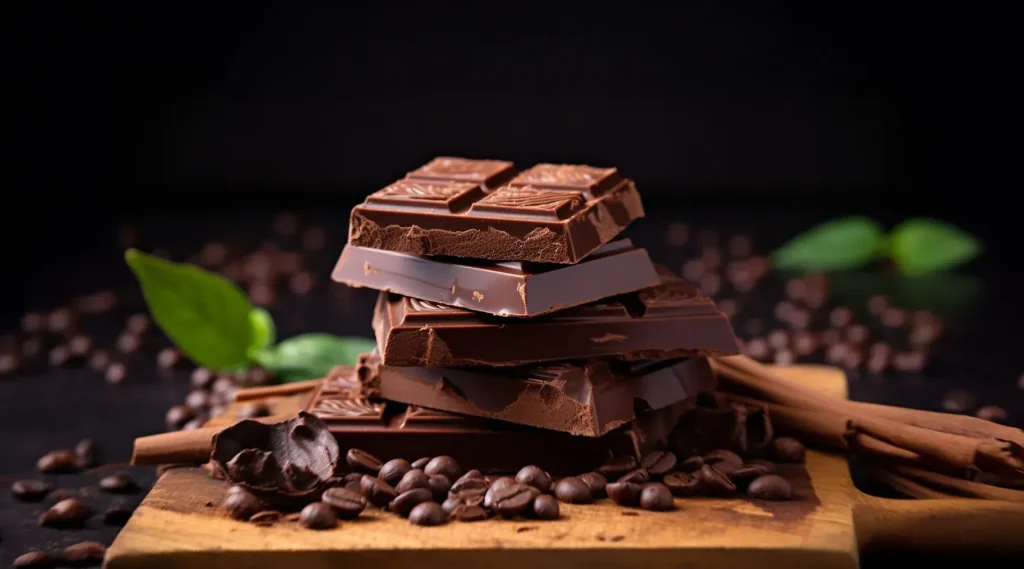
This one action highlights why dark slabs are commonly stocked in bakeries. They can be scraped, sliced, melted and/or used whole. Dark Compound Chocolate Slabs add to this versatility and can be adapted for use in fast-paced environments. Here, we discuss good and not so good applications for Dark Compound Chocolate Slabs. We also share ideas for maximising their potential.
Why Slabs and Why Compound
In terms of form, slabs are convenient and easily sliced. Unlike chocolate chips, they don’t run and unlike powders, they don’t clump. Pieces can then be removed and the remainder rewrapped.
Now onto the compound element. Compound chocolate is a combination of cocoa powder and vegetable fat. As a result, there is no need to temper it. Simply melt, apply and it will solidify with a reasonable sheen. For a small bakery without a tempering machine, this is extremely advantageous.
Cost is another plus. Typically, Dark Compound Chocolate Slabs are less costly than genuine couverture. This means staff can be encouraged to liberally decorate products without concern for the effect on profit. Innovation frequently occurs in this environment.
Shavings and Curls
Producing shavings is the easiest and most commonly misused application for slabs.
The slab must be at room temperature (on a mild day) – not too hot or it will become runny and not too cold or it will crumble. Holding a slab in a clean cloth stops your hand from melting it. Slide a peeler or sharp blade along the slab’s edge. Extensive, loose shavings are produced by a long, even movement. Shorter movements yield smaller shreds.
This is the classic use of Dark Chocolate Slabs for Cake Decoration. Shavings can be added to ganache ices, shreds can be sprinkled on cheesecakes and lengthy shavings can be pressed around the perimeter of a tiered cake using a palette knife. Dark chocolate provides a striking contrast to pale iced products. It also conceals minor imperfections in icing – something busy decorators will value.
Pro tip – scrape shavings into a dish. Then transfer them using a spoon or tweezers. Don’t use your fingers as this will leave finger marks.
Grating, Chopping and Mixing In
Whilst some slabs are for external decoration, many are for internal use.
Grated slab can be added to a liquid and fully integrated with no large chunks. Slabs can also be sliced using a heavy knife. Again, many bakers favour this method of cutting as it produces irregular sections. Not only does this give a home-style appearance, the different sized pieces also react in varying ways to heat. Some melt to form pools and others retain their form.
Dark Chocolate Slabs are well suited to being sliced and added to brownies, cookies, muffins and tea cakes. Add them late in the mixing process. Again, only a small amount is required. Where possible, ensure the slices are chilled as warm ones will become runny and cause the mixture to become discoloured.
As well as being sliced, slabs can also be used as an inner layer. Add them to a base before cooking and they will slightly sink in. This creates a chocolate ‘spine’ in a bar shaped product, for example.
Melting for Coatings
Compound chocolate really shines in coating applications. It can be melted in the microwave, in short intervals, or over a pan of just below boiling water. Continually stir the chocolate and once it has melted evenly it can then be used for dipping, drizzling and/or pouring.
Strawberries, biscuits, wafers, nuts and cake pops are all good candidates for dipping. As there is no need for tempering, a smooth coating can be achieved immediately – no lengthy learning curve is required. Hence, Dark Chocolate for Dessert Coatings is frequently seen in commercial bakeries. A line cook can coat one hundred items just as quickly as it would take to temper a single batch of real chocolate.
If the melted slab is too viscous, add a little neutral oil. However, do so gradually as only a small amount is often required to make significant changes.
Those in the trade who buy from a supplier such as Choconutri frequently comment on the good consistency of each delivery of slabs. Despite what people may recognise, this is in fact highly important. If a slab always melts in the same way, then no adaptation of processes is required with each new box of product.
Glazes, Drizzles and Moulding
Following melting, there are numerous further applications for slabs.
Warmth is key. Drizzle a melted slab and some oil mixture over a cake on a wire rack. The liquid will flow down the sides and form a glossy outer layer. Or, use a fork to drizzle narrow lines of melted slab and oil over tarts and doughnuts. Pipe small shapes from melted slab and oil onto baking paper. Allow to set and then use as decorations. Alternatively, pour a thin layer of melted slab and oil onto a tray. Allow to harden and then crumble into rough pieces. These can then be added to ice-cream or a display dessert.
Moulding is also enjoyable. Silicone moulds can be used to create bars, hearts, shells and mini cups which can contain fruit or cream. Even in a hurried environment, dark slabs produce smartly moulded products.
These are just a selection of the Creative Uses of Dark Chocolate Slabs. Most don’t require specialist equipment. Often, ideas stem from staff observing a slab and thinking of alternative applications. As already mentioned, teams working with Choconutri frequently discover that a single slab can be utilised in a variety of ways across a menu as it can be both grated, used for glazing and coated.
When Compound is Not Ideal
To round off, I will be slightly more candid.
Compound lacks the complexity of real dark chocolate. Should you be making a light product such as mousse or truffle where cocoa butter is important for the flavour as it melts on the tongue, compound will not provide such depth. Moreover, as the fat in compound acts differently, a traditional ganache recipe may need adapting. Again, a direct exchange for real chocolate may not be suitable.
There is also an issue regarding labelling. In some areas, if a product contains vegetable fat, then it cannot be labelled as chocolate and must rather be labelled as compound coating. Always check relevant labelling legislation. Incorrect labelling can lead to issues of much greater magnitude than poor flavour.
Therefore, Dark Chocolate for Dessert Coatings and decoration is perfectly placed. Compound excels at enabling products to be moulded, dipped, shaven and glazed. However, it is not as good at products where chocolate is central to the offering. Awareness of these distinctions ensures that menus are truthful and that clients don’t feel they are being deceived.
Furthermore, good quality Dark Compound Chocolate Slabs are not as uniform as is often thought. Manufacturers can use differing levels of cocoa, types of fat and degrees of sweetness. Always sample test products before buying in bulk.
Storage and Use
There are a number of steps that can be taken to ensure slabs, and therefore products made with them, are of high quality.
Store in a cool, dry place. An optimum temperature range is between 18 and 22 degrees. Excess heat causes slabs to soften. High humidity can cause a loss of sheen. Furthermore, as fats are odour absorbing, ensure that partially consumed slabs are well wrapped. Avoid storing them with pungent items such as onions as they will impart their flavour to the slab.
A white film may appear on slabs. Known as bloom, this is generally not a problem and frequently disappears when the slab is melted. However, if the slab is used as a whole product, then it is unsightly. Ensure that older slabs are used before newer ones. Include date information on opened packaging.
As with all fat-based ingredients, store slabs in a cool and fresh environment and ensure that they are well sealed.
Conclusion
Although unassuming, a dark slab sits on a shelf and waits to be scraped, sliced or melted. It can then be used for a huge range of applications including iced Cake Decoration, brownie inclusions, fruit and even tart coating – adding an air of luxury to otherwise plain products.
Whilst not requiring costly equipment, Creative Uses of Dark Chocolate Slabs are often the result of staff experimenting, analysing and retaining successful ideas. Dark Compound Chocolate Slabs facilitate this as they are tolerant of the expedient methods often employed in fast-paced environments. Choose a reliable slab and investigate its properties. Then allow it to inspire you. Inspiration can sometimes strike when using a peeler and enjoying a relaxed afternoon!