

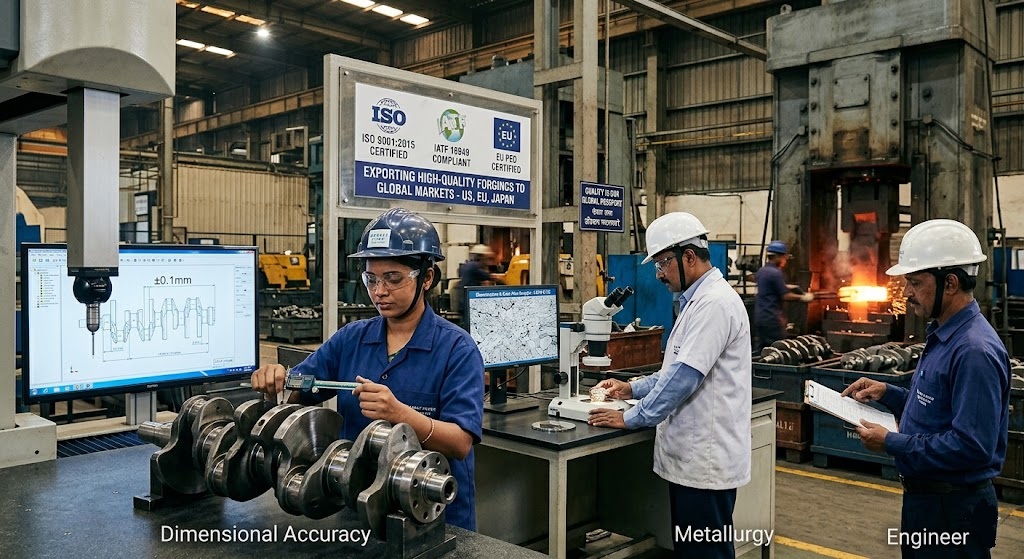
Forged components used in global industrial systems are expected to survive conditions that are far more aggressive than what older mechanical equipment handled twenty or thirty years ago. Heavy truck axle parts now face continuous torque fluctuation over millions of operating cycles. Railway couplings absorb repeated impact loading under variable temperature conditions. Oilfield forgings work under high-pressure environments where even minor metallurgical instability can slowly develop into structural failure after long service exposure.
Under such conditions, buyers no longer evaluate forgings through strength values alone. Modern procurement teams study dimensional consistency, grain refinement behavior, heat-treatment stability, inclusion control, inspection traceability, and compliance documentation before approving suppliers for long-term industrial programs.
This is why companies operating in the forging exporter India segment are under much greater technical pressure than earlier manufacturing generations. Export customers now expect forged parts to behave predictably not just during inspection but after years of rotational stress, vibration exposure, thermal cycling, and repeated mechanical loading.
The difference between an average forging supplier and a globally accepted exporter is increasingly determined by process control discipline rather than production volume.
Dimensional Stability Has Become a Critical Engineering Requirement
Modern industrial assemblies operate with tighter tolerances because machines themselves are running faster, carrying heavier loads, and generating more vibration than older systems.
A forged component may appear dimensionally acceptable during visual inspection while still creating operational problems later during assembly or continuous use. Slight eccentricity variation in a forged shaft can increase bearing load imbalance during high-speed rotation. Small flatness deviation in pressure-retaining flanges may create uneven sealing stress under thermal cycling conditions.
This is one reason advanced buyers sourcing from a forging exporter India manufacturer increasingly demand dimensional repeatability throughout the entire batch instead of isolated sample inspection.
Large gearbox systems, for instance, may require concentricity control within fractions of a millimeter because rotational imbalance at high speed gradually increases vibration amplitude across the system. Over time, even small geometric inconsistency affects bearing life, lubrication stability, and thermal behavior.
Modern forging exporters therefore combine forging operations with CNC finishing, coordinate measurement systems, laser dimensional verification, and digital inspection tracking instead of depending solely on manual measurement practices.
The objective is not merely producing the correct shape. The forging export objective is maintaining predictable geometry under real industrial operating conditions.
Grain Flow Engineering Quietly Determines Fatigue Resistance
One major advantage forged components hold over conventional machined or cast products lies inside the grain structure itself.
Casting solidifies metal independently within the mold cavity, which may create irregular grain orientation along with shrinkage zones or internal discontinuities. Machining removes material from larger stock without optimizing internal grain direction according to operational stress paths.
Forging changes the material differently.
During controlled deformation, the grain structure flows along the geometry of the component itself. This directional grain alignment significantly improves fatigue resistance under repeated stress cycling.
The effect becomes especially important in parts such as:
- Crankshafts
- Connecting rods
- Railway components
- Industrial couplings
- Heavy transmission shafts
- Suspension forgings
These components experience continuous stress reversal during operation. A small interruption in grain continuity can slowly become the starting point for fatigue crack propagation.
This is why advanced companies in the forging exporter India category spend substantial effort optimizing die geometry and deformation sequencing rather than focusing only on external dimensional formation.
Internal grain continuity often determines whether the component survives millions of operating cycles or fails prematurely under long-term service conditions.
Billet Heating Discipline Directly Influences Metallurgical Stability
The quality of a forging operation begins long before the metal enters the die cavity.
Improper billet heating creates uneven internal temperature distribution, which later affects material flow, grain refinement, and mechanical uniformity. Overheated regions may develop coarse grain structure, while underheated areas resist deformation and increase stress concentration during forging.
Large forging facilities therefore monitor billet temperature very aggressively during production.
Infrared thermal systems, controlled furnace zoning, and automated temperature tracking are increasingly used to maintain narrow thermal variation throughout the heating cycle.
For many alloy grades, temperature deviation exceeding even 20°C to 30°C during forging preparation can significantly affect final metallurgical behavior.
This level of thermal discipline is becoming common among serious export-oriented forging manufacturers because global customers increasingly evaluate long-term fatigue performance rather than short-term mechanical strength alone.
Forging Pressure and Deformation Ratios Matter More Than Many Buyers Realize
The mechanical superiority of forged components depends heavily on how the metal is compressed during deformation.
Insufficient deformation may leave internal segregation zones or incomplete grain refinement inside the material structure. Excessive localized pressure, on the other hand, can create internal strain concentration and directional weakness.
Advanced forging operations carefully control deformation ratios to maintain proper grain consolidation throughout the component.
Heavy industrial presses operating between 2,000-ton and 8,000-ton force capacities are now commonly used for critical industrial forgings because controlled compressive force improves internal density and reduces structural discontinuities.
This process becomes particularly important for forged components used under high-impact or cyclic load conditions where internal weakness eventually becomes visible through fatigue cracking.
Buyers evaluating suppliers from the forging exporter India sector increasingly study process capability instead of relying only on finished-part inspection reports.
Heat Treatment Often Separates Premium Forgings from Average Ones
Many forged parts appear mechanically strong immediately after forming yet still contain unstable internal stress conditions capable of reducing long-term durability.
Heat treatment corrects and stabilizes the metallurgical structure after forging deformation.
Improper quenching can create excessive brittleness. Uneven tempering may leave inconsistent hardness distribution across the component. Poor furnace circulation sometimes produces dimensional instability during cooling.
Because of this, advanced forging exporters operate highly controlled thermal processing systems capable of maintaining narrow furnace variation across large production batches.
Controlled heat treatment improves:
| Thermal Operation | Metallurgical Effect | Operational Benefit |
| Normalizing | Uniform grain refinement | Better structural consistency |
| Quenching | Increased hardness | Improved wear resistance |
| Tempering | Stress reduction | Higher fatigue stability |
| Annealing | Controlled ductility | Improved machinability |
For many export applications, hardness consistency is monitored within very narrow ranges because even small variation influences long-term mechanical behavior.
Surface Quality Directly Influences Service Life
Surface integrity affects forged component performance far more than many procurement teams initially assume.
Small laps, folds, surface tears, machining grooves, or scale pits often become the first locations where fatigue cracks begin developing under repeated loading conditions.
During cyclic operation, microscopic cracks originating at the surface slowly propagate deeper into the material structure until visible failure eventually occurs.
This is why advanced forging exporters place strong emphasis on surface conditioning and inspection after forging operations.
Modern inspection systems commonly include:
- Magnetic particle testing
- Ultrasonic examination
- Surface roughness verification
- Dye penetrant inspection
- Hardness mapping
- Dimensional contour analysis
The strongest companies within the forging exporter India category increasingly use inspection systems not only for quality certification but also for identifying process instability before large-scale production variation develops.
Compliance Requirements Have Become Extremely Detailed
Global industrial sectors now demand far deeper traceability compared to earlier export markets.
Railway systems, energy equipment manufacturers, heavy automotive programs, and oilfield applications increasingly require complete production history for critical forged parts.
Export forging companies now maintain records covering:
- Raw material heat numbers
- Furnace temperature logs
- Press force tracking
- Heat-treatment records
- Inspection reports
- Mechanical test results
- Batch traceability documentation
The purpose is not simply administrative compliance. Detailed traceability allows buyers to isolate process deviation quickly if operational problems appear later during service life.
This level of documentation discipline has become a major competitive factor in global forging supply chains.
One example of manufacturers operating within this increasingly demanding industrial environment is Sendura Forge, where export-focused forging capability aligns with modern metallurgical and dimensional expectations rather than traditional volume-based production alone.
Export Packaging and Logistics Quietly Affect Product Quality
Forging quality can deteriorate during transportation if packaging systems remain weak.
Large forged components moving across international logistics chains face vibration, moisture exposure, impact loading, and environmental variation during shipment. Improper packaging may create surface corrosion, dimensional distortion, or handling damage before the component even reaches the customer.
Advanced exporters therefore invest heavily in:
- Corrosion-resistant coatings
- Moisture-controlled packaging
- Custom pallet stabilization
- Protective machining covers
- Traceable shipment identification
Global buyers increasingly evaluate delivered-condition quality instead of production-condition quality alone.
Final Perspective
Export forging today operates under much tighter engineering expectations than earlier manufacturing environments where strength certification alone often satisfied procurement requirements.
The growing international confidence in the forging exporter India sector reflects major improvements across metallurgical discipline, dimensional precision, thermal processing stability, inspection systems, traceability management, and process repeatability.
As industrial machinery continues operating under heavier loads, faster rotational speeds, and longer service cycles, buyers are placing greater importance on forged components capable of maintaining predictable behavior under continuous operational stress.
The exporters strengthening their position globally are the ones reducing internal structural inconsistency quietly in the background while delivering forged components that remain mechanically stable long after production and shipment are complete.