

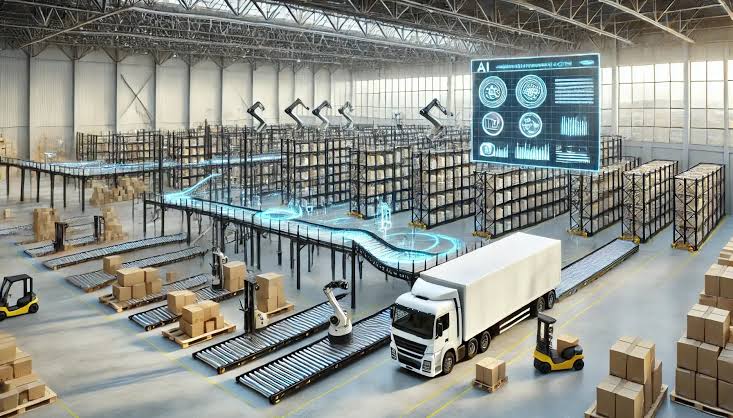
One of the most critical industries of today, the logistics industry is experiencing its biggest revolution yet. As the logistics sector is constantly searching for ways to ship products cheaper, faster and more efficiently, a shifting landscape of expectations from buyers, a surge in deliveries and more sophisticated supply chain processes present new challenges for logistics providers. Here is where AI and automation come into play.
AI provides the ability to process extensive operational data, to identify patterns, and to make better decisions; automation reduces the reliance on human effort for manual, repetitive activities. The impact of these technologies will be felt across a spectrum of activities – from warehouse operations and inventory planning to transportation and last mile.
Logistics Market Growth Is Encouraging Technology Adoption
According to Expert Market Research, the global logistics market was valued at USD 11.97 Trillion in 2025. The market is estimated to expand at a CAGR of 6.30% from 2026 to 2035 and is projected to reach USD 22.05 Trillion by 2035. While the market is increasing, the expanding scope of logistics activities and the rising demand for logistics are likely to lead companies to invest in technology.
For logistics vendors, technology is no longer a profit-laden extra; it’s a sensible solution to handle the rise in operational strain. AI and automation enable companies to cowl extra floor with information, cut back avoidable errors and coordinate actions between two factors within the provide chain.
Smarter Route Planning and Transportation
AI can be particularly effective in the area of transportation. A delivery route that is optimized with a rider’s schedules can still end up being much more difficult than anticipated due to weather conditions, road work, unanticipated delays, or even traffic. AI systems work with various data sources and can recommend how to adapt.
For fleet operators, the benefits of this could be more efficient routing and vehicle utilisation. Vehicles could be allocated to deals based on space and delivery time, rather than rigid routes.
These advantages could also impact way beyond just the delivery window. Improved routing could result in a more efficient use of mileage and fuel, which is imperative as logistics providers are required to deliver services at lower cost and reduce their carbon footprint.
Automated Warehouses Are Becoming More Common
Product distribution is also being affected by automation in warehousing facilities. A conventional distribution center usually relies on humans to find the product, pick and pack it, and move the inventory. Today, many of those logistics are becoming automated.
A robotic system that transports items within a warehouse automated storage and retrieval system that stores them systematically. Conveyor system and sorting technology that transports items efficiently through distribution centres.
AI is also helping to take this a step further – by assisting systems to determine where a product is to be located, or prioritise certain orders. Which can be especially helpful in large warehouses with thousands of products and orders a day.
AI Is Improving Inventory Management
Too much inventory adds to storage costs and too little can cause delays and missed sales. Having the “best” inventory – that magical optimal – has been a challenge.
AI can use past sales data, seasonal trends, customer patterns and other information to provide more accurate demand forecasts. This can help determine a potential level of inventory for specific locations and time periods.
This method allows logistics providers and retailers to make better replenishment decisions while, at the same time, decreasing the chances of items languishing in warehouses and allowing the items which consumers want to be available when they want to buy them.
Automation Is Changing Last-Mile Delivery
The last step of delivery is often one of the hardest parts of the entire logistics process. First of all, one of the most annoying steps of the distribution of individual parcels is to deliver multiple parcels to many different addresses.
And there are also ideas around automation and AI to make this process easier, with delivery management platforms that automatically allocate orders, route optimise, and give customers real-time updates.
These autonomous delivery vehicles, drones and delivery robots are being trialled in some markets. While adoption on a broad scale will take time and is subject to issues like regulation, infrastructure, safety and cost, this gives an idea of the future of last-mile logistics.
Real-Time Visibility Is Becoming Essential
More frequently than ever before, consumers and businesses want to have insight into goods at every point of its journey. Artificial Intelligence and the Internet of things enable logistics providers to offer increased visibility along the full transportation and distribution network.
Sensors, GPS, internet of things devices and cloud-based systems can gather data about products, vehicles, temperature, location and delivery status. AI can process all this data to determine if the delivery is experiencing a delay or other circumstances.
In some circumstances, this visibility can be especially valuable. Certain types of freight, such as those that are temperature-sensitive, need to be monitored at all times during shipping.
Predictive Maintenance Can Reduce Disruptions
Machinery All equipment, conveyors, vehicles and machinery used in your facility need servicing on a regular basis. Any unforeseen breakdown can have a negative impact on your business and lead to costly delays.
Predictive maintenance solutions powered by AI can collect data from equipment and can detect the early signs of a potential problem, ahead of a failure. Businesses can use this data to assess when equipment is likely to need maintenance – rather than traditional fixed schedules.
Having a well-maintained fleet of equipment can also assist in prolonging the lifespan of equipment, decrease the risk of unanticipated downtime, and increase the dependability of logistics activities.
AI Is Helping Logistics Companies Respond to Demand
Things can change rapidly with demand in the world of logistics. Out-of-season shopping, seasonal promotions, unanticipated events and modifications in a client’s behaviour can all impact shipment volume.
AI can be useful for spotting demand trends and getting resources ready. If a logistics provider has data for past months and years, the provider can plan ahead of a rate shift in order to set the required number of staff, vehicle, warehousing, and delivery capacity.
This responsiveness to changing demand could be especially helpful as e-commerce continues to reshape the demand profile.
Human Workers Will Remain Important
Automating more and more does not mean that logistics will be fully automated. Human activity is still vital for handling complex cases, taking decisions, exceptions, and those critical interactions with customers and suppliers.
Instead, automation can handle routine or strenuous tasks, freeing people up to work on jobs where human judgment is more necessary. The change could lead to a new type of worker for many companies-a data-oriented, digital-savvy specialist who knows the ins-and-outs of machines and their upkeep.
Training will thus be an integral part of technology adoption. Organizations require employees with a good knowledge of the logistics procedures as well as of the systems being introduced to advance them.
Sustainability Is Becoming Part of the Technology Conversation
Environmental issues are also playing a role in the acceptance of AI and automation in logistics. Organizations are seeking a plan to minimize fuel usage, transportation, empty space in trucks and power consumption in warehouses.
AI can also assist by optimizing routes, optimizing load planning, and aligning capacity and demand. Automated warehouse control can likewise lead to better space and resource utilization.
Technology will not be the solution to the environmental problems plaguing the logistics industry on its own but improved data and more efficient operations will enable companies to improve their performance in areas that can be measured.
The Future of Logistics Will Be More Connected
The logistics network of the future may be more connected than the traditional supply chain. Vehicles, warehouses, inventory management, suppliers, retailers, and customers will rely more and more on sharing data.
AI will be crucial in helping us make sense of the expanding data sets. Rather than documenting what’s already taken place, logistics systems will rely on data to forecast issues, suggest courses of action and optimize operations on the fly.
This provides a great setting for this technological shift to take place. Since the global logistics market is set to expand to USD 22.05 Trillion by 2035, bigger and more sophisticated logistics networks mean we require more efficient tools for their management.
Conclusion
The logistics industry is becoming more intelligent, aided by AI and automation by means of shifting it away from being process-centric to a more connected, data-driven space. Examples include warehouse robots, automatic sorting, predictive maintenance, intelligent route planning, demand forecasting and much more.
The end game will not necessarily be the logistics company that has automated the most. It is those that have applied technology where it will resolve real operational issues, while humans deal with issues that demand expertise, judgement and flexibility.
Much of the future adoption of AI and automation in logistics comes down to whether or not companies can combine their technology capabilities with the right people, trusted data, and optimized supply chains.