
The editing room has always been where filmmaking truly takes shape.
A camera captures moments, but an editor creates meaning. The difference between raw footage and a compelling film comes from thousands of creative decisions: choosing the right shot, controlling pacing, building emotional transitions, balancing sound, and shaping the story.
However, modern filmmaking has created a new challenge. Productions are generating more footage than ever before. Higher-resolution cameras, multiple shooting angles, documentaries, interviews, podcasts, and digital content have increased the amount of material editors need to manage.
The result is a familiar problem across the industry: post-production takes time.
While filmmakers have access to powerful editing software, a significant amount of an editor’s day is still spent on repetitive tasks such as reviewing footage, organizing clips, cleaning audio, preparing sequences, and creating first cuts.
Artificial intelligence is now changing this process.
AI video editing is not about replacing editors or automating creativity. Instead, it is becoming a way to make the editing process more efficient by helping creators handle time-consuming tasks while keeping creative control where it belongs: with the filmmaker.
Tools such as invideo Editor represent this shift by bringing AI assistance into the editing workflow, helping creators work faster while maintaining control over the final edit.
The Growing Complexity of Modern Film Post-Production
Film editing has always been a detailed process.
A professional post-production workflow involves several stages, beginning with organizing footage and continuing through editing, sound design, color work, visual effects, and final delivery.
Editors often move through stages such as assembly cuts, rough cuts, fine cuts, picture lock, color correction, and mastering before a project is completed.Â
Each stage requires a different combination of technical knowledge and creative judgment.
During an assembly cut, editors focus on bringing footage together and understanding the available material. During rough and fine cuts, they refine the structure, pacing, and emotional impact of the story. Once the picture is locked, teams move into finishing stages such as color grading, audio mixing, and final mastering.
The creative decisions involved in these stages cannot simply be automated. An editor needs to understand the intention behind a scene and how an audience will experience it.
However, many supporting tasks around video editing can be improved through AI assistance.
Why Traditional Editing Workflows Take So Much Time
The amount of footage created during production has grown significantly.
A filmmaker may return from a shoot with hours of material for a project that will eventually become a 10-minute sequence. Documentary filmmakers, for example, may work with dozens of interviews and hundreds of hours of recordings.
Before storytelling begins, editors must first understand what they have.
They need to identify important moments, locate strong performances, organize clips, and create a structure that supports the story.
This preparation stage is necessary, but it can consume a large portion of the post-production timeline.
AI is becoming useful here because it can help editors process information faster.
Instead of replacing the creative process, AI agents assists with the groundwork that happens before creative decisions are made.
How Artificial Intelligence Is Entering the Editing Room
The role of AI in filmmaking is expanding across different parts of post-production.
Rather than one single AI feature changing the industry, several smaller improvements are combining to create faster workflows.
AI-Assisted Footage Organization
One of the biggest challenges for editors is managing large amounts of footage.
Finding a specific moment in hours of recordings requires patience and attention. AI tools can assist by analyzing footage, identifying scenes, understanding spoken content, and making material easier to search.
For creators working on interviews, podcasts, documentaries, and educational content, this can significantly reduce the time spent reviewing footage.
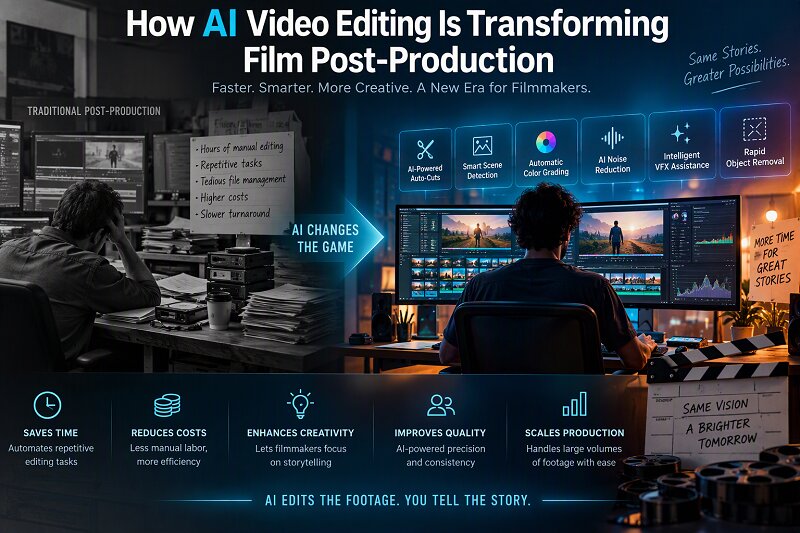
Modern AI editing workflows include capabilities such as transcription, scene detection, automatic captions, and content organization.Â
The editor still decides what belongs in the final story, but AI can make the search process faster.
AI-Assisted Editing and First Cuts
The first cut is one of the most important stages of any project.
It creates the foundation for the final story.
Traditionally, editors manually review footage and build an initial sequence. This process can take many hours, especially with long-form content.
AI-assisted editing introduces a faster approach.
Instead of starting completely from scratch, creators can use AI tools to help prepare an initial version of the edit. This gives editors a starting point that they can refine based on their creative vision.
The result is not a finished film created automatically. It is a more efficient beginning to the editing process.
AI Audio Enhancement in Post-Production
Audio quality has always played a major role in professional filmmaking.
Viewers may tolerate imperfect visuals, but poor sound can quickly affect the quality of a production.
AI-powered audio tools are helping creators improve dialogue and overall sound quality through features such as noise reduction, dialogue cleanup, and audio enhancement. Editor Feature List
For independent filmmakers and smaller production teams, these tools can make professional-quality audio workflows more accessible.
AI Support for Color and Visual Refinement
Color grading is one of the final stages where filmmakers shape the visual identity of a project.
Color choices influence mood, emotion, and storytelling.
AI-assisted tools can support technical aspects of this process by helping with tasks such as color matching, consistency adjustments, and visual enhancement.
The creative decisions remain with the filmmaker, but AI can reduce the time required for technical corrections.
The Rise of AI Agents in Video Production
One of the biggest developments in AI-powered creative tools is the move toward AI Agents.
Traditional editing software provides features that users operate manually.
AI Agents introduce a different approach. They allow creators to communicate goals and receive assistance with parts of the workflow.
For example, an editor may want to prepare an interview video and instruct an AI assistant to create a first version, identify important sections, or improve the structure.
This creates a workflow similar to working with an assistant editor.
The AI handles parts of the preparation process, while the human editor focuses on storytelling and creative decisions.
Where invideo Editor Fits Into the Future of Editing
The growth of AI-assisted workflows has created a new category of editing tools.
Unlike AI video generators that focus primarily on creating videos from prompts, AI-assisted editors focus on helping creators work with real footage and improve the editing process.
This is where invideo Editor fits into the modern post-production landscape.
invideo Editor is designed as an AI-powered editing environment where creators can work with their video projects while using AI assistance to speed up parts of the workflow.
The value comes from combining automation with control.
Creators can use AI assistance to reduce repetitive work while still making decisions about:
- Story structure
- Timing
- Visual style
- Audio choices
- Final presentation
For content creators, marketers, and independent filmmakers, this approach provides a balance between speed and creative freedom.
Understanding invideo Agent and invideo Editor
Although both are part of the broader AI video creation ecosystem, invideo Agent and invideo Editor serve different purposes.
Invideo Agent focuses more on helping creators move from an idea toward video creation.
It supports the early stages of production, where creators are developing concepts and building initial video projects.
invideo Editor focuses on the editing process.
It is designed for refining and improving video projects through an editing workflow.
The difference can be understood simply:
Invideo Agent helps create the foundation.
Invideo Editor helps shape the final video.
Together, they represent different stages of a modern AI-assisted production process.
How AI Is Helping Independent Filmmakers
Independent filmmakers often face the challenge of achieving ambitious creative goals with limited resources.
A small team may handle production, editing, sound, marketing, and distribution.
AI-assisted workflows can help reduce some of the technical workload.
A filmmaker working on a documentary, for example, could use AI assistance to organize interviews, identify important sections, and speed up early editing stages.
This allows more time to focus on the parts of filmmaking that require human creativity.
AI does not make filmmaking effortless. It makes more efficient workflows possible.
Will AI Replace Professional Editors?
The idea that AI will completely replace editors overlooks what editing actually involves.
Editing is not just cutting clips.
A great editor understands:
- Storytelling
- Emotion
- Timing
- Character development
- Audience attention
AI can identify patterns and assist with technical work, but it does not replace human understanding of why a story works.
The future of editing is likely to involve collaboration between creators and AI tools.
Editors will continue making creative decisions while AI helps reduce repetitive tasks.
The Future of Film Post-Production
The editing room of the future will likely look different from the traditional workflow.
Editors will still be responsible for shaping stories, but they will have more intelligent tools available to support their work.
AI may help smaller teams produce more ambitious projects. It may allow creators to experiment faster and spend more time on creative exploration.
The biggest change will not be that machines become filmmakers.
The biggest change will be that filmmakers gain more time to focus on filmmaking.
Conclusion
AI video editing is changing film post-production by improving the parts of the workflow that traditionally consume the most time.
From organizing footage to assisting with early edits, AI tools are helping creators move faster without removing the creative decisions that define great filmmaking.
invideo Editor represents this new approach by combining AI assistance with an editing environment where creators remain in control of their projects.
The future of filmmaking will not be built around humans versus AI.
It will be built around creators using better tools to bring their stories to life.