

For two years, Elena, who ran a small chain of specialty grocery stores on the outskirts of Chicago, had been wanting a smarter approach to answering customers’ inquiries in her mobile app, summarizing order notes for her employees, marking off any repeated complaints, and identifying a trend in what people were asking for before it became clear in a formal survey. Each time she took part in sending her customers’ data to a third-party AI service, she was charged a fee per customer request, and she would hope that her customers’ grocery preferences didn’t remain on someone else’s server for longer than they should. It’s all changed with the calculus this year, and it’s changed due to Apple’s actions on the platform, not anything a vendor sold her.
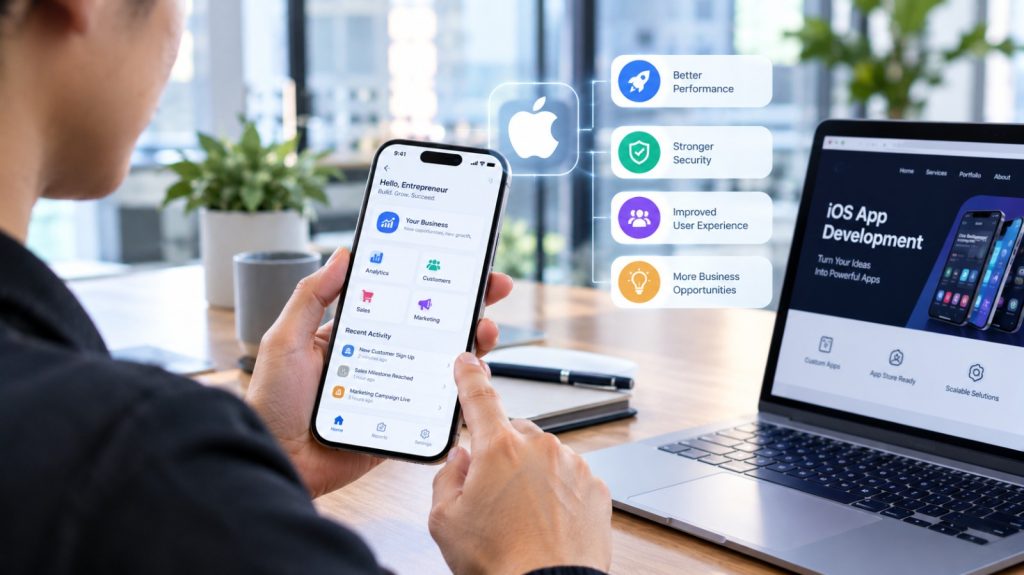
That shift is exactly why more businesses like Elena’s are now reaching out to an iOS app development company instead of assuming AI features mean handing customer data to an outside cloud service by default. Apple has opened its on-device Foundation Models, the same models powering Writing Tools and Apple’s built-in AI features, to third-party developers directly, which means an app can now run genuine AI processing locally on a customer’s phone instead of routing every request through an external API. For a business owner, that’s not a minor technical footnote. It changes what’s actually possible to build, what it costs to run, and how much customer data ever has to leave the device in the first place.
Why This Is a Bigger Deal Than a Typical iOS Release
Typical annual iOS updates often include minor enhancements and refinements, improved gestures, a revamped settings menu and a few other performance improvements that developers are aware of but users are hardly. This cycle, is not just degree, but in kind. The more significant update is hidden behind the version number of the new iOS and iPadOS, though: on-device language models are now a true, documented API surface that any developer can access and use, rather than a locked internal feature available only to Apple’s own apps. That one change impacts almost any type of business app, from customer service to logistics to healthcare, as it eliminates the two biggest pain points between a business and using an AI feature: the cost of the cloud API on each request, and the privacy risk of sending customer data off-device.
What On-Device Intelligence Actually Changes
Running a language model locally on a customer’s phone rather than in the cloud changes more than the privacy story, though that alone matters enormously for any business handling sensitive customer information. It also removes latency, since a request never has to leave the device and wait on a network round trip, and it removes the recurring per-call cost that made AI features a real ongoing line item on a company’s cloud bill rather than a one-time development expense. For a business like Elena’s, this means a feature that summarizes a customer’s order history and support notes on their own phone, instantly, without a single byte of that data touching Apple’s servers or a third party’s, and without a monthly bill that scales with how many customers actually use the feature.
Siri Just Became a Real Business Channel
Alongside the on-device models, Apple has significantly expanded what Siri can do inside a business’s own app through App Intents, the framework that lets developers expose specific actions to the system. Siri can now chain multiple steps across apps in a single request, and those actions can run in the background without the app needing to be open at all. A logistics company can let a customer ask Siri to check a delivery status and get a real, current answer pulled directly from the business’s own app, not a generic web search result. A service business can let App Intents handle appointment rescheduling entirely through voice, without the customer ever opening the app manually. Developers who build a solid App Intents integration now are positioning their app as a genuine participant in how customers interact with their phone by voice, not just a icon they tap.
Where to Actually Start Before Building Anything
Before any of this technology matters, a business commissioning a new build has to answer a question most skip past too quickly: which of these capabilities actually solves a real problem this business has, versus which ones sound impressive in a pitch deck. Any honest guide to custom iOS app development for businesses starts with that question rather than with a feature list, because Foundation Models genuinely help a business drowning in unstructured customer text, notes, reviews, support tickets, where summarization and pattern detection save real staff hours. App Intents genuinely help a business whose customers already ask Siri or a voice assistant to handle routine tasks. Neither helps a business whose actual bottleneck is somewhere else entirely, a checkout flow that loses customers halfway through, an inventory system that doesn’t talk to the point-of-sale terminal. The platform capability is only valuable in service of a specific, identified problem, and the businesses getting real value out of this iOS cycle are the ones that started with the problem rather than the feature list.
Hardware Reality Nobody’s Pitch Deck Mentions
Here’s the detail that gets left out of most vendor conversations: the most advanced Apple Intelligence capabilities aren’t universally available across every iPhone still in active use. They depend on newer hardware with enough on-device processing power to run these models locally, which means a meaningful share of a business’s existing customer base, especially any customer running an older device, won’t have access to the AI features a new build showcases in a demo. A serious development plan accounts for this split from the start, building a solid, fully functional core experience that works identically on every supported device, with AI-enhanced features layered on top as an enhancement for customers whose hardware supports it rather than a requirement the whole app depends on.
The Cost Conversation Looks Different Now Too
For years, adding any real AI capability to a business app meant budgeting for two separate cost lines: the development work itself, and an ongoing, usage-scaling bill from whichever cloud AI provider powered the feature. That second line item made AI features genuinely risky to commit to for a smaller business, since a feature that took off with customers turned into a cloud bill nobody had modeled accurately at the pitch stage. On-device Foundation Models change that math in a real way, since the processing runs on hardware the customer already owns rather than a server the business is paying for by the request. That doesn’t make custom iOS development cheap, integration work, testing across device generations, and building a fallback experience for older hardware still take real engineering time, but it does remove the part of the cost equation that used to grow unpredictably with a feature’s own success, which is exactly the kind of financial uncertainty that used to make smaller businesses hesitant to build AI into a product roadmap at all.
What This Means for the Competitive Landscape
The businesses most likely to benefit from this shift aren’t necessarily the largest ones. A regional chain like Elena’s, or a single-location service business, previously had to either skip AI features entirely or accept an ongoing cloud bill that ate into thin margins just to compete with larger companies that absorbed that cost more easily. On-device processing narrows that gap considerably, since the marginal cost of a customer using an AI feature drops close to zero once the app itself is built. That’s a meaningfully different competitive dynamic than the cloud-AI era created, where scale advantages tended to compound in favor of whichever business had the easiest time absorbing a growing API bill. A smaller business building a well-scoped, on-device AI feature today can offer something genuinely comparable to what a much larger competitor built at far greater ongoing cost, which is a rare moment where a platform shift actually narrows the gap between a small business and a much bigger one rather than widening it further.
Where the Real Opportunity Sits for Most Businesses
The businesses seeing the clearest early wins aren’t necessarily the ones building flashy AI chat interfaces into their apps. They’re the unglamorous cases: a supply chain company using on-device pattern recognition to flag disruptions before they cascade into missed deliveries, a healthcare practice using local text summarization to cut down on staff time spent reading through patient intake forms, a retail chain like Elena’s using automatic note summarization to catch a recurring complaint before it shows up as a wave of one-star reviews. None of these are the demo-friendly features that make a good screenshot. All of them save real time and real money in a way that shows up on a spreadsheet rather than in a marketing screenshot, which is usually a much better sign that a feature is actually worth building.
What Changed for Elena’s Stores
Elena’s app now summarizes customer support notes locally on each staff member’s phone, flags recurring complaints across locations without any of that data ever leaving her company’s own infrastructure, and does it without a recurring API bill tied to how many customers use the feature in a given month. None of that required convincing customers to adopt anything new or explaining a complicated privacy policy change, because the processing simply happens on the device already in their pocket. That’s the actual shift running underneath this entire iOS cycle, not a flashier interface, but a genuine expansion of what’s technically and financially possible for a business that isn’t a tech giant with its own AI infrastructure to fall back on.