

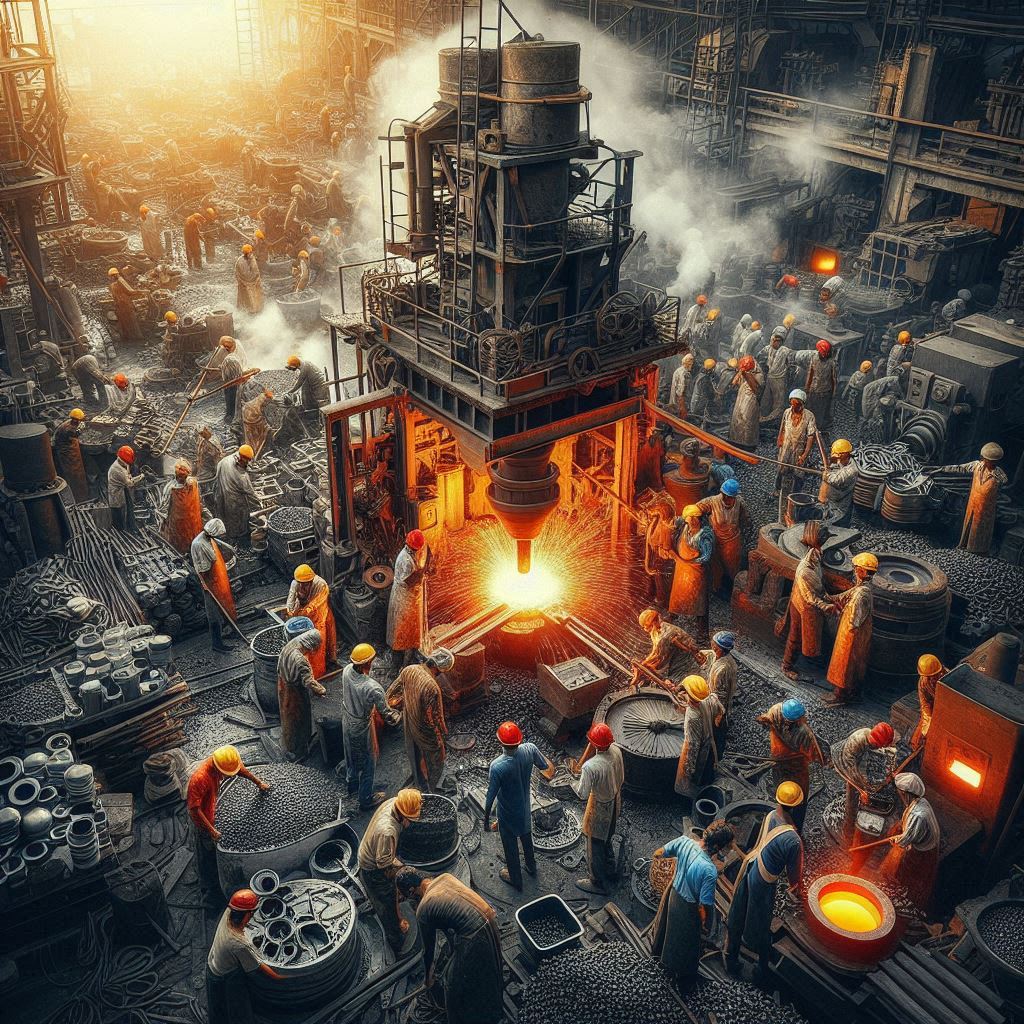
Accuracy, sophistication, and excellence: standards reserved for centuries by bespoke craftsmen are now leading mass buyers to lost wax castings manufacturers. No longer the legacy of millennia ago, lost wax casting is a contemporary precision masterpiece—a option advancing manufacturing where unparalleled refinement, material versatility, and surface superiority are paramount. This in-depth article demonstrates why visionary buyers prefer excellence over sheer mass.
The Unparalleled Precision of Lost-Wax Casting
Lost-wax casting involves making a wax copy of the desired final part type. Multilayered ceramic or investment shells are constructed around that fragile pattern, which is subsequently melted out—”lost”—and filled with molten metal. The outcome: parts whose surfaces, internal geometries, and thicknesses exactly reproduce the original wax, with little distortion. Unlike sand or permanent mold methods, rough surface finishes and dimension discrepancies—all too frequent elsewhere—are effectively eliminated.
Precision to within a fraction of a millimeter becomes the norm not the exception. Fine features—sharp edges, thin walls, hidden undercuts—are reproduced perfectly. In industries like aerospace, medical devices and complex industrial machinery this ability to replicate design intent is what sets lost wax casting apart. Buyers who need exacting tolerances know that secondary machining if needed at all is minimal—often just polishing rather than reworking.
Material Versatility That Other Processes Can’t Duplicate
Whereas most casting processes limit operators to choose alloys—die casting commonly confines manufacture to aluminum, zinc, or magnesium—lost wax castings manufacturers unlock the entire periodic table. Stainless steels, temperature-resistant nickel and cobalt alloys, titanium, aluminum, bronze, cobalt-chrome, and carbon steels are all options.
The ceramic investment shell withstands harsh temperatures and accommodates hostile alloys. That is, components can be designed for strength, corrosion, or temperature resistance, specifically to application requirements. This versatility allows buyers to seek innovation without compromise, taking advantage of advanced materials without losing shape complexity or finish.
Efficient, Streamlined Workflow and Near-Net-Shape Capability
Dimensional tolerance and surface finish are important, but what is productivity? Although lost-wax casting has a comparatively higher upfront cost—wax patterns and ceramic shells both take time and labor—the benefit is the minimal need for downstream processing.
In comparison to sand casting, where tooling is less complicated but finished pieces tend to require large amounts of machining, lost-wax casting commonly provides near-net-shape pieces that require minimal or no machining. Elimination of milling, turning, deburring, and grinding time saves money and reduces lead times and total manufacturing cost for intricate parts.
This benefit makes special appeal in medium-volumes of production runs. Customers get sophisticated parts in their hands, ready for assembly or installation, rather than raw blanks requiring subsequent finishing. For throughput-based environments where sophistication cannot be sacrificed, this compromise of up-front tooling intricacy in exchange for long-term productivity is extremely useful.
Superior Surface Finish Without Compromise
Surface texture is important. Aside from appearance, smooth finishes minimize friction, facilitate improved fluid dynamics, and simplify cleaning for sanitary or biomedical applications. Lost-wax casting by its nature produces surfaces much smoother than sand or permanent mold techniques.
The ceramic mold imparts a clean surface—usually requiring only polishing or minimal finishing. This is in sharp contrast to the roughness and grainy texture evident in sand casting, or the usual seams and flash lines that can occur with die or permanent molds. The outcome is parts that are functionally higher quality and cosmetically finer, optimally suitable for high-performance, high-visibility applications.
Consistency Across Batches, Even Without Large Volume
When people envision mass production, they tend to envision only huge factories churning out colossal quantities of simple parts. However, consistency is crucial even on moderate volumes. Lost-wax casting provides repeatability even when not in millions. Once wax patterns and ceramic shells are standardized, the same parts come out with little variation.
Each batch enjoys process stability. Quality control is easy to maintain; deviations are few. Buyers seeking dozens to thousands of parts—but demanding exact uniformity—profit one of a kind. They escape the sand-casting variability or die casting tooling limit. Precision is scalable without venturing into mass production extremes.
How Other Casting Processes Compare—and Why Buyers Turn to Precision
A better comprehension is found when lost-wax casting is pitted against the other prevalent processes—sand casting, die casting, permanent mold, and the more pertinent lost-foam or shell techniques.
Sand Casting: Cost-Effective, But Rough and Unreliable
Sand casting constructs molds with compacted sand around patterns. The method is inexpensive and supports large, heavy parts. Its lower tooling costs—making it a candidate for very large parts or where thick walls and coarse tolerances are okay—make it appealing.
But there is a compromise: surface finish is rough, dimensional tolerance is poor, and internal consistency is not consistent. Pattern wear and mold erosion produce rough surface and sporadic defects such as sand inclusions. Buyers requiring high repeatability, complex shapes, or smooth surfaces find sand casting to require extensive secondary finishing or redesign.
Die Casting: Rapid and Accurate, but Alloy-Constrained and Inflexible
Die casting forces molten non-ferrous metal under pressure into hardened steel dies. It provides superior dimensional accuracy, even surface finish, and fast cycle times—perfect when produce-thousands-of-parts-fast is the requirement.
But die casting generally limits customers to softer, low-melting-point metals and moderate part complexity because of gating and mold design limitations. Porosity may hinder heat treating or welding. Initial high costs for long-lasting molds demand justification by massive production runs. Customers requiring flexibility, complexity, or specialty alloys frequently find die casting too restrictive despite its rapidity.
Permanent Mold Casting: Stronger Than Sand, Still Limited
Permanent mold casting puts molten metal into reusable metal molds, stronger and better surface finish than sand casting. It’s good for moderate volume and decent accuracy.
Nevertheless, tooling is still expensive, and mold geometry limits complexity. Volume must be adequate to offset tooling expenses. Purchasers of very detailed, light-weight parts—or sharp internal details—find permanent mold techniques lacking compared to lost-wax casting’s expressive accuracy.
Lost-Foam and Shell Processes: Limited Alternatives with Limitations
Lost-foam casting, similar to lost-wax casting, employs vaporizing foam patterns. It supports complex geometries, but the friability of the foam, the expense of patterns, and porosity issues restrict its application largely to high-production volumes or simpler geometries.
Shell molding has a better surface finish than conventional sand casting with the use of resin-bonded shells. It can offer greater accuracy but cannot equal ceramic investment molds in either complexity or smoothness.
Purchasers always looking for the highest detail or least finishing find lost-wax casting singularly placed on this continuum.
Industry-Specific Advantages That Cause Buyers to Choose Precision
Precision is a global advantage—but lost-wax casting’s actual worth comes alive when designed specifically for certain industries:
- Aerospace: Engine components and turbine blades require tight tolerances, high-temperature alloys, and perfect surfaces—just what lost-wax casting provides without mass machining.
- Medical and Dental:Implants, surgical tools and dental prosthetics need exact dimensions, smooth finish and biocompatible metals—conditions sand or die methods rarely meet.
- Energy and Oil/Gas: Components in harsh environments—corrosive, high pressure and heat—benefit from high performance alloys and complex geometry; lost-wax casting provides that durability.
- Industrial Gear and Valve Equipment: Delicate housings, fluid-dynamic shapes, and thin walls are cast more advantageously than machined into form, conserving weight, cost, and time.
They illustrate why buyers more and more settle on precision in place of volume. The marginal cost at the expense of coarser approaches is worth it in performance, dependability, and swiftness to last installation.
Economics: When Precision Pays Off
Lost-wax casting, on the surface, can be more expensive. Wax pattern, ceramic shell setup, and longer cycle time add more per-part setup costs. However, there is more value upon closer inspection:
- Less secondary machining reduces labor and waste.
- Near-net shape reduces material usage.
- Improved yield saves scrap and rework.
- Better surface finish eliminates or simplifies finishing operations.
- Material flexibility provides value through performance improvement.
- Repeatability eliminates retooling expense over production runs.
Buyers conducting even modest volume runs realize these savings quickly. When factoring in engineering overhead, part longevity, and minimal finishing, the long-term economic case for precision is compelling.
A Modern Example: Leading Precision at Scale
In the high-precision cast industry, Inova Cast PVT. LTD. is an industry leader—having the ability to take complex designs and reproduce them with great accuracy via lost wax castings manufacturers techniques. They have a broad range of alloys covered by their capabilities, tight tolerances, and large enough scale to accommodate industry drivers requiring quality as well as consistency. The combination of contemporary tooling, materials science, and craftsman precision is the essential value that makes such suppliers valuable to customers globally.
Looking Ahead: Hybrid Routes and Innovation
The landscape is changing. Digital design, 3D printed wax or resin patterns, and automated ceramic shell building are reducing costs and cycle times. This closes the gap between lost-wax casting and faster, cheaper methods—without sacrificing precision.
Hybrid techniques utilize 3D printing for pattern, automated shell construction, and burnout control, providing accuracy at accelerating speed and with favorable economies of scale. Purchasers can anticipate reduction in lead time, expense, and variability with the same signature quality that characterizes precision casting.
Conclusion: Why Buyers Choose Precision
Each casting process has its sweet spot—but purchasing decisions more and more value precision where performance, complexity, and efficiency converge. The lost-wax casting gives the highest level of detail, a wide range of alloys, good surface quality, and a consistent repeatability. Purchasers with requirements for sophisticated functionality beyond mass replacement value accuracy and low post-processing.
For decision-makers who ask “Why invest in precision?” The answer is performance dividends throughout the product life cycle. From design freedom to operation reliability, from engineering refinement to market differentiation—precision casting is an investment that reaps continuous dividends.
In selecting lost wax castings manufacturers, buyers confirm that careful detail, stringent standards, and performance over time are more important than sheer quantity alone. The future belongs to sectors that call for precision—and precision responds.