

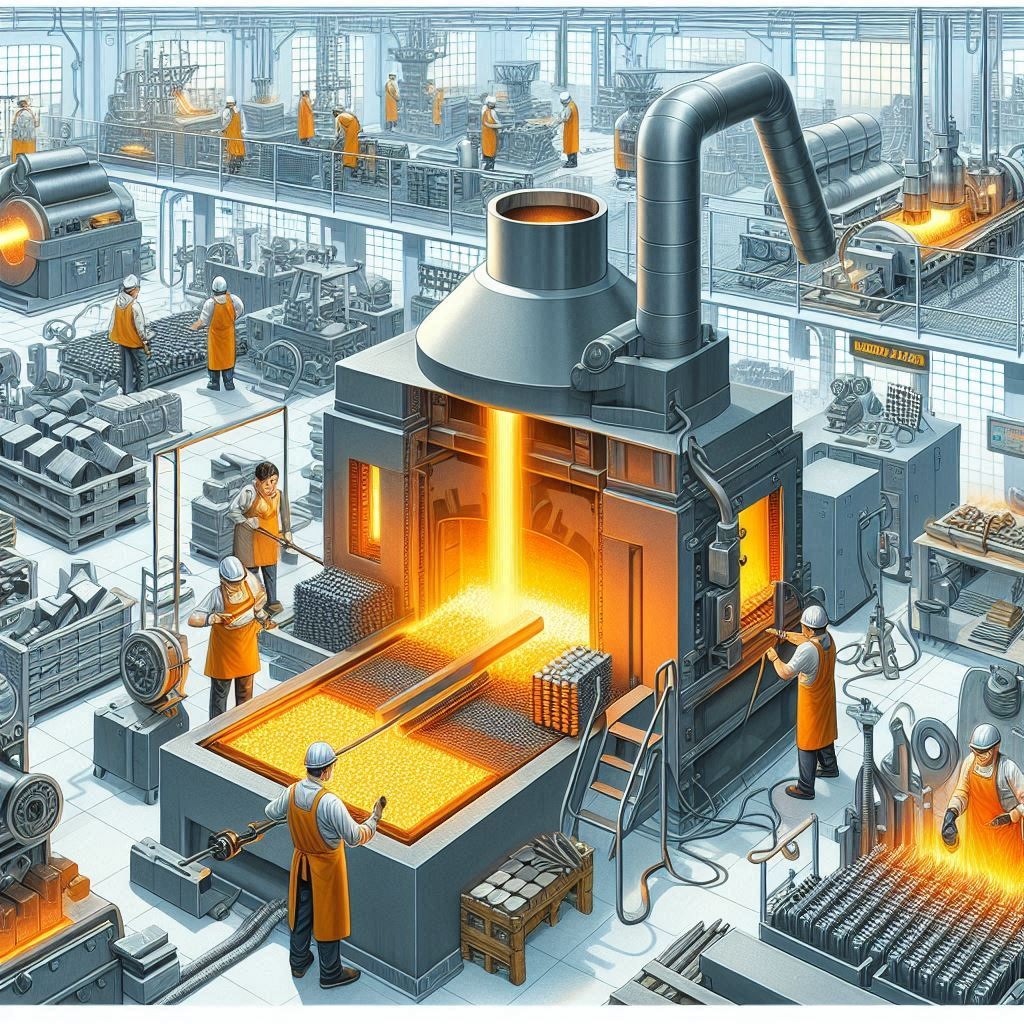
Industrial metal parts do not appear from a machine in one step. Before a component reaches an engine, a gearbox, or a piece of heavy machinery, the metal usually passes through several forming and finishing stages. Forging is one of the older manufacturing methods still widely used for this purpose.
Across many sectors of engineering, forging components are chosen when the part is expected to handle repeated load, vibration, or sudden stress. Equipment manufacturers, vehicle producers, and machinery builders often rely on forged parts for shafts, levers, hubs, rings, and structural fittings.
The forging route is not a single operation. Instead, it moves through a sequence of controlled stages where metal gradually changes shape and internal structure. Each stage adds something — either strength, dimensional accuracy, or surface quality.
The following sections explain the typical production stages involved when manufacturing industrial forging components.
Raw Material Comes First
Everything starts with the metal itself. Before presses, dies, or furnaces come into the picture, engineers must decide which material grade will work for the intended application.
Steel is the most common material used in forging components. Carbon steels handle many general industrial uses. Alloy steels enter the picture when higher strength or wear resistance becomes necessary. Aluminum alloys are sometimes selected when lighter weight is important.
The material usually arrives at the forging plant in long bars or thick billets. These pieces come from steel mills that already performed initial casting and rolling operations.
Before production begins, material certificates are checked. Chemical composition and mechanical properties must match the specification required for the component. If the base metal does not meet those requirements, the rest of the process cannot compensate for it later.
This early stage may appear simple, but it plays a large role in the reliability of finished forging components.
Cutting the Billets
The long metal bars delivered by the supplier cannot go directly into the forging press. They first need to be divided into smaller pieces.
These pieces are called billets or slugs. Their size depends on the final volume of the part being forged. Engineers calculate the required weight carefully so that enough metal fills the die cavity during forming.
Industrial cutting equipment handles this job. Band saws, circular saws, or shearing machines are commonly used depending on the diameter and hardness of the bar stock.
Once cutting is complete, the billets often move through a short cleaning step. Oil residue, rust, or scale may be removed before heating begins. Clean metal surfaces reduce the chance of surface defects forming during forging.
At this stage the metal still looks ordinary — short cylindrical pieces stacked near the furnace, waiting for the next step.
Heating Before Shaping
Forging presses apply enormous pressure, but cold metal resists deformation strongly. Heating the billet makes shaping much easier.
Billets are placed inside industrial furnaces where temperature slowly increases. For steel forging components, heating usually takes place above 1000°C. Aluminum forgings require lower temperatures but still need careful thermal control.
Heating must remain uniform. If one side of the billet becomes hotter than the other, uneven metal flow may occur once the press closes. Operators therefore monitor furnace conditions closely.
When the billet reaches the correct temperature, it glows bright orange or yellow depending on the metal. At that point it becomes plastic enough to be shaped under pressure.
The heated billet then moves quickly to the forging press because temperature loss begins immediately once it leaves the furnace.
Forming Inside the Forging Press
This is the stage most people picture when thinking about forging components.
A heated billet is placed between forging dies mounted on a press or hammer. These dies contain cavities shaped roughly like the finished component.
When the press closes, several hundred or sometimes several thousand tons of force compress the metal. The billet spreads and flows into the die cavity, gradually taking the required shape.
In many cases the part does not reach its final form in one blow. Multiple forming steps may take place. Each step reshapes the metal further until the die cavity fills completely.
During this compression the internal grain structure of the metal changes direction. Instead of remaining random, the grains follow the contour of the forged shape. That alignment increases resistance to cracking and fatigue.
This structural benefit is one of the main reasons forging components are used for parts that face heavy mechanical stress.
Removing Excess Flash
After forging, the part often carries a thin ring of excess metal around its edges. This extra material is called flash.
Flash forms because the die cavity must fill completely during the forging stroke. The surplus metal escapes through narrow gaps between the dies.
Although flash helps ensure proper die filling, it must be removed before the part can continue to the next stage.
Trimming presses handle this job. The forged piece is placed into a trimming die where a punch cuts away the excess metal in one motion.
Once trimming is finished, the component looks much closer to its final form, though several additional stages still remain before completion.
Heat Treatment After Forging
Forging alone shapes the metal but does not always produce the final mechanical properties required. Heat treatment steps often follow.
Different heat treatment cycles can adjust hardness, strength, and toughness inside forging components. The exact process depends on the material grade and the service conditions expected later.
For steel forgings, normalizing is sometimes used to refine grain structure after hot working. Quenching and tempering may follow when higher strength levels are required.
These treatments involve controlled heating and cooling cycles. Small variations in temperature or cooling rate can influence the final mechanical properties.
Because of that sensitivity, heat treatment furnaces operate under strict monitoring conditions.
Surface Cleaning and Descaling
After forging and heat treatment, metal surfaces usually carry oxide scale. This scale forms during high temperature exposure in the furnace.
Before machining or inspection, the scale must be removed.
Shot blasting is widely used for cleaning forging components. In this process, small steel particles strike the surface at high velocity, knocking off the scale layer.
The process also leaves a uniform surface texture that makes later inspection easier. Cracks or folds become easier to detect once the oxide layer disappears.
Surface cleaning may appear like a minor stage, but it helps reveal defects that would otherwise remain hidden.
Machining the Final Features
Forging shapes the overall geometry of a part, but certain features require higher precision than forging alone can provide.
Machining operations therefore follow for many forging components. These may include drilling holes, cutting threads, turning shafts, or milling flat surfaces.
CNC machining centers are commonly used at this stage. They allow tight dimensional tolerances and consistent accuracy across large production batches.
Some forged parts need only light machining. Others require several operations before reaching final dimensions. The amount of machining depends on the design of the component.
By the end of this stage, the part usually matches the drawing dimensions specified by the engineering design.
Inspection and Quality Checks
Before leaving the forging facility, forging components pass through inspection procedures.
Dimensional checks confirm that the finished part meets tolerance limits. Non-destructive testing methods may also be used. Magnetic particle inspection helps detect surface cracks, while ultrasonic testing can reveal internal defects.
Hardness measurements sometimes verify that heat treatment achieved the intended strength level.
Inspection does not occur only at the end of production. Many forging plants perform checks at several stages — raw material arrival, billet preparation, forging operations, and final finishing.
This layered inspection approach helps maintain reliability across large production volumes.
Production Stability in Large Forging Operations
Industrial forging often runs continuously for long periods. A production line may produce thousands of identical forging components in a single week.
When volumes reach that scale, maintaining stable process conditions becomes important. Temperature variation, die wear, or lubrication changes can affect product consistency.
Modern forging plants monitor these factors closely. Operators track furnace temperature, press force, and die condition during each production run.
Small adjustments keep the process within the desired operating range. This helps ensure that parts produced early in the run show the same properties as parts produced later.
Consistency like this is essential when forged parts eventually become part of larger machines or vehicles.
Closing Remarks
As such, the process of forging involves the transformation of simple metal billets into reliable mechanical parts. The process involves several steps. Preparation of the materials, heating, forging, trimming, heat treatment, cleaning, machining, and inspection all contribute to the production of reliable forging parts.
Although the steps involved in the forging process may be basic in nature, they work in unison to produce reliable forging parts that can withstand extreme conditions.
Although the forging process has been in existence for quite some time, it remains an essential tool in the production of reliable parts for several industries.