

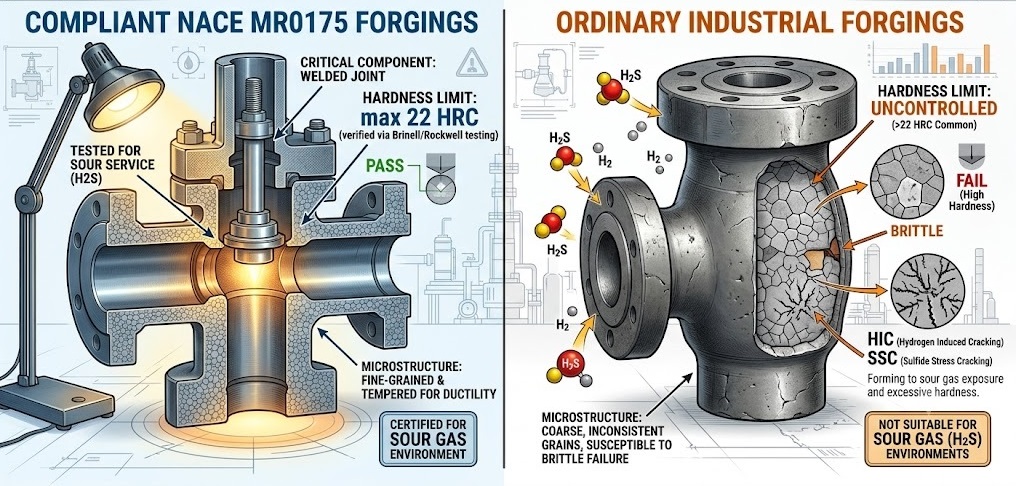
Ask a well veteran about a sour field and more than one will tell you the same story: a forged component that passed the shop tests, went into the line and cracked clean through in a few weeks, even under normal pressure and without outside impact.
Hydrogen sulfide in the system causes brittle failure. There may only be a trace of it present in the wet medium, but enough for the good and reliable forging to become useless within months. This is why oil and gas forged components built for H2S service are a separate category from general-purpose forgings – the difference is defined by NACE MR0175/ISO 15156, of which the key element are the hardness limits.
What Makes a System Sour?
The standard applies to wet systems containing hydrogen sulfide above a certain cutoff. For many configurations this is a partial pressure of 0,3 kPa or 0,05 psi H2S, a low value by any measure. Many wells that operators would classify as only mildly sour fall under its jurisdiction, as do a considerable number of gathering lines and manifolds.
The mechanism for failure is sulfide stress cracking (SSC). The presence of H2S and water causes steel to corrode and release hydrogen atoms. These will combine with each other and escape as gas if there is sufficient opportunity, but H2S prevents the reaction and causes the atoms to diffuse into the steel. They will collect in regions of the metal experiencing maximum tension and embrittle the grain structure there; combining this with tensile stress from line pressure or residual forging forces will cause a crack to form, and the harder the steel is the sooner this will happen.
Why Hardness Took Center Stage
Testing for cracking resistance on every single forging is not practical. Hardness is a quick, affordable and reasonably accurate indicator of the likelihood of a forging cracking, and as such became the default standard. For carbon and low-alloy steels the limit is 22 HRC, while martensitic stainless steels, including the duplex and super duplex grades as well as nickel alloys have separate hardness categories according to chemical composition, heat treatment and fluid aggressiveness. The same applies for duplex grades, and a good reading alone will not be sufficient for approval.
How a Number Can Be Misleading
Two forgings can have the same reading on a hardness test and behave completely differently in service. One could be fully tempered and homogenous, while the other is a mixture of martensite and softened zones which will be prone to hydrogen cracking. The standard takes this into account as well, and considers the process that led to the figure.
Where General-Purpose Forgings Fail
A general-purpose forging is bought for its dimensions, strength and reasonable toughness. Hardness will be noted, but the buyer makes no promises regarding a hardness ceiling from the outside to the core of the forging. There are three ways this can go wrong.
The chemistry is the first point of failure. Low-alloy steels designated for sour service are restricted to approximately 1 percent nickel, while free machining grades containing sulfur or lead are outright banned. The same applies for phosphorus and sulfur, which promote grain boundary segregation.
Heat treatment follows, where a thick block will cool unevenly after quenching and create varying hardness levels across the forging. A good reading at the surface can mask unacceptable values further inside the material, a problem that is often only revealed after machining or when the forging fails.
The last consideration is cold work, which creates zones of high hardness and tensile stress. The standard limits these unless further heat treatment is performed to relieve the stresses.
How a Forging for Sour Service Is Made
Reliable oil and gas forged components are designed around the standard from the start of the process onward.
Clean steel is the starting point, achieved by vacuum degassing and strict limits of sulfur, phosphorus and other residuals to prevent inclusions from forming. During forging, sufficient reduction is required to break up the cast structure and close any voids in the metal, allowing the heat treater to start with a consistent grain structure.
The furnace has several stages to play in the process. Low-alloy grades are usually quenched and tempered, the latter at a temperature sufficient to convert martensite into a stable form. Quench medium, soak time and thickness of the section need to be coordinated to ensure uniformity between the core and the surface. Stainless and nickel alloy forgings are subjected to other processes, such as solution annealing, ageing or double tempering, to remain within the specified band of hardness values.
Weld repairs and bore cladding present a hazard of their own; omission of post-weld heat treatment can cause the heat affected zone to have a hardened band adjacent to the weld.
About Shailesh Forging Works
The most crucial aspect of buying forged components for sour service is supplier discipline and the paper trail. Shailesh Forging Works is a forging manufacturer which supplies products to demanding industrial fields such as oil and gas. Buyers are invited to visit the company web page for greater detail on the range of products and capabilities.
Testing and the Paperwork
A single reading from the surface of a forging proves little. To obtain acceptable results, a test needs to be performed at several depths: surface, mid-wall and the core of the thickest section (usually on test rings or prolongations from the same heat treatment lot). Rockwell C is the preferred method of hardness testing, although Vickers is more practical on welds and heat affected zones due to the limited surface area.
The paper trail is equally important for oil and gas forged components. A full certification includes:
- heat chemistry and melting route
- heat treatment charts with temperatures and hold times
- hardness survey with test locations
- mechanical properties, including impact values
When required, lab testing to NACE TM0177 provides evidence that the material will resist cracking in a simulated sour environment. A component without a paper trail is, for all intents and purposes, an unknown component.
The Purchase Order That Sets the Bar
Many problems in sour service originate with an insufficient purchase order. The phrase “suitable for sour service” on a drawing does little to inform the forge of the necessary precautions. A well written specification will include the standard and its edition, the grade, the maximum hardness, the H2S partial pressure, operating temperature and any additional limitations imposed by the operator. Buyers of oil and gas forged components for use in sour wells should also specify hardness mapping and heat treatment records at the point of quotation to avoid disagreements upon delivery.
Cost is an unavoidable factor in every purchase, and controlled chemistry, additional testing and tighter heat treatment will add to the price of a forging. Weighed against the cost of a wellhead leak, an unscheduled downtime or another round of failure analysis, the investment appears relatively modest.
Conclusion
The difference between an ordinary forging and a reliable one under sour service conditions is not visible to the naked eye. It is present in the chemistry, the uniformity of the heat treatment, the hardness control and the paper trail that confirms the first three aspects. NACE MR0175/ISO 15156 codifies this difference into a set of requirements: hardness limits, acceptable materials, controlled processes and verifiable results.
For the operating companies, the best course of action is to specify these requirements clearly in the purchase order and work with a supplier that regards them as standard practice. Oil and gas forged components that are built this way will provide extended service life in sour wells and the expense of such production remains well below the cost of failure.

