

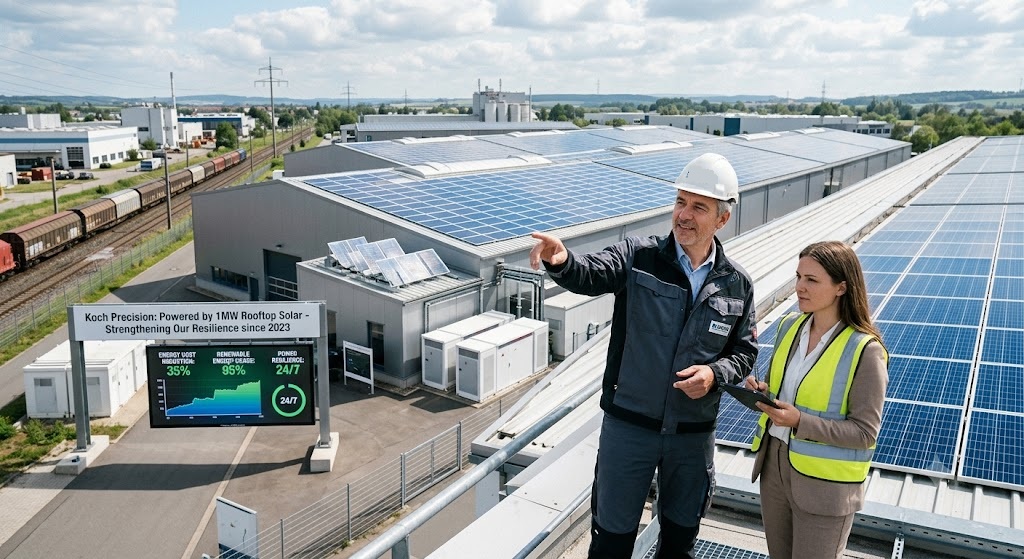
Factory resilience is a concept that plant managers understood intuitively long before the term entered the strategic planning vocabulary. Redundant machinery, buffer inventory, diversified suppliers, backup generators — these are the operational decisions that keep a factory producing when something in the supply chain breaks. Energy supply is rarely on this list until it fails, because grid electricity arrives invisibly and reliably enough, most of the time, that it is treated as infrastructure rather than as a supply chain input.
The factory owners who are now turning to solar power for factories at an accelerating rate are not driven by environmental sentiment, though that is a benefit they report. They are driven by the recognition that their current energy supply arrangement is neither resilient nor economical at the scale their operations require. Indian industrial electricity tariffs have increased in every state over the past decade. Grid reliability remains patchy enough in many industrial clusters that diesel generator backup is a permanent operational cost rather than an emergency provision. And the PLI-scheme-linked export commitments that many manufacturers are now operating against have introduced sustainability disclosure requirements from global buyers that their current energy sourcing does not satisfy.
None of these pressures are temporary. All of them are addressable through solar, and the factory owners who have moved earliest are demonstrating the returns that explain why adoption is accelerating.
The Energy Cost Problem That No Tariff Negotiation Solves
A factory’s electricity bill has two structural characteristics that distinguish it from a residential or small commercial bill. First, the bill is large enough that even a modest percentage reduction represents a significant absolute saving — a factory spending ₹1.5 crore annually on electricity saves ₹22.5 lakh per year if solar displaces 15% of that cost, and ₹52.5 lakh if it displaces 35%. Second, the bill is governed by tariff structures that include maximum demand charges — typically 30–50% of the total industrial electricity cost — that do not scale linearly with consumption and that are charged regardless of whether the contracted peak demand was actually fully utilised in the billing month.
Industrial electricity tariffs in India have increased at compounding rates of 5–9% annually in most states over the past decade, reflecting the DISCOMs’ own rising power purchase costs, transmission and distribution upgrade costs, and cross-subsidy obligations to agricultural and residential consumer categories whose tariffs are politically constrained below cost-recovery levels. A factory owner who signed a power purchase agreement with a DISCOM at ₹7.50 per unit in 2016 is paying ₹11–13 per unit for the same supply in 2025. Nothing in the factory’s operating model changed; the energy input cost increased by 45–75% while the factory’s own product pricing faced competitive pressure that did not permit equivalent price increases.
Solar power for factories breaks this cost trajectory at the point of installation. The marginal cost of electricity from a rooftop or ground-mounted solar system is zero — the sun charges no royalty on its radiation. The capital cost amortised over the 25-year system life produces a levelised cost of energy (LCOE) for industrial solar in India at current equipment prices in the range of ₹2.0–3.5 per unit for rooftop systems, and ₹1.5–2.5 per unit for larger ground-mounted systems with economies of scale in installation. Against a grid tariff of ₹10–13 per unit for industrial consumers in many states, the displacement of grid electricity with solar-generated electricity at that LCOE represents a cost saving of ₹7–10 per unit on every unit the factory self-generates and self-consumes.
Demand Charge Reduction: The Saving Most Factories Do Not Budget For
When a factory’s solar system produces electricity during peak daytime production hours, it is not simply displacing energy units that would otherwise be purchased. It is reducing the net power draw that the DISCOM meter records in every fifteen-minute interval during the production day. If the maximum demand that the meter records during any fifteen-minute interval in the billing month is lower because solar is supplying a portion of the factory’s load during that interval, the demand charge is levied on a lower figure.
A factory with a contracted maximum demand of 500 kW that installs a 300 kWp rooftop system will, during clear midday conditions, draw approximately 200 kW net from the grid rather than its full 500 kW — because the solar system is supplying 300 kW of the factory’s 500 kW load directly. If the demand charge is assessed at ₹400 per kW per month, and the recorded peak demand falls from 500 kW to 250 kW (on days when solar generation coincides with the factory’s peak operating load), the demand charge saving is ₹400 × 250 = ₹1,00,000 per month, in addition to the energy cost saving from the units displaced.
This demand charge interaction is factory-specific — it depends on the alignment between the solar generation profile (highest from 9 am to 3 pm in most Indian orientations) and the factory’s production peak hours. Factories with significant nighttime or early morning shifts, where the production peak occurs outside the solar generation window, capture less demand charge benefit than factories whose peak production coincides with solar peak output. A load analysis that maps the factory’s hourly demand profile against the site’s hourly solar generation potential is the calculation that quantifies this saving accurately — and that a capable solar power for factories EPC contractor performs as part of the project feasibility, not as a supplementary service after the system is installed.
Operational Resilience and the Generator Problem Solar Solves
Most factories in Indian industrial clusters outside Tier 1 metro areas operate with diesel generator backup as a standard fixture. The generator covers load shedding, transformer faults, grid frequency excursions outside equipment tolerance, and the planned outages that DISCOMs impose during maintenance windows. The cost of maintaining this generator backup — diesel fuel at current prices of ₹95–105 per litre, generator maintenance contracts, periodic overhaul costs, and the operational overhead of fuel procurement and storage — is a recurring operational cost that is often presented internally as an unavoidable infrastructure cost rather than a choice.
At factory scale, diesel generation costs ₹18–28 per kWh depending on generator efficiency, load factor, and current diesel prices — two to three times the grid tariff for the same electricity. A factory that runs its generator for 6 hours per day across 25 working days per month to cover load shedding is consuming 150 generator-hours per month, and the cost premium over grid electricity on those hours represents a persistent operational drain that management treats as normal.
Solar power for factories equipped with a battery storage component eliminates or dramatically reduces generator dependence by supplying critical factory loads from the solar-charged battery bank during grid outages, without the fuel cost, noise, emission, and fuel storage compliance issues that generator backup entails. A hybrid solar-plus-storage system sized to cover the factory’s critical electrical load — process control systems, ventilation, refrigeration, sensitive machinery that cannot tolerate power interruptions — for the typical outage duration at that location addresses the resilience problem that the generator was managing, at a cost per covered hour that, after amortisation of the storage capital over its cycle life, typically falls below the diesel generator’s operating cost per hour within three to four years of installation.
Factories that achieve genuine independence from generator backup are also removing a liability that has grown in regulatory significance: diesel storage above specified thresholds requires compliance with Petroleum Rules, 2002 under the Petroleum Act, mandatory petroleum licence from PESO, and periodic inspection of storage facilities. Eliminating the generator backup entirely removes this compliance requirement along with the cost.
Export Market Access and the Green Energy Documentation That Buyers Now Require
The factory owners whose adoption of solar power for factories is most commercially driven are often those with significant export operations supplying European or North American brands. These buyers have implemented Scope 3 supply chain emission reduction programmes that require Tier 1 and Tier 2 suppliers to demonstrate progress on renewable energy adoption — not as a goodwill gesture but as a quantified metric that the buyer reports in its own sustainability disclosures under the EU Corporate Sustainability Reporting Directive, CDP reporting, or their corporate Science Based Targets initiative commitments.
The documentation that export-oriented factories need to produce for their buyers is specific: Renewable Energy Certificates (RECs) from the Central Electricity Regulatory Commission for units generated by an MNRE-registered solar installation, or an I-REC (International Renewable Energy Certificate) for installations meeting the I-REC standard’s requirements for international attribute tracking. These certificates, issued per megawatt-hour of verified solar generation, are the currency of the renewable energy attribute market that global sustainability programmes use to claim renewable electricity consumption.
A factory without this documentation cannot substantiate a claim of renewable energy use for its export buyers’ supply chain tracking, even if it has a solar system installed on its roof generating electricity continuously. The REC and I-REC issuance is tied to the generation meter data from the solar installation, and the certification process — registration with the RECPDCL (REC Programme Development and Certification in India), generation data upload to the registry, and certificate issuance — requires a properly registered installation, a calibrated generation meter, and a registration process that typically takes 3–4 months from installation commissioning to first certificate issuance.
Solar power for factories serving export market supply chain sustainability requirements must therefore be installed through an EPC contractor who understands REC and I-REC registration requirements and who can ensure that the installation’s metering and monitoring infrastructure satisfies the registry’s data reporting standards from commissioning, rather than discovering after installation that the meter configuration does not generate the data format the registry requires.
Structural And Roof Considerations Specific to Factory Buildings
Factory rooftops differ from commercial or residential roofs in ways that affect solar system design significantly. Industrial shed structures — pre-engineered buildings with mild steel trusses and metal sheet cladding — have structural load capacities and roof cladding characteristics that require specific assessment before solar mounting is designed and installed.
Truss-mounted solar installations on industrial pre-engineered buildings (PEB) must be designed against the structure’s allowable purlin load capacity, which varies significantly with purlin span, gauge, and the original design specification for that building. A purlin rated for 0.5 kN/m² dead load capacity does not automatically accommodate the solar panel mounting system’s 12–15 kg/m² without verifying that the total load — panels, mounting rails, clamps, and ballast if any — stays within the rated capacity with an adequate safety margin. Overloading purlins without assessment is a structural risk that shows up as roof distortion during monsoon loading, when the combined weight of the solar installation and standing water on a low-slope roof can exceed the purlin’s design capacity if either was miscalculated.
Rooftop waterproofing in industrial buildings is typically metal sheet cladding with lapped joints rather than a continuous membrane, and penetration-based mounting that drills through the metal sheet creates a point load on the sheet that, if not properly backed and sealed, deforms the sheet at the penetration over time and creates water ingress at the joint. Clamp-based mounting that grips the sheet’s standing seam without penetrating it — the standard approach for standing seam metal roofs — avoids this issue entirely and is the preferred mounting method for industrial PEB rooftops.
Ground-mounted solar on factory premises — using the vacant land area within the factory compound rather than the roof — is the correct solution where the roof structure is inadequate for the intended capacity, where the roof orientation is unfavourable, or where the required system capacity exceeds the roof area available. Ground-mounted systems at factory scale (500 kWp to 2 MWp) access better economies of scale in installation cost than rooftop systems of equivalent capacity, and their orientation and tilt can be optimised freely without constraint from the building’s orientation.
The Capital Structure That Makes Factory-Scale Solar Accessible
Factory-scale solar installations — typically ranging from 100 kWp to several MWp depending on the facility — represent capital investments of ₹45 lakh to several crore rupees, and the capital structure through which this investment is financed affects both the investment’s return profile and the factory owner’s balance sheet.
Term loans from nationalised banks and development finance institutions for solar projects — including SIDBI’s solar loan products and the financing schemes linked to the National Solar Mission — are available at interest rates of 8.5–11% per annum for secured commercial borrowing against identified solar assets, with tenors of 7–12 years that match the payback period of most industrial solar investments. The internal rate of return on a well-designed factory-scale solar system at Indian industrial tariff levels typically runs 18–25% pre-tax, producing a positive spread over the cost of debt that makes leverage financially rational.
Operating lease and RESCO (Renewable Energy Service Company) models — where a developer finances, owns, and operates the solar asset on the factory premises and the factory purchases the output at a contracted rate — remove the capital expenditure from the factory owner’s books entirely in exchange for a portion of the financial benefit relative to direct ownership. This model suits factory owners who wish to preserve capital for core business investment or whose balance sheet structure makes on-book asset financing undesirable, and who are satisfied with electricity cost reduction below the grid tariff rather than the full financial return of direct ownership.
Infrax Renewable Limited, a Rajkot, Gujarat-based Solar EPC company established in 2015 with over 10,000 completed projects across 30,000+ kW of installed capacity and a 98% customer satisfaction rate — providing solar power for factories through end-to-end services including load analysis, structural assessment, custom system design, professional installation, regulatory liaison for DISCOM interconnection and REC registration, and post-commissioning monitoring and after-sales support, with 100% financing facilitation through national banks and NBFCs — represents the category of experienced industrial solar EPC contractor whose project delivery across residential, commercial, and industrial sectors provides the structural assessment rigour, regulatory experience, and installation discipline that factory-scale solar investments require.
Conclusion
Factory owners turning to solar power for factories in 2025–2026 are responding to a convergence of pressures — energy cost trajectories that continue to move against them, grid reliability that diesel backup manages expensively, export market sustainability requirements that purchased grid power cannot satisfy, and LCOE economics that make solar generation significantly cheaper than grid electricity across the system’s operating life. The factory that goes solar is not making an energy decision in isolation. It is making a strategic decision about what kind of input cost trajectory it intends to be exposed to for the next twenty-five years.
The factories that execute this decision well — with rigorous load analysis, correctly sized battery storage, structural assessment before installation, REC registration from commissioning, and monitoring infrastructure that maintains system performance across decades of operation — reduce their energy cost, eliminate or dramatically reduce their generator operating cost, satisfy their export buyers’ supply chain requirements, and insulate their input cost base from a tariff trajectory they cannot otherwise control. The ones that execute it poorly — undersized systems, inadequate structural assessment, missing regulatory registrations — capture a fraction of the available benefit and spend the remainder of the system’s life managing the consequences of decisions made carelessly at the outset.

