
About ten years ago, I was on a factory floor in Pune, cutting oil’s smell, and all around the heavy machines battering out thump-thump rhythm. A very experienced project manager in the business for forty years, was looking deserted at an enormous piece of high tensile steel that was just spoiled. This steel was meant to be a part of a pressure vessel, but rolling it manually resulted in a “flat end” so drastic that it even appeared to be a structural defect. He wiped his forehead, looked at me, and said, “We are guessing with million-rupee materials.”
That was a big lesson for me. Indian fabrication has been all about the “Ustaad” culture, the master who uses his intuition to direct rollers. But intuition is something the world can’t scale, and it doesn’t guarantee precision at the sub-millimeter level that today’s global standards demand. To be truthful, if you are still depending on manual intervention alone, you are not just behind the curve, but also, you are throwing away money every single day.
The movement to Automatic Plate Rolling Machine Manufacturers is today, not merely a trend. It is a survival strategy. Essentially we are witnessing a paradigm shift in the method of bending metal going from “near enough” to “exact”.
What Makes the Manual Era a Thing of the Past (And Why that’s a Good Thing)
Your manual machines are very durable, I understand you are used to them, and they’re what you’ve paid for. Also, you can fix them with a wrench and a bit of foul language. But let’s face it, the point of no return for errors in such industries as wind energy, aerospace, or heavy infrastructure has effectively disappeared.
You are using a manual system means:
- The “Flat End” is a Problem: You will waste material or you will have to do lots of post-processing if you do not have a pre-bending setup perfectly synchronized.
- Inconsistent Results: There is no guarantee that a manual operator will be able to compensate for spring-back of the plate especially for high-strength steels.
- Operator Fatigue: The decisions of an ‘exhausted’ operator on a Tuesday morning are quite different from a ‘fresh’ one on a Monday.
Labor costs in India are going up, but, what’s really happening is that the cost of skilled labor is going through the roof. The “steel-feel” type of person is becoming a rare commodity. This is where automation comes in.
Key Tech: What Does “Automatic” Mean in 2026?
Automation in plate rolling means more than just a digital readout.
It is the CNC integration which controls roll geometry in real-time.
Getting Roll Geometry Right
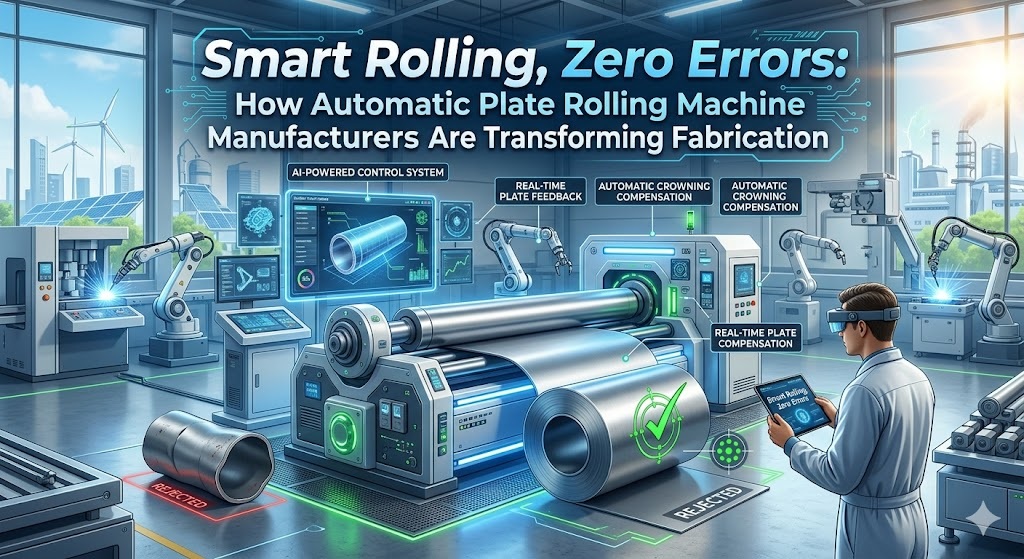
Automatic Plate Rolling Machine Manufacturers put the thrust on four-roll systems.
A 4-roll apparatus is the ideal configuration for automation.
You have the bottom roll, which grips the plate, and the side rolls, which perform bending.
It is balanced, it is stable, and, most importantly, is the one a computer can predict with precision.
AI and Material Databases at Work
This is remarkable. I believe the most radical change has been in the software not in hydraulic valves. New machines come with material data banks.
To cut a long story short, you give thickness, yield strength, and diameter. The machine decides the rolling passes.
This is not fire and forget. The best systems have electronic sensors that measure radius while the plate moves.
If the steel is a bit tougher than the previous batch, the machine will change the roll pressure at once.
Seeking and Sourcing:
Those in Delhi or Bangalore offices contemplating the acquisition of a new Automatic Plate Rolling Machine Manufacturers should not just be looking at the price. Think about the whole ecosystem.
1. Support and Tele-Diagnostics
Downtime is the terror in the Indian context. When you purchase an automatic, you buy, in effect, a computer not just a piece of metal. The manufacturer allows remote diagnostics?
In factories if sensor trips technicians in Germany or Ahmedabad can log in and fix the code? Short answer, no then move on.
2. Software User Experience
I have seen very old and dull looking machines with very poorly designed control panels. The workers who do not have good experiences will simply not rely on automation. They will try to handle it manually thus losing the benefits of automation. Instead you require a Graphical User Interface (GUI) that also gives 3D visualization of the rolling process in a very straightforward manner.
3. Integration with BIM and ERP
What the market leaders want is availability of direct link from machine to your design department.
Minimizing steps from CAD model to the real physical roll is the place where zero error really and truly happens.
The Reasoning behind Automation: Can the Numbers Stand Up to It?
I had talks with a number of CFOs who cringed at the cost of an automatic line over a traditional 3-roll mechanical machine.
That’s a valid worry. But you have to consider Total Cost of Ownership (TCO).
| Feature | Manual/Mechanical | Automatic CNC |
| Setup Time | 45–60 minutes | 5–10 minutes |
| Pre-bending Waste | High (50-100mm) | Minimal (1.5x thickness) |
| Labor Requirement | 2-3 Skilled workers | 1 Operator |
| Consistency | Variable | 99.9% Repeatable |
In fact, let me put it another way. If you only do one-off low precision working, you can stick to manual. However, if you are planning on volumes or working with expensive alloys, it is only the Automatic Plate Rolling Machine Manufacturers that is able to give you a machine that will make savings in scrap pay for the machine in itself.
Implementation: Your Workshop Floor’s Next Steps
You have taken the plunge. You have selected a leading Automatic Plate Rolling Machine Manufacturers.
You cannot simply place a 50-ton machine on a bare floor and hope for the best.
- Foundation is First: These machines have very sensitive components. Leveling and reinforcement of the floor are prerequisites.
- The “Hybrid” Training Period: Don’t just get rid of your master rollers. In fact, use them to train the machine and to first validate the CNC outputs.
- Plate Cleaning: Rollers and sensors are prone to damage when rolling rusty plates even if they are not being cleaned.
The Environment Factor Yes It Does
These days, “sustainability” sounds like empty talk – yet companies must meet it to bid on international projects. Machines that run without constant human control tend to be easier on the planet, simply because of how they operate.
Why?
Those leftover bits stay useful. Fewer scraps mean less waste overall
When the machine runs, it uses just enough energy because of smart hydraulics and variable speed controls. Power isn’t wasted during downtime since demand drops when full strength isn’t required.
Typical Mistakes: Joan of Arc Won’t Tell You This
I have witnessed the major failure stories. One of the cases that was really a break down was that a firm that purchased a very pricey automatic had not comprehended that the overhead crane capacity was unable to cope up with the high speed at which the machine could produce. They were blessed with the world-class roller that remain dormant as they failed to shift the cylinders fast enough.
Another one? Over-specifying. Why do you need 40mm capacity machine if 90% of your work is 12mm? The more “automatic” a machine is, the more it likes to work in its optimum range only. Discuss with the Automatic Plate Rolling Machine Manufacturers about the workload you normally have, not just the rare big project.
Thinking Back: That Instant Realisation
Not long ago I was at that same shop in Pune. They had finally upgraded. The mechanical 3-roll beast was a museum piece. They replaced it with a sleek, 4-roll CNC powerhouse.
The operator was a young man around 24 years old, and he was looking at the roll on a tablet.
The cylinder we see here? Perfect. There’s no flat end. No re-rolling required.
The project manager who told me about the “guessing game” sounded quite surprised; he only laughed and said, “now I don’t have to shout; I can finally hear myself think.”
What are the next steps?
“Autonomous Rolling” is the next thing. In your wildest dream, the machine rolls the plate and also has the integrated welding head that from the moment edges meet starts the longitudinal seam.
We are not able to do that for all cases yet but the Automatic Plate Rolling Machine Manufacturers have been very good at it.
If you intend to remain in the game of Indian B2B market or export your fabricated components to Europe or the US, you will need that “Zero Error” stamp. You will also need the consistency that can only be provided by a computer controlled system.