
Very vividly, I still remember a meeting about five years back in a dusty meeting room near Pune where we were discussing a failed crankshaft of a heavy-duty industrial engine. Not only was it worn out; it was broken literally as it was carrying a load for which it was rated. The procurement lead was pale, the lead engineer was fuming, and I was silently going through the $12, 000 ‘savings’ which they’d boasted about six months back during the change of suppliers.
Later on, it turned out that the grain flow inside the steel was all messed up it was a structural failure waiting to happen. This was the moment when I truly realized that the ‘lowest price’ option in the industrial components world is almost always a ticking time bomb. Selecting the right Steel Forging Supplier is not merely a matter of ticking a box in a ledger, it is about making sure that the fundamental support of your project does not give way under pressure.
To be honest, in a fast-growing market like India, the numerous options may make you feel like ‘looking for a needle in a haystack’. But there is no need to worry. We will together slice through the confusion and chart a plan that delivers results.
Why Forging Quality is Your Secret Competitive Edge
Before we figure out the “how, ” let’s clarify the “why.” People usually talk about faster time to market and cost reductions. However, if your product fails in the field, time is irrelevant. Quality is what differentiates and helps build trust at a much faster pace than any advertising slogan.
The Science of Strength
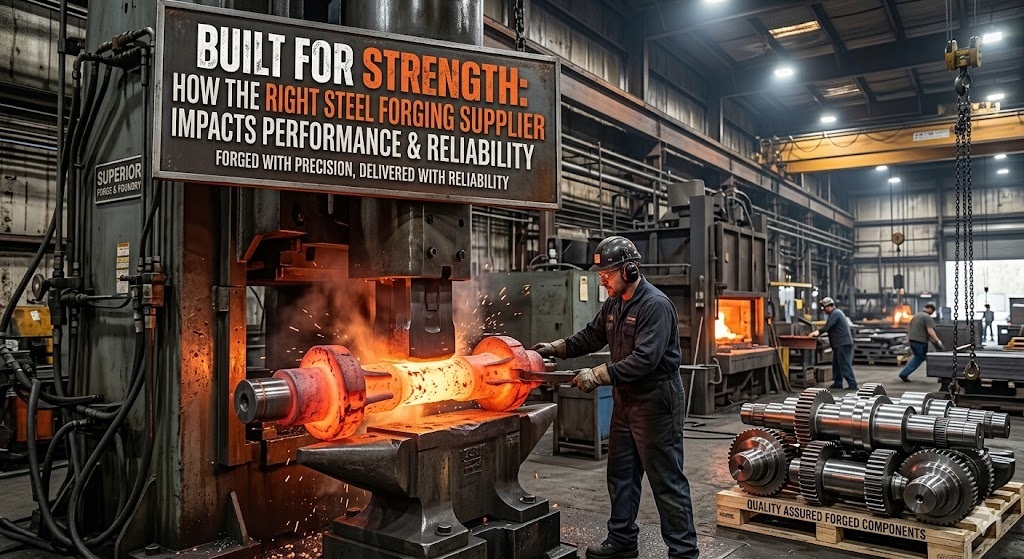
Forging is special as it changes the metal’s grain so that it aligns with the part’s shape directly. In contrast to casting, where the liquid metal is poured into a mold and then hope that the result is good, forging results in a consistent grain flow. Therefore:
- Higher Impact Strength: Ability to take in energy without breaking.
- Excellent Fatigue Resistance: Necessary for parts that are subjected to millions of cycles.
- Less Material Waste: Going for near-net-shape with precision forging means less machining time and cost.
By selecting a reputable Steel Forging Supplier, you are securing much more than just the purchase of shaped metal; you are securing your operation’s continuity.
Step 1: Defining the ‘Non-Negotiables’ (The Technical Bar)
Honestly, lots of times people skip this one. Their assumption is, “steel is steel.” Far from it. So you have to be very specific about your technical requirements before even considering the manufacturer’s brochure.
Material Purity and Grade
- Watch out for sketchy conductivity or impure materials when dealing with India’s setup. Flawless high-end steel must skip tiny flaws – those little traps where pressure piles up unexpectedly.
- Here’s something worth noting. Ask for a Material Test Certificate linked straight to the initial melt. If there’s even a pause, take note. That delay tells you plenty.
The Precision Factor
Are the supplier equipment compatible with your particular part? The company that is mostly heavy open-die forging shafts, may have quite a bit of trouble with the very tight tolerances for small, closed-die automotive parts.
Step 2: Certifications, The Paper That Guarantees Performance
Indian certifications are not only bureaucratic procedures but also a third-party promise. Just as you wouldn’t purchase a wire without an ISI mark, likewise you shouldn’t buy forging without proper credentials.
The Global Standard
Start here when talking about quality standards. This version from 2015 shows a clear plan exists – so results stay consistent.
- Whatever the sector – aircraft or cars – one thing stays clear: without AS9100 or IATF 16949, entry is blocked. These aren’t just papers on a wall. They signal that corners weren’t cut. Risk gets serious attention where such marks appear. Standards climb when they’re part of daily work.
- What matters isn’t just that your supplier runs tests. A lab inside their facility means little unless it meets national benchmarks. Having NABL accreditation changes the picture entirely. Not every test setup follows strict guidelines. Approval from a recognized body shows consistency. Just claiming testing happens doesn’t prove reliability. The real difference appears when results come from certified systems.
Pro Tip: Apart from checking if a supplier possesses a certificate, also verify that the certificate is still valid. I have witnessed suppliers attempting to present expired ISO certificates far more times than I would like to admit.
Step 3: Vetting the Manufacturing Process
Ideally, you would like to have in your business circle a supplier who is not living in the past. The steel forging business is a high-tech industry and your Steel Forging Supplier should be a leader, not a follower.
Evidence of Modernity
Are we talking about manual hammers or CNC-served ones? The automated lines run faster and additionally, keep the results consistent, which is the key factor when one needs thousands of parts that are identical.
The R&D Factor
The industrial world is changing at a fast pace e.g. transition to electric vehicles or renewable energy. Is your supplier experimenting with new materials and processes or just make the ‘typical product’ as they had done for decades? Research-based companies are not only up-to-date; they are also securing the resources which you will need in three years from now.
Step 4: Assessing Logistics and Scale
This is where the true test of viability comes in. A manufacturer’s capabilities matter less to you unless they can supply what you want, just as you want it, right on time.
Can They Handle the Pressure?
A small forge might tempt you with a low-ball quote, but what if they cannot cope with 20% more of your order volume? Review some examples of their past works. If the supplier has never worked on a project at your scale, you basically pay them to learn through your project.
Supply Chain Robustness
Steel prices are quite fluctuating in nature. It is the best players who have backward integration, probably they are having their own smelting capabilities or at least very close relationships with chief mills. You would like to partner with a supplier who is able to manage the risk of raw materials so that you are not the one always bearing every price shock.
Step 5: The ROI of “Expensive” Steel
We must not ignore the issue of ‘cheap’ lure. Many times you come across offers in the Indian market which are even 20% or 30% cheaper than the best-known brands.
The Hidden Costs of Low-Cost Forging
- Internal Voids: Low-cost forges generally require less pressure and hence do not close internal porosities.
- Poor Heat Treatment: Most of the time this is where one saves cash. If the processes of quenching and tempering are off, then the final product could be very brittle or too soft.
- Machining Nightmares: A non-standard forging will cause breaks of CNC tools frequently, thus leading to time delays in part completion.
Once you take into account the costs of non-production, replacements, and legal risks, such ‘savings’ vanish very rapidly. Total ROI considers all angles: financial, operational, and even cultural.
Step 6: Finding the Human Element
Artificial Intelligence is a wonderful tool for scheduling optimization, but it has not managed to get rid of the expertise requirement of human hands in the forge.
Specialized Talent
Are expert metallurgists part of your Steel Forging Supplier’s team? Since manufacturing problems emerge (and manufacturing, by definition, is not without problems), you want a ready-to-go team capable of immediate in-process troubleshooting through problem identification and resolution, rather than just pointing to a computer.
The Value of Ongoing Support
Making a purchase is not a brief transaction. It is a partnership that could last for many years. For instance, does the supplier assist you in design of your part so that it can be optimized for forging process? A good supplier will not hesitate to oversee the work of your team and direct them, possibly saving you thousands of material costs that are unnecessary.
Step 7 Facing India’s Market Complexities
One moment you’re looking at sleek labs that match Berlin’s best. Next thing, back alleys where rules vanish like smoke. Some workshops run on precision others thrive where shortcuts rule. High-tech hubs stand tall while shadow markets hum below. Standards rise in one district crumble just blocks away. Gleaming factories share soil with makeshift sheds. Innovation pushes forward even as old tricks drag behind.
Verification is Key
- You should not just take the supplier’s word for it. Go visit their factory. I really mean it. If a supplier is not willing to let you go around the factory, then leave.
- Studying the packaging will have a significant effect on the product’s safety from the environment and any handling damages. Receiving a precision forging that has been damaged might be a nightmare for you.
The Global Perspective
Nowhere else is growth clearer than in the demand for strong steel parts, pushed by national building goals and local manufacturing pushes. Ideas spread faster when materials meet tough standards. A supplier tuned into what comes next helps your business move with change, not after it. Progress likes partners who think early.
Conclusion
Business speed is basically not about rushing; it is rather about eliminating the time of hesitation. You get rid of hesitation by having a supply chain that you can trust blindly.
Deciding on a Steel Forging Supplier is a long-term investment, and it will have an impact on all areas of your company from engineering to finance. If needed, start small. Execute a pilot project. Validate the value. And then scale up.
Do not allow a small price difference to attract you at the cost of the very foundation of your project. That minor initial saving will almost certainly come with higher energy costs, maintenance problems and, worst of all, safety risks.