
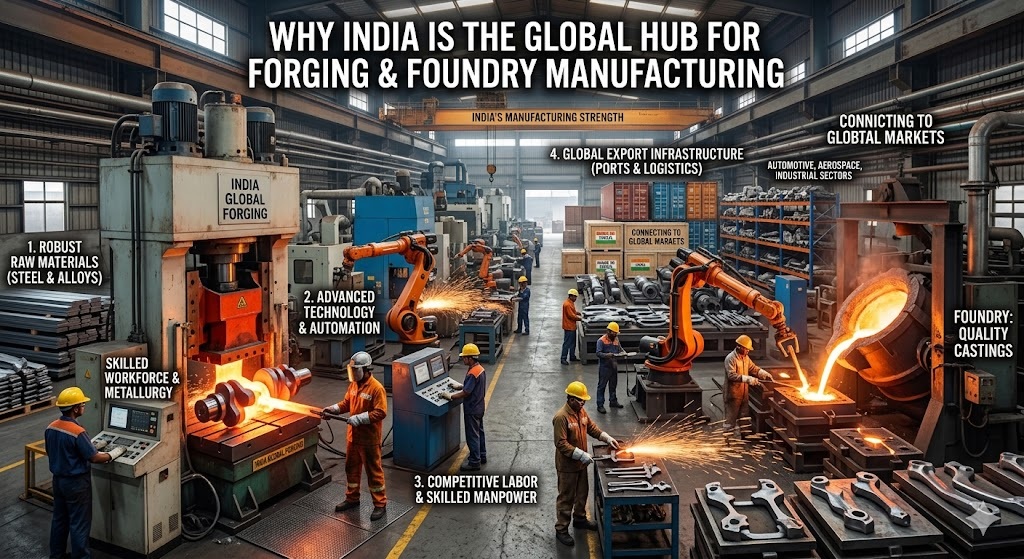
India is now a global leader in the forging foundry sector thanks to a strong manufacturing base, skilled labour force, low-cost production capacity and rapidly expanding industrial infrastructure. India also has access to a wide variety of raw materials (including steel and alloys), which enables large-scale forging operations for a number of industries, including automotive, aerospace, railway, defence, oil & gas and heavy engineering.
From a geographical perspective, India is well positioned with access to all of the major international shipping routes via both eastern and western ports, making shipping to Europe, the Middle East, Asia and North America easy and cost-effective. Additionally, because India is located so centrally in the global trade network, logistics costs and delivery timeframes are lower than they would be for most international customers. Finally, the Indian government has taken several steps to promote foreign investment by launching programs such as “Make in India”, establishing industrial corridors and creating a friendly climate for foreign companies to set up their activities in India. As such, India is becoming one of the leading locations for the establishment of foreign foundries globally.
Types of Forging Foundries in India and Top Manufacturers Leading Global Exports
The forging industry in India has many aspects. The forging industry is made up of many kinds of forgings. Types of forging include; open die, closed die, ring rolled, precision forged, hot forged, cold forged and making seamless rolled rings. Forgings are used to produce many different types of forgings or products. Examples of products made from forged materials include crankshafts, axle beams, connecting rods, gears, flanges, shafts, railway couplings, parts used in gas turbines, oil and gas fittings, structures for aerospace, defence equipment parts, components of mining machinery and products for heavy engineering applications for various industries such as automotive, railways, aerospace, marine, power generation, construction, agriculture, and defence.
India exports forged components to the USA, Germany, Europe, Middle East, Japan and various Asian nations. Exports include; automotive parts, industrial forgings, railway components, aerospace forgings and oil & gas equipment. India is one of the leading global forging manufacturing centres due to its large volume production capability, advanced machining capabilities, low production prices, and experienced engineers. Companies like; Unique Forge, Ramkrishna Forgings, MM Forgings, Happy Forgings, CHW Forge, Mahindra Forgings are all large suppliers of high quality forged products to major global OEM’s as well as large industrial manufacturers.
Tips for selecting the best forging foundry
To select the best forging foundry to forge your parts and components, you should carefully evaluate their company’s manufacturing capabilities (including quality management system certifications like ISO 9001), industries serviced, reviews from past customers, etc. Start by browsing their website for relevant information (ISO certifications, industrial approvals, manufacturing processes, export capabilities, number of years of experience manufacturing complex forgings) and checking out customer reviews on their Google Business Profile; what’s important here is looking at multiple sources/similar type of companies so that you can assess the company’s reputation accurately. Determine if the foundry manufactures forged parts/forgings in the following major industries: automotive, aerospace, rail, oil & gas, and heavy engineering. Speak to the foundry(s) individual(s) involved in selling to you to discuss your project’s technical specifications, materials required, lead-time and price. Find out the total number of quotations you get from the foundry or foundries you are considering; next determine what foundry or foundries give you the lowest price possible while still giving you acceptable quality products. Request confirmation from each foundry regarding any guarantees, warranties, quality assurance policies, certifications and some form of after-sale service support they provide. Having this information will serve to guarantee that you will receive good, long-lasting, dependable parts and/or components and reduce any potential manufacturing problems (such as returning and/or refusing out of specification parts and/or components due to poor quality).