

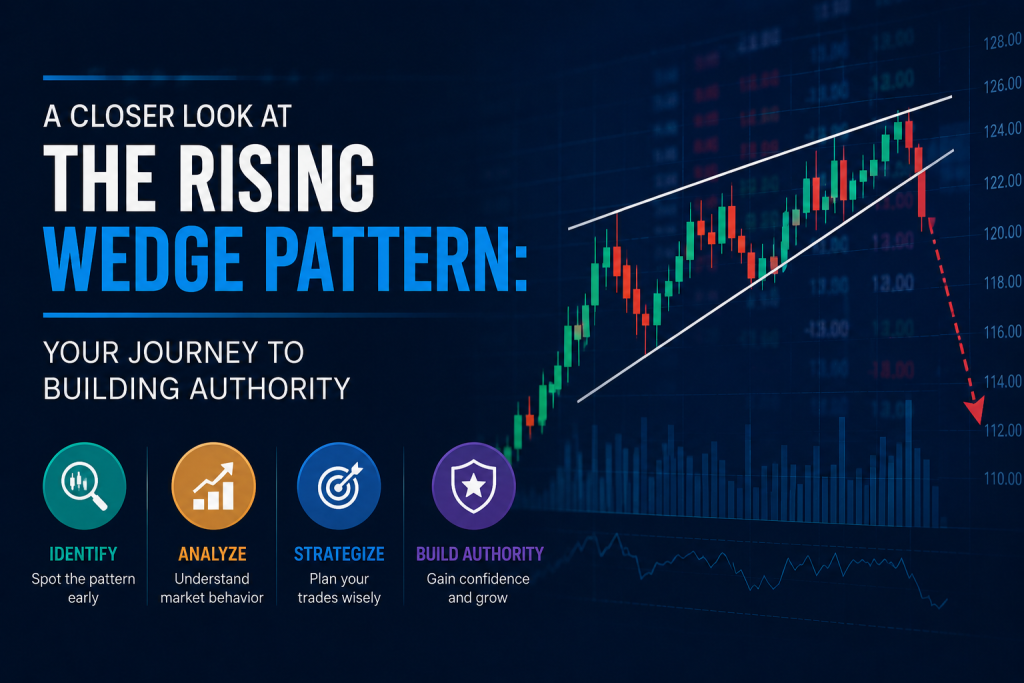
Many traders and investors, including you, have found yourself gazing at charts and graphs on a screen, unsure what to do or how to find trends. One of the patterns that regularly pops up in technical analysis is the rising wedge pattern. If you want to become a more established player in the market and want to gain some insight into this topic, then this is the spot for you! Let’s explore the rising wedge pattern in depth and how you can make use of it.
What is a Rising Wedge Pattern?
Before we dig in the details, let’s set the scene. The rising wedge is a technical indicator that indicates that there is a possible price reversal. It shows up when an asset’s price is forming higher highs and high lows, but the bull market is subsiding. Imagine a wedge being formed – you are now having two sloping lines coming together. This trend can be a red flag for an impending downtrend as it progresses.
How to recognise a rising wedge.
The rising wedge pattern is not difficult to spot, however, it does require some practice. First, search for a series of upward price movements that are in a conical pattern. You’ll want to see:
- Higher maximums and minimums.
- The upper trendline has a downward sloping trend, but a steeper one than the lower trend, which has a downward sloping trend.
- Reducing size as the pattern progresses.
The last is important – if you have a falling volume and rising prices, that’s your red flag! It implies fewer players will think that the price is going to rise as it merges; a standard indicator that a change in direction could be upcoming.
The rising wedge has nothing to do with arithmetic.The rising wedge is not about numbers.
The psychological part of trading is something that often times we overlook. The rising wedge pattern is a cautionary one. Why? As the traders push the price up, excitement, euphoria grows. But intelligent traders catch on that the rally is waning. People who realize this can benefit the market by getting in on the potential dip.
Now, imagine a room full of excited buyers. All of them are looking to make a lot of money. However, there is a wise trader there, who is quietly studying the market. This trader is waiting for a rising wedge and is ready to sell as people are getting ready to charge forward. It’s a psychological advantage that is essential for anyone wanting to establish authority within the marketplace.
Trading Strategies with the Rising Wedge Pattern
Now let’s consider the things you can do with this knowledge. It is important to recognize the rising wedge pattern and use the pattern correctly within your trading strategies. Here are some tips for you:
Identifying the points at which to enter and exit the market.
When you spot a rising wedge formation, it is better to wait for the confirmation prior to taking any actions. Ideally, you should see the price break down below the lower trendline of the wedge. This can be your starting point for selling. Regarding the exit points, you should take advantage of a previous support level or percentage-based targets.
2. Setting Stop-Loss Orders
Don’t risk your hard-earned money! If you are trading on a rising wedge pattern, use stop loss to protect your investment. If you’re shorting an asset, your stop-loss should be above the recent highs. By doing this, if the trade turns out to be a bad bet, the losses will be minimized.
3. Combining with Other Indicators
Don’t put all your eggs in one basket. There are important aspects to the rising wedge pattern, but it’s not a foolproof strategy. Use it in conjunction with other technical indicators, like Moving Averages, Relative Strength Index (RSI), or MACD. This will make your signals more reliable, and make better decisions.
How Rising Wedge Patterns Relate to Bear Markets
It’s that time of year again – the time for bear markets.It’s that time of the year again – the time for bear markets. One of those signs of a bear market that will be rising is the rising wedge pattern. Often happens on the final leg of a bull market when the majority of investors are feeling confident.
When the bear market is on, there is a shift in the emotions. Once traders were full of hope, they get nervous. However, the rising wedge pattern comes to the rescue here, as it can indicate that prices may soon start to decline. The more you can do these things and then you can understand and see that pattern, you not only will protect your investments, but you will be in a position to get a head start on a down market.
Students will use real-life examples to practice the rising wedge pattern.
Let’s take a look at some of these examples to cement our understanding. Suppose you invest in a tech share that has been on an up-and-down roller coaster. You see the price rising but not so quickly over a couple of weeks. You see a rising wedge pattern forming on the chart as you are looking.
You think you can get a great deal and sell when the price drops below the bottom trendline of the wedge. Within a few moments, the price falls sharply and you’ve made little to no losses. You can even talk about this success story to others in order to further prove your expertise.
The importance of backtesting and what to learn from it.
If you believe you can simply trade your way to wealth, then you’re in for a shock! Errors are a part of the learning process. Knowing about the rising wedge pattern does not guarantee you will not be losing money. The best traders certainly know how to learn from their experiences, in fact.
Try out testing your strategies. This involves using past data and knowledge of the increasing wedge effect to determine if it would have worked well in the past. You will review your failures and successes from previous years and know how to improve your abilities and establish credibility with the market.
The ending is Your Journey Towards Authority.
As you progress in your trading career, keep in mind that investing is as thrilling as a roller coaster. A rising wedge pattern is a very instructive one and is valuable to those who want to take their authority to the market to a higher level. Once you know and use this pattern you can trade more effectively through the ups and downs of the market.