

A solar battery does not die in one dramatic moment. It fades. Quietly. Backup drops from six hours to four. Then to two. Then one evening, the power cuts and the house goes dark faster than expected. That is how battery failure looks in real life.
Yet most homeowners obsess over panels and barely question what actually determines battery life. The reality is blunt: battery lifespan is engineered. Or destroyed. Especially in systems built around solar battery storage for home, longevity is the difference between a wise investment and a recurring expense.
Here’s what truly decides how long a solar battery survives.
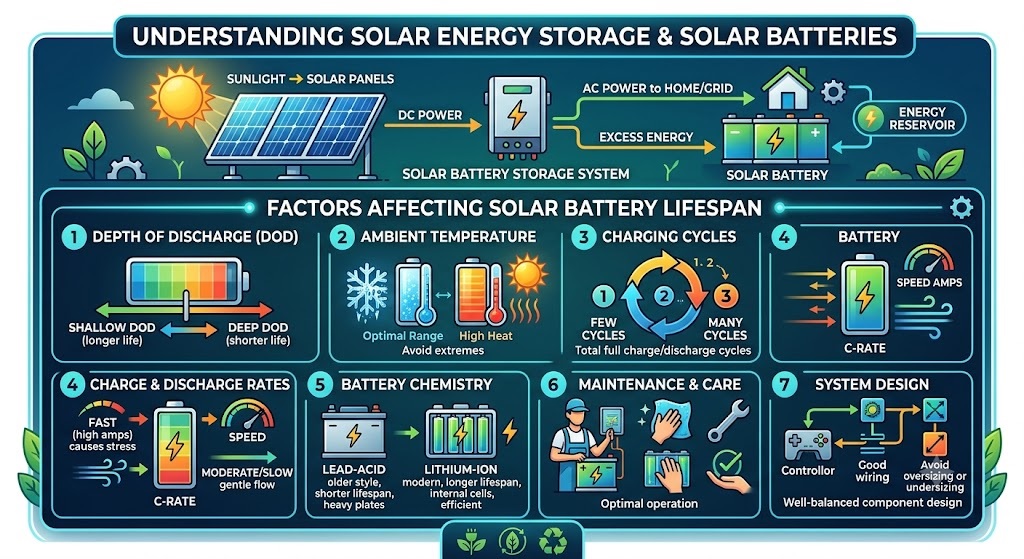
Depth of Discharge: Drain It Daily, Pay for It Early
Every battery has limits. Cross them repeatedly, and the clock accelerates.
Depth of Discharge (DoD) measures how much capacity is used before recharging. A battery rated at 80% DoD should not be drained beyond that point regularly. But in poorly sized systems, batteries often get pushed to 95–100% discharge every night.
That abuse compounds.
Lead-acid batteries are especially vulnerable. Deep discharge triggers sulfation — a chemical buildup that permanently reduces capacity. Lithium batteries tolerate deeper discharge but still degrade faster when pushed to extremes daily.
When solar battery storage for home is undersized, deeper discharge becomes routine. And routine abuse kills lifespan.
Heat: The Indian Reality Check
Battery chemistry does not like heat. It tolerates it. That’s different.
In Indian cities, ambient temperatures regularly exceed 40°C. Install batteries in cramped rooms without ventilation, and internal temperatures climb even higher.
Heat speeds up chemical reactions. Faster reactions equal faster degradation. Capacity fades quicker. Internal resistance increases. Performance drops.
Lithium batteries handle heat better than lead-acid. But no battery enjoys prolonged exposure to high temperature.
Thermal planning is not a luxury. It’s survival strategy.
Cycle Count: Every Night Costs Something
A battery’s life is measured in cycles. One full discharge and recharge equals one cycle.
If a lithium battery is rated for 4,000 cycles, daily cycling translates to roughly 10–11 years in ideal conditions. But ideal rarely exists.
Multiple partial cycles per day. Grid instability. Erratic charging patterns. Sudden load spikes.
All of it eats into cycle life.
Frequent outages in certain regions push batteries harder. More cycles per year means faster aging.
Cycle life is not theoretical. It’s math. And math does not forgive careless usage.
Charging Discipline: Faster Is Not Smarter
There’s a dangerous myth that faster charging is better.
High charging currents generate heat. Heat increases stress. Stress accelerates aging.
Improper inverter settings or mismatched charge controllers can overcharge or charge too aggressively. That’s slow damage in action.
Advanced lithium systems use intelligent Battery Management Systems (BMS) to regulate charging parameters. Without a strong BMS, even premium cells degrade unevenly.
When designing solar battery storage for home, charging control is as important as the battery itself.
Battery Chemistry: Not All Storage Is Equal
Lead-acid batteries are cost-effective but maintenance-heavy. They require electrolyte checks, distilled water refilling, and corrosion monitoring. They dislike deep discharge and high heat.
Lithium-ion batteries cost more upfront but offer:
- Higher depth of discharge tolerance
- Longer cycle life
- Lower maintenance
- Better energy density
- More stable performance
Chemistry choice should match usage pattern. Heavy daily cycling demands lithium. Occasional backup may justify high-quality tubular lead-acid.
Choosing purely on initial cost often leads to earlier replacement.
Installation Quality: Invisible but Critical
Poor installation quietly destroys batteries.
Loose terminals create resistance. Resistance creates heat. Heat shortens life.
Incorrect cable sizing leads to voltage drops and uneven charging. Lack of grounding increases risk during electrical surges.
Batteries require spacing for airflow. They require dry environments. They require structural stability.
When system integration is engineered carefully — as seen in structured deployments by Infrax Renewable — battery performance aligns with manufacturer expectations. That alignment is not accidental. It’s design discipline.
Load Management: What You Run Matters
A battery doesn’t care what it powers. But lifespan does.
Running lights and fans is different from powering air conditioners, geysers, and heavy kitchen appliances.
Excessive load causes rapid discharge. Rapid discharge increases stress. Stress reduces cycle life.
Smart systems prioritize essential loads during backup mode. High-consumption devices stay restricted.
Energy discipline extends hardware life.
Grid Quality and Voltage Fluctuations
In regions with unstable grids, batteries cycle unpredictably. Voltage spikes stress inverters. Charging patterns become irregular.
If the inverter and protection systems are not robust, battery health suffers.
Hybrid systems must isolate battery charging from erratic grid conditions. Without that buffer, degradation accelerates.
The grid may be unreliable. The system design cannot be.
Maintenance: Neglect Is Expensive
Lead-acid batteries demand hands-on maintenance.
Electrolyte levels drop over time. If not replenished correctly, plates get exposed and permanently damaged.
Terminal corrosion increases resistance and heat.
Lithium systems reduce maintenance needs but still require periodic inspection and software monitoring.
Neglect never saves money. It only postpones visible failure.
Battery Management System: The Brain Behind the Cells
In lithium batteries, the BMS controls everything.
It balances individual cells. Prevents overcharge. Prevents deep discharge. Monitors temperature. Shuts down during unsafe conditions.
Weak BMS design leads to cell imbalance. Imbalanced cells degrade faster. Once imbalance becomes severe, overall capacity collapses prematurely.
Battery quality is not just chemistry. It is intelligence layered on top of chemistry.
Idle Periods and Storage Conditions
Leaving a battery unused for months without proper charge state damages it.
Lead-acid batteries self-discharge and sulfate when idle. Lithium batteries prefer partial charge storage, not full or empty extremes.
If a property remains unoccupied, battery management settings must adjust accordingly.
Inactivity can be as damaging as overuse.
Environmental Factors: Dust, Humidity, Airflow
Dust clogs ventilation. Humidity corrodes terminals. Poor airflow traps heat.
Battery rooms should be dry, shaded, and ventilated. Direct sunlight exposure is a mistake. Moist basements are equally problematic.
Environmental negligence reduces lifespan silently.
Designing for Longevity, Not Marketing Numbers
Most buyers ask, “How many hours of backup?�
The better question: “How many years of reliable performance?�
That question changes system sizing. It changes battery selection. It changes inverter pairing. It changes ventilation planning.
In structured implementations of solar battery storage for home, capacity is matched to real consumption patterns, not optimistic assumptions. That difference determines whether a battery survives eight years or barely crosses four.
Longevity is engineered. Or ignored.
Final Word
Solar batteries fade long before they fail completely. Capacity drops gradually. Backup shrinks slowly. Replacement arrives sooner than expected when discipline is absent.
Depth of discharge, temperature, charging control, chemistry choice, installation quality, load behavior, maintenance, and environmental conditions — each factor shapes lifespan.
Battery life is not a mystery. It is consequence.
Treat solar battery storage for home as a precision energy asset, not a black box that stores power. Design carefully. Install correctly. Operate intelligently.
Because when the sun sets and the grid fails, the battery carries everything.
And it will only carry it for as long as it has been treated right.