
A major EPC contractor carrying out refinery expansion work in Gujarat wanted cylindrical shell segments to be fabricated with a heavy wall. The procurement manager, however, had awarded the task to a local fabricator whose quotation was almost fifteen per cent cheaper than that of the competitors. On paper, everything seemed ideal for the project budget. When it was two weeks to the installation deadline, however, the site inspection team called a halt on the installation. The rolled plates had severe flat ends, straight, unbent segments running along the longitudinal seam, surface scarring, and thickness variation were noticeable. Rectification needed press-braking manually, flame heating heavily, and re-rolling.
It was the fabricator, indeed, who had managed to roll high-yield structural steel with a conventional power of a three-roll machine, mechanical without any pre-bending capabilities, an under-powered piece of machinery. After a while of being delayed and getting on-site at a very late stage, these segments were completely covered by extra re-working, freight demurrage, and schedule slippage. So the price advantage the project had initially gained was wiped out. The price advantage has been wiped out totally by the delays.
Industrial procurement is replete with situations like this. Just because you have purchased a formed metal part or have decided to invest in a plate-bending machine doesn’t mean that a complete match in thickness and width is the only thing you need not consider. The key also lies in understanding how the cold-forming technology reacts, which machine design is better for tolerances, and what a skilled Sheet Metal Roller Manufacturer uses to design machines capable of rolling hard alloys without compromising the structure.
What Is a Sheet Metal Roller and How Does Modern Roll Bending Work?
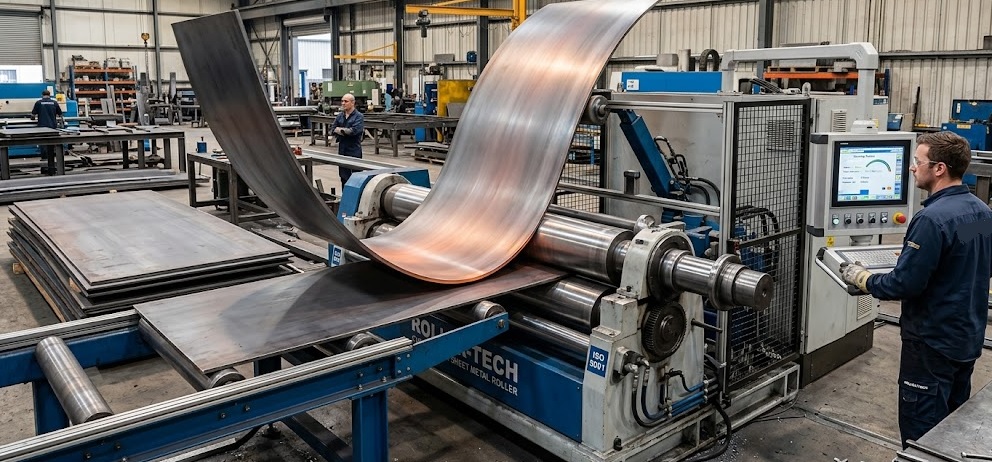
Sheet metal rollers, which are also called plate bending rolls or roll bending machines in heavy industries, are mechanical or hydraulic systems used to turn flat metal sheet and plate into cylindrical, conical, and multi-radius curved profiles. Roll bending is different from a press brake because a press brake forms the curve with a series of sharp, linear, incremental bends along the die, whereas roll bending uses continuous three- or four-point bending forces as the material passes through the synchronized rotatable rolls.
Modern cold-forming technology works through the principle of yielding a metal beyond its yield strength while staying below the tensile strength. The outer radius of the metal stretches under tension during roll forming while the inner radius is compressed. A springback, a phenomenon where metal naturally wants to return to its original shape, is what one gets when the forming action is completed. Today’s advanced roll technology, however, is able to factor these phenomena as well as deflect the material’s tendency towards springback.
Why Machine Selection Is Critical in Industrial Sourcing
Plant managers and sourcing teams in manufacturing centers like Pune, Chennai, Ahmedabad, and the NCR are always worried about the fact that buying formed metal parts or purchasing machines may cost them a lot in the long term. The production of these parts relies on the process of roll bending, which in turn is the basis of making equipment like pressure vessels, storage tanks, and wind towers, boiler drums, HVAC ducting, and heavy structural columns.
Here’s a list of the operational risks that are connected to picking an incorrect machine or going for an unqualified provider:
- Non-Conformance in Dimension: Since cylinders that are out of shape result in major alignment failures while performing automatic welding, such situations may eventually turn into problems like uneven root gaps, welding faults, and structural breakdowns.
- Material Degradation: Work of stainless steels can result from incorrect passes, or even surface scratching can lead to weakening of such materials before they are used at any site.
- High scrap pre-bending: If the plate edges are not pre-bent at all, it leaves long flat areas on both ends. Removal of the flat ends by cutting results in the loss of the material used, a very costly process, especially considering it is the raw material.
- Cycle-Time Losses: Older mechanical machines necessitate multiple material re-handlings, flips, and manual shimming, which not only increase labor costs but delay the project throughput.
Some Technical Things To Consider When Checking Roll Bending Equipment
Evaluation of roll bending equipment or determining whether a supplier is able to do the job on the floor requires thinking beyond just what machine is being used. For example, a machine that can just roll 20 MM mild steel may have issues when it comes to rolling 20 MM high yield structural steel or stainless steel. Purchasing teams should therefore assess several basic aspects of the technology involved.
1. Machinery layout: the difference between 3-roll and 4-roll machines
You need to know how the machine works to determine if it is suitable for your operations.
- 3-Roll machines that use initial pinch: they feature two front rolling elements arranged vertically over the top, and a rear bending wheel. Light and medium gauge work can be done with them fairly precisely, but both ends have to be bent manually through flipping.
- 3-Roll Variable Geometry machines: Here, the roll positioned at the top is capable of vertical movement while the bottom two rolls move horizontally. By virtue of this variation in geometry, the operator has the ability to change the center distances, and this will be very useful in case of extremely thick plate materials, thick-walled vessels, and varying metal yields.
- Hydraulic 4-Roll systems: nowadays they are a standard in mass manufacturing for very good results. Here, the top and bottom rolls clamp the material firmly without slippage while the two other rolls are on the sides and can move freely in opposite directions to shape the material. This layout permits the formation of complete curves from both sides, leading and trailing, without the need to remove the plate or flip it over.
2. Power Transmission Mechanisms and the Distribution of Forces
The older machines completely relied on mechanical gearboxes and clutch systems; the results were often unpredictable, with jerks in transition and very limited control over torque. Nowadays, industrial equipment manufacturers have switched to independent hydraulic drives directly attached to the rolls, with the rolling elements having the planetary gears mounted on them. This eliminates energy losses from the drive system; maximum torque can be transferred at low speeds of rotation, and even polished or lubricated surfaces are unlikely to slip.
3. Ability To Pre-bend and To Keep End Flatness To A Minimum
Pre-bending refers to creating the bend of the leading and trailing edges before rolling the central panel of the plate.
As the leading edge of the plate has to enter between the rolls unsupported for part of its length, it will remain flat if the machine is unable to apply a pinch force directly at the edge. For this reason, a really excellent Sheet Metal Roller Manufacturer will engineer their machines in such a way that the zone of this flat edge is limited to 1.5 to 2 times the thickness of the plate, which means that any preforming of edges through a press brake is no longer necessary and the material loss due to cutting off scrap would be prevented.
4. Roll Deflection Compensation i.e. Crowning
Differential bending is a consequence of the deflection caused by extreme hydraulic forces. The rolls are long solid steel cylinders which are only naturally deflected in the middle part when loaded by the hydraulic forces. If uncorrected, this deformation leads to the middle of the sheet being pressed less than the edge and producing an unwanted shape of “barrel” or “hourglass.” Quality machine builders can get around this either by machining the roll profile with a slight convex shape, called a crowning, or by installing hydraulic support mechanisms for the lower rolls, which prevent the rolling stock from deflecting.
The Evaluation of the Sheet Metal Roller Manufacturer for Capital Procurement
Your Sheet Metal Roller Manufacturer should be evaluated not just for technical capabilities but also for structural integrity and customer support after you have made the decision to buy. A comprehensive evaluation program should revolve around the following four aspects primarily:
Roll Metal Material and Frame
The foundation of a good machine should be a weld of heavy stress-relieved steel plates forming a machine frame capable of supporting continuous cyclic loading without structural distortions. Besides, the metallurgy of rolled material is an equally crucial aspect of machine manufacturing. Forged high-grade alloy steel (e.g., 42CrMo4 or like material) with a surface hardness of 50, 55 HR from induction hardening and finished with precision grinding is what defines the quality of a roll. Hardened rolls can be beneficial for forming stainless steel or wear-resistant materials which are prone to galling and leaving marks on the roller.
Control Systems and Integration with Automation
Mechanical production of goods at scale is dependent on the ability to make identical products. Manual hydraulic valve controls without the use of a gauge are based very largely on the instincts and the luck of an operator. Digital readouts (DROs) showing roll positions are better for the middle class, while top-of-the-range CNC control systems can figure out how and if a particular sheet should bend and spring back in the manufacturing process of multi-radius shapes, curved and conical surfaces based on the data of the properties of the material input. When making procurement decisions, it is necessary for procurement departments to find out whether the manufacturer has a user-friendly control interface enabling customers to carry out different settings and to do troubleshooting online without any hassle or difficulty, as well as the compatibility of their product with the current software used by the company for factory floor management.
Ergonomics and Health & Safety of the Plant Design
Plate rolling is a rather dangerous process, as there are not only pinch points involved but also very heavy objects hanging from above and machinery which is in continuous motion. As a potential buyer, you will be expected to look into the question of whether or not the rolling machine will be accompanied by such safety-related accessories as an overhead load-carrying arm, hydraulic lock braking, laser light barrier, emergency stop wires at the perimeter, side guides to prevent tall thin cylinders from falling during rolling, and side support mechanisms to prevent such things from happening.
Frequent Errors in Making a Sheet Metal Roller Purchase Decision
Buying machines is difficult due to machine specifications or contract manufacturing agreements. This is where some pitfalls are common among sourcing teams:
- Sizing Based Only on Maximum Thickness: The machine marked as having a “25-mm capacity” could mean, however, that it is only able to handle this thickness at maximum diameter with mild steel only. The bending required force to form smaller diameters and/or using materials having higher yield strength (like Hardox, or high-tensile structural materials) would increase greatly. Capacity curves instead of just capacity figures should therefore be taken into account when evaluating bending machines.
- Undervalued Variation in Material Yield Strength: It is estimated that for a given gauge, stainless steel will require about half the power to bend as mild steel. In order to avoid cracks in aluminum, the pressure to be applied must be fine-tuned. Failing to take the different yield strengths into account when you select a machine will bring in hydraulic breakdowns or frame fatigue very quickly.
- Missing out on Secondary Handling Tools: Rolling large diameter shell rings will not come to you just by having a roller only beside it. When top cranes, side supports, and automatic ejectors are not in sync, thin-walled cylinders that are still rolled out collapse under their weight, causing damage and safety issues.
- Fixating Upon the First-Come, First-Served: The decision to go for lower-grade equipment is often followed by dealing with poorly manufactured hydraulics, non-hardened rolls, and little or no local after-sales support, which leads to a loss through downtime, expensive replacement parts with very short supply, and no technical help even if you really need one.
On-the-ground Issues When Sourcing From the Indian Market
Across the areas of power generation, green hydrogen, infrastructure, defense, and automotive manufacturing, the Indian industrial sector is rapidly expanding the use of new capital equipment. Along with this expansion, demand for accurate cold-forming equipment has gone up sharply. In India, the sourcing of equipment involves the evaluation of a trade-off between domestically made, imported, and customized machinery.
Domestic engineering companies have made a lot of progress in the production of high-power hydraulic roll bending machines. Working with local Sheet Metal Roller Manufacturers would bring you a host of benefits such as reduced transportation costs, localized support from technical services, spare parts readily available, and simpler customs issues. Also, with local manufacturers, you can change bed lengths and roll diameters according to your area standards for raw materials and power limitations.
If purchasing a machine or component is to be done from local suppliers, the below points should be checked:
- Raw Material Tracing: Verify the mill test certificates (MTC) of roll forges, frame steel, and other materials for chemical and mechanical properties.
- Standard Compliance: Check international standards like ISO 9001 for quality and also safety standards (for instance CE marking where applicable).
- Vendor Assessment: Through physical inspections, assess the supplier`s machine tool capacity, assembly facilities, and internal testing setups (including bending under load and checking hydraulic pressure) before approval.
- Service SLAs: Ensure that there is local support by verifying availability of technical staff, reaction time of the support team in emergency situations, and stock guarantees of spare parts.
FAQs (Frequently asked questions)
What’s the fundamental distinction between a 3-roll and a 4-roll sheet metal roller?
In a 3-roll, only 3 rolls are used, and flipping the plate has to be done manually to pre-bend both ends. On the other hand, in a 4-roll, the pinching roll is added to secure the plate and allows the machine to perform high-accuracy automated pre-bending of the edges in one pass without removing the plate from the machine.
How is material springback impacting the roll bending operation?
Springback is essentially a result of the material’s tendency to bounce back to its natural flat shape after shaping. The amount of springback is usually determined by the yield strength of the material and also by the material thickness and bend radius.
In the past, the operator had to know the amount of correction or over-bend by trial and error, which was very time-consuming and inaccurate. Now, modern sheet metal rollers can precisely anticipate springback through their computer-controlled systems, which store data for different metals and their respective properties, thereby reducing the error margin and saving time. With some metal plates, they will be overbent by an additional 0.5 3 mm to compensate for springback. The system is able to detect and store metal profiles and will adjust its parameters accordingly.
Is it possible that a sheet metal roller will form only the cones of perfect shape?
In order to obtain the forming of cones, side-bending rollers are tilted; thereby, different pressure is exerted along the length of the plate. Machines with hardened conical side-guide bearings are beneficial to control the plate’s smaller radius during the rolling process.
Do rolled hardened rolls play a role when handling stainless steels?
Roll-formed stainless steel, due to its inherent toughness and hardness, rapidly work- hardens the forming material. This can lead to surface pitting, scratching, or galling of the rolling rolls and, if not addressed, result in subsequent defective parts and material corrosion resistance degradation.
What is a method to determine the required machine capacity for high-tensile steel?
The forces required for bending increase by the proportion to that of the material’syield strength. If the machine is originally designed for the use of mild steel (yield strength ~250 MPa), rolling high-tensile steel (yield strength ~700 MPa) needs the recalibration of the capacity formula. It is a good practice to refer to the manufacturer of sheet metal rollers regarding material capacities if any of you are planning to carry out heavy-gauge bending with high-yield materials.
Purchase Summary
The conversion of flat metal sheets into accurate, defect-free cylindrical or conical metal parts calls for the delicate interplay of mechanical force, metallurgical knowledge, and machine accuracy. In fact, procurement success mainly hinges on one’s ability to look beyond unit prices or basic machine specs at first glance. As such, by conducting an analysis of the structural build, drive efficiency, pre-bending capabilities, as well as long-term service support, procurement teams can safeguard their supply chains, reduce material waste, and stay ahead of the curve in various industrial fields.