

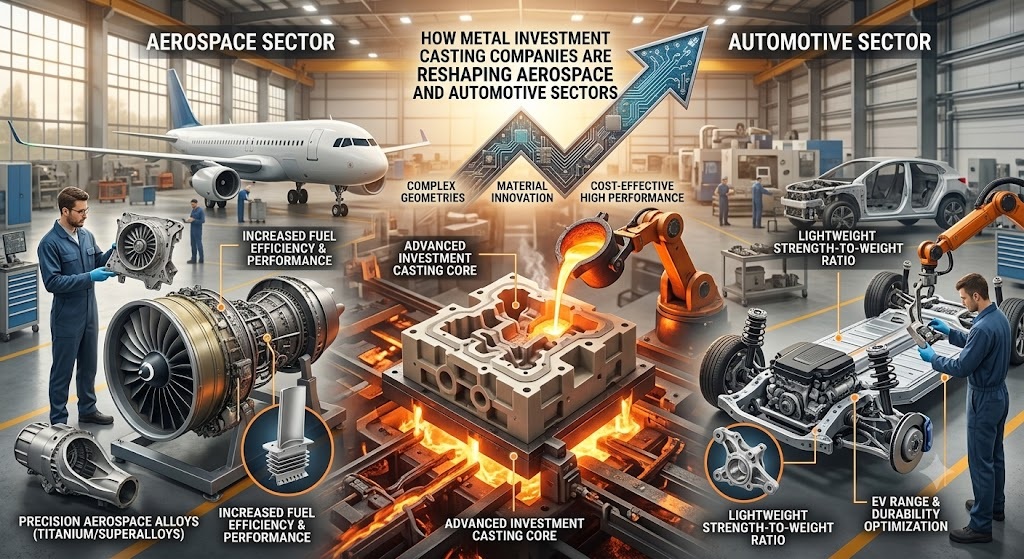
Step into the hangar of any modern aircraft manufacturer or peek inside the assembly hall of an electric vehicle startup, and you’ll notice the same quiet obsession: precision. Out of sight, beyond the headlines about fuel efficiency or battery range, lies a chain of suppliers reshaping the very DNA of these industries. At the heart of this change is something deceptively modest in appearance: metal investment casting.
What makes this process so critical is its ability to give form to ideas no other method can execute as efficiently. A metal investment casting company provides more than parts—it offers design freedom, weight savings, and material mastery that engineers cannot afford to ignore. The way aerospace soars higher and how automotive pushes performance boundaries are both entwined with how this process evolves.
From Ancient Craft to Industrial Power
The lost-wax method comes from ancient times—years before CAD programs and robotic foundries were introduced. Ancient craftsmen shaped jewelry, temple bells, and weapons with wax patterns and ceramic molds. The principle hasn’t changed: create a wax pattern, encase it, burn the wax out, then pour molten metal into the cavity left behind.
What has changed is almost everything else. Today’s foundry floor is a fusion of physics and data. Engineers run thermal simulations to predict how alloys will flow; robots dip wax trees into ceramic slurries for perfect coating; metallurgists test exotic alloys designed to endure pressures and heat far beyond what older metals could survive. This is not simply “casting” anymore—it is aerospace‑ and automotive‑grade engineering with a pedigree of ancient creativity.
Aerospace: Every Gram, Every Degree Counts
The aerospace industry operates under pressure both literal and figurative. Performance must rise while costs fall. Turbines must withstand searing temperatures without failure. Structures must resist fatigue over millions of cycles. And meanwhile, regulators demand fuel efficiency and lower emissions in aircraft that already stretch physics itself.
Turbines and Engines
It is in turbine engines that investment casting proves irreplaceable. The shape of a turbine blade is not arbitrary; it is a miniature masterpiece of fluid dynamics. Inside, cooling channels snake through the blade to prevent meltdown. These passages are impossible to machine conventionally. Only investment casting, often with single‑crystal solidification, delivers such geometry. Without it, jet engines simply would not reach today’s levels of efficiency.
Titanium Beyond Forging
For structures, titanium is a hero metal: light as aluminum but strong as steel. Machining titanium from billet stock wastes precious material and drives up costs. Casting it directly to precise shapes changes the economics dramatically. Aircraft seat frames, landing gear components, and engine brackets are now born lighter yet tougher—trimming kilograms off an aircraft that translates to thousands of liters of jet fuel saved over its lifespan.
Avionics Housings
One doesn’t often think of cast metal when talking electronics, yet avionics rely heavily on investment‑cast housings. These structures shield delicate instruments but must remain feather‑light. Casting creates fine, complex housings that machining could not replicate with such efficiency.
Without investment casting, modern aerospace would be heavier, thirstier, and less safe. That’s how vital the process has become.
Automotive: Precision in Motion
The car industry has been synonymous with stamping presses and die‑casting machines. But as vehicles face electrification, stricter emissions, and consumer hunger for performance, the role of investment casting grows sharper.
Turbochargers and Exhaust Systems
Internal combustion engines under emissions pressure need every efficiency trick possible. Turbo impellers spun at extreme speeds and hot exhaust manifolds demand high‑temperature alloys and flawless balance. Investment casting meets both needs with high‑strength stainless steels and nickel alloys shaped to perfection.
Electric Vehicle Lightweighting
For electric drivetrains, it isn’t combustion heat but battery efficiency at stake. Lightweight magnesium or aluminium castings India parts reduce energy consumption and extend driving range. Cooling housings, inverter structures, and drive‑unit mounts cast in intricate, weight‑saving designs mean EVs can squeeze more mileage out of every charge.
Safety‑Critical Parts
There’s also the question of safety. Components that can’t fail—steering knuckles, suspension arms, braking system parts—benefit when cast as single pieces. Welding multiple parts together creates weak spots; casting eliminates those junctions. The result: fewer potential points of catastrophic failure.
For cars of the future—whether EV, hybrid, or high‑performance ICE—investment casting is carving out an increasingly central role.
Material Science: The Quiet Enabler
Behind every breakthrough is often a forgotten hero: the alloy. Superalloys with cobalt, molybdenum, and nickel resist temperatures in turbines. Titanium alloys shave weight in fuselages. Stainless steels balance cost with durability in automotive systems. A metal investment casting company doesn’t just pour metal—it tailors metallurgy to the final application.
It’s metallurgical know‑how that separates a vendor from a true partner. Aerospace primes demand not just parts but casting expertise that can align material chemistry with specific engine demands. Automotive majors seek lighter alloys that keep costs manageable but performance high. This dual demand keeps investment casting ahead of traditional methods.
Sustainability Driven by Design
Both aerospace and automotive are under sustainability spotlights. The implications for casting are profound:
- Less Waste: Machining consumes far more metal and energy. Casting parts nearly to shape eliminates overcutting and extends alloy supplies.
- Longer Life: Smoother surfaces allow fatigue life to extend, reducing replacement demand.
- Fuel and Energy Savings: Weight trimmed from aircraft wings or EV subsystems translates directly into lower lifetime emissions.
Casting becomes more than a production technique—it is a lever for meeting global environmental goals.
Industry 4.0 and the Casting Floor
Step inside a modern foundry and the sense of transformation is obvious. Automated wax injection machines hum with efficiency. Simulation software runs nonstop to predict flow, shrinkage, or porosity before a single mold is poured. Additive manufacturing produces patterns in intricate shapes once considered impossible. Sensors monitor mold temperatures in real time, catching deviations before they snowball into defects.
This digitization puts casting firmly in the Industry 4.0 camp. The balance of craftsmanship and computation is widening the process window: faster lead times, higher consistency, and a scale fit for both prototyping and full production.
Obstacles and the Road Ahead
Challenges remain. Cycle times are longer compared to die casting. Costs of high‑performance alloys still bite into automotive margins. Volume scalability holds back wider adoption in mass‑market cars. Yet research is pushing limits: faster ceramic shell building, 3D‑printed molds, and hybrid methods blending additive and casting.
In aerospace, experiments with ceramic cores are producing even more elaborate internal geometries. In automotive suppliers, partnerships with foundries are targeting mass‑market EV parts that balance cost and casting precision. Progress is uneven, but momentum is beyond doubt.
Casting as a Supply Chain Strategy
The conversation is no longer about buying parts but about securing partnerships. Global OEMs evaluate casting suppliers not only on capability but resilience, innovation, and location. A well‑established metal investment casting company shortens lead times, reduces logistics risks, and adds R&D support.
These companies are no longer back‑end vendors. They are central collaborators shaping whether an EV meets its weight targets or whether an aircraft engine achieves its promised efficiency gains.
A Case That Illustrates the Shift
Among several players moving the needle, Siddhalaxmi demonstrates the evolving face of casting leadership. With advanced process discipline, mastery over alloys, and sector‑focused applications, the company reflects how foundries are transforming from supply shops into engineering powerhouses. Its trajectory shows how precision casting is stepping out of shadows to become a decisive factor for aerospace and automotive innovation alike.
Final Reflection
The aerospace and automotive landscapes are not defined merely by bold marketing campaigns or sleek new models. They are built, quite literally, from the inside out—through the materials and processes that deliver performance silently, reliably, relentlessly.
Investment casting is the backbone process allowing designers and engineers to stretch limits. Without it, turbine engines would be less efficient, aircraft heavier, vehicles less safe, and EV ranges shorter. With it, both industries carve paths toward lighter, stronger, and more sustainable futures.
A metal investment casting company is not just producing components; it is shaping the trajectory of global mobility. The sectors are flying higher and driving faster because casting, in its modern form, has proven to be far more than molten metal in a mold—it has become a strategic force powering the next era of engineering.